Seminars and workshops
Seminars and workshops within the Centre for Health Governance research area will be announced here.
At the Centre for Health Governance, we host two main seminar series:
CHG Health Policy Forum
An open platform where policymakers, researchers, and practitioners meet to discuss current health policy challenges. These events are open to a broad audience and streamed online. Most sessions are held in Swedish.
CHG Research Seminars
A more informal setting for presenting and discussing ongoing research and analytical work. These seminars are primarily in English and aimed at researchers and analysts.
Upcoming CHG Health Policy seminar
Nov 19: Lågvärdevård – varför är det så svårt att sluta? (Low-value care – why is it so hard to stop?)
Oskar Lindfors, General practitioner at Järpen Health Centre, member of the Swedish Society of Medicine's working group for Choosing Wisely, and editor of the book Vård utan värde
Lars Sandman, professor of healthcare ethics and director of the Prioritization Centre at Linköping University
Björn Järbur, hospital director at NU Hospital Group (NU-sjukvården)
Read program and register here!
Dec 9: AI bortom piloten – vad krävs för att AI faktiskt ska fungera och skapa värde i vården? (AI beyond the pilot - what does it take for AI to actually work and create value in healthcare)
Daniel Gyllenhammar, post doc, Halmstad University
Elin Siira, assistant senior lecturer, Högskolan i Halmstad
Magnus Kjellberg, director Kompetenscentrum AI, Sahlgrenska University Hospital, andregional AI coordinator, Västra Götalandsregionen
Markus Lingman, medical information manager, Sahlgrenska University Hospital
Lorna Bartram, AI Transformation Strategist - Healthcare, AI Sweden
Upcoming research seminars
September 3 sept: (Thursday)
Location: Hälsovetenskapligt Centrum, room 4030
Time 15.00-16.15
Speaker: Henrik Andersson (VTI, Toulouse)
Title: Health benefits from cycling and their role in economic cost-benefit analysis
October 1 (Thursday)
Location: Hälsovetenskapligt Centrum, room 4030
Speaker Gawain Heckley (Health Economic Unit, Lund University)
Time 15.00-16.15
Title: New Approaches to Understanding Screening Participation: Insights from Two Swedish Atrial Fibrillation Trials
November 12 (Thursday)
Location: Hälsovetenskapligt Centrum, room 4030
Speaker: Shan Huang (Stockholm School of Economics)
Time 15.00-16.15
Title: Paid to rush? Physician performance incentives, quality, and downstream costs
December 10 (Thursday)
Location: Hälsovetenskapligt Centrum, room 4030
Speaker: Chiara Marocco (Danish Centre for Health Economics, University of Southern Denmark)
Time 15.00-16.15
Title: Cost-Effectiveness of a home-based screening test for cardiovascular diseases leveraging to increase diagnostic precision?
Passed research seminars spring 2026
Centre for Health Governance and the Health Economics, Policy Evaluation Research (HEPER) group arranges internal research seminars during the spring.
January 8: (Thursday)
Location: Hälsovetenskapligt Centrum, room 4030
Time 15.00
Speaker: Mikael Svensson (HEPER)
Title: Reproducible economic evaluation research
February 5 (Thursday)
Location: Hälsovetenskapligt Centrum, room 4030
Speaker Ulf Strömberg (HEPER) & Juan Vaz (HEPER)
Time 15.15-16.30
March 5 (Thursday)
Location: Hälsovetenskapligt Centrum, room 4030
Speaker: Annika Lindskog (Economics)
Time 15.00-16.15
Title: Historial disease exposure and government response to Covid-19
April 29 (Thursday)
Location: Hälsovetenskapligt Centrum, room 4030
Speaker Roxanne Kovacs Centre for Health Governance, Dept of Econ University of Gothenburg
Time 15.00-16.15
Title:: Gender-based discrimination in healthcare: Audit-study evidence from Kenya
Abstract: We study gender discrimination in healthcare using a within-provider randomised audit experiment. Observationally equivalent male and female standardised patients with heart disease symptoms visit healthcare providers in Nairobi, isolating the causal effect of patient gender on provider behaviour. The same healthcare workers are less likely to deliver guideline-indicated care to female patients. The evidence is difficult to reconcile with taste-based discrimination. Results are instead consistent with belief-based discrimination, rooted in beliefs about signal credibility - as discrimination is concentrated in male providers and those holding more negative gender stereotypes. A randomised training intervention does not reduce discrimination.
Centre for Health Governance and the Health Economics, Policy Evaluation Research (HEPER) group will continue to arrange internal research seminars in the fall. These will be an opportunity for researchers to present ongoing projects and receive collegial feedback from other researchers from various fields. The seminars will be held with one or two speakers per session.
June 11 (Thursday)
Location: Hälsovetenskapligt Centrum, room 4030
Speaker: Yannik Obelöer (Economics) + TBA
Time 15.00-16.15
Title: Waiting to be well: Delayed mental healthcare for the young + TBA
CHG Health Policy Forum seminars autumn 2025 (in Swedish)
September 24, 2025
"Vem ska styra vården? Staten, regionen elller något däremellan?"
November 18, 2025
"Prevention i primärvården – möjligheter, fallgropar och vägen framåt"
CHG research seminars autumn 2025 (in English)
September 4, 3 PM. Where: Hälsovetenskapligt Centrum 4030.
Speaker: Kelly Ragan (SOFI)
September 30, 12-13.15 PM. Where: Handelshögskolan B44.
Speaker: Marcela Alsan (Harvard) [Tillsammans med Nationalekonomi och statistik inom General Economics Seminars-serien]
October 2, 3 PM. Where: Hälsovetenskapligt Centrum 4030.
Speaker: Anton Klockhoff (Linköping)
November 13, 3 PM. Where: Hälsovetenskapligt Centrum 4030.
Speaker: Gustav Kjellsson (CHG, HEPER) + Jens Wikström (CHG, NEK)
December 11, 3 PM. Where: Hälsovetenskapligt Centrum 4030.
Speaker: Mikael Svensson (CHG, HEPER) + Lisa Norrgren (VGR)
Other events
Upcoming CHG Health Economics Workshop (in Swedish)
October 6, 2026
"Att integrera hälsoekonomisk utvärdering i klinisk forskning" ("Integrating Health Economic Evaluation into Clinical Research")
Follow link for program and registration
October 22–23, 2026
CHG Workshop on Economics, Inequality, and Health
Keynotes: Meltem Daysal (University of Copenhagen) and Rita Ginja (University of Bergen)
Organized with support from the Jan Wallander and Tom Hedelius Foundation and Tore Browaldh's Foundation (Handelsbanken's research foundations)
January 14–15, 2027
Policy conference (in Swedish)
Title: Att styra och leda framtidens välfärd
Organizer: Co-organized with the Centre for Global Human Resource Management, with support from the Swedish Association of Local Authorities and Regions (SKR) and the Swedish Research Council for Health, Working Life and Welfare (Forte)
Registration: More information about the program and how to register can be found here: "styraochleda.se"
Passed CHG Health Economics Workshop
October 23–24, 2025 at the School of Business, Economics and Law, University of Gothenburg
Keynote speakers are Torben Heien Nielsen (University of Copenhagen) & Jonathan Zhang (Duke University) (in Swedish)
Workshop October 21, 2025 "Integrating health economic evaluation into clinical research" (in Swedish)
Passed CHG research seminars
March 27, 2025
"Research project Magnet4Europe"
The seminar was held in Swedish. For more info see Swedish page.
January 15, 2025
The Centre for Health Governance (CHG) hosted an engaging seminar about two critical studies on socioeconomic disparities in healthcare and longevity. Mårten Palme (Stockholm University) and Gustav Kjellsson (CHG & Sahlgrenska Academy, GU) provided valuable insights into the intersections of health equity, patient choice, and income-related health outcomes.
Topics discussed:
- Patient Choice and Socioeconomic Disparities in Primary Care Selection
This study examines socioeconomic differences in primary health care quality. Focusing on a large Swedish region, the research reveals that high-SES individuals are more likely to a be enrolled at primary care centers with higher objective and subjective quality. While these differences are primarily due to better access to such providers within acceptable travel distances, the results underscore the risk that allowing for patient choice may exacerbate health disparities in provider quality. - Income Inequality and Life Expectancy: Long-Term Trends and Causes
This study spans over six decades and provides a comprehensive analysis of income disparities in life expectancy among individuals aged 40 or older. The results highlight a significant widening of the life expectancy gap between the 5th and 95th income percentiles, driven largely by circulatory diseases and an increasing income gradient in preventable and treatable deaths. The findings emphasize the persistent impact of income inequality on health outcomes, despite historical reductions in economic disparities and increased social spending.
November 27, 2024
“Socioeconomic inequality within the health care system”
Tomas Bokström, Shirin Bartholdsson, Mikael Cäker.
The seminar was held in Swedish. For more info see Swedish page.
October 3, 2024
"The role of providers’ intrinsic motivation for quality of care and responses to a non-financial incentive"
Presenters: Anne Sophie Oxholm, Danish Centre for Health Economics, University of Southern Denmark
Anne Sophie is an associate professor at Danish Centre for Health Economics at the University of Southern Denmark focusing on behavior on health care markets, and in particular on financial incentive schemes targeted to health care professionals, health care professionals’ motivational profiles, and inequality in patients’ access to care. The work that she will present is a part of collaboration and co-authored with both fellow economists and general practitioners. We are therefore also hoping for a mixed crowd. The plan is also to (as usual) continue the discussions in a more informal way after the seminar. We are hoping to see many of you there.
Abstract: Providers’ intrinsic motivation is deemed important for quality of care and responses to incentives. Building on self-determination theory, we test the hypotheses that more intrinsically motivated providers perform better and respond less to a non-financial incentive. We exploit the introduction of a cluster randomised accreditation scheme in Danish general practice, where practices were randomised to accreditation in different years. Using data from a nationwide survey and administrative registers, we compare accredited practices’ performances with not yet accredited practices, while taking intrinsic motivation into account. We find a positive relationship between practices’ intrinsic motivation and performance on some quality measures. We also find that intrinsic motivation moderates the response to accreditation. While the least intrinsically motivated practices respond to accreditation by increasing their performances, the most intrinsically motivated practices do not respond to the incentive. These findings point to the importance of taking providers’ intrinsic motivation into account when designing incentives.
May 23, 2024
"Universal Health Coverage – Challenges and Opportunities in Bangladesh, India, and South Africa"
Prof. Jahangir Khan, Prof. Sharon Fonn, Ass. Prof. Swapnarag Swain
Universal health coverage (UHC) is a vision where all people and communities have access to quality health services where and when they need them, without suffering financial hardship. UHC is included in Sustainable Development Goals (target 3.8), declared by the United Nations in 2015. Since then, countries are at different stages of progression towards UHC and facing different challenges but also opportunities. In this seminar, we present experiences on UHC from three low- and middle-income countries: Bangladesh, India and South Africa. The presentations cover their UHC status, current health policy discussions, and challenges and opportunities for UHC.
March 21, 2024
“Should "willingness-to-pay" thresholds change with disease severity?”
A seminar on population preferences and equity considerations of disease severity in economic evaluations in Sweden, with economist Erik Grönqvist from Uppsala University
Abstract:
The standard cost-effectiveness framework for healthcare products relies primarily evaluating on health gains from treatment compared to its cost. However, there is an intuitive feeling that the value of treating patients who are more severely sick is higher than that for treating patients who are healthier. This is possibly driven by a preference for equity among the population. In the presence of a public health system operating with limited resources, it would be useful to understand public perceptions about the nature of this trade-off. We study the Swedish general population’s preferences in the trade-off between the health gain from a treatment and the disease severity of the target patient when conducting healthcare prioritization. We employ a discrete choice experiment to measure the population’s opinions on this trade-off. We then try to establish measures for the value of each unit of health gain for patients in different states of disease severity.
February 8, 2024
"Private healthcare insurance in a public healthcare system"
John Lapidus, economic historian and Jens Wikström, economist.
In this seminar, John and Jens will talk about their fascinating research on the development of private health insurance in Sweden.
John Lapidus is an economic historian, and will introduce and discuss the development of private health insurances based on his research and recent books on the privatization of the Swedish welfare state.
Jens Wikström is an economist and will present his ongoing research answering questions such as: who is it that buys private health insurance in Sweden, and how do individuals’ health care utilization change when signing such an insurance? These results is based on novel data that Jens has collected joint with his colleagues.
During the seminar, John and Jens provided a lot of food for thought about this under-researched, yet extremely timely and policy-relevant topic.
November 2, 2023
"Health economic aspects of person-centred care"
Hanna Gyllensten, Associate Professor, Benjamin P Harvey, PhD student and Salma Pardhan, PhD Student.
The lecture summarized the current knowledge on the cost-effectiveness of person-centred care, using results from both a systematic review and our own economic evaluations of clinical trials. They also provided an overview of important methodological aspects in such evaluations with a particular focus on outcomes assessment using findings from a recently developed core outcome set for healthcare programmes that focus on shared decision-making and participation, such as person-centred care.
September 7, 2023
“Premium refunds and healthcare use”
Martin Karlsson, Professor of Economics at the University of Duisburg-Essen, Chair of Health Economics at CINCH (Competent in Competition and Health) research centre, and a Research Fellow at IZA. Martin is also an affiliated professor at the Dept of Economics. A joint work with Daniel Avdic, Simon Decker, and Martin Salm.
March 16, 2023
Kristina Jakobsson and Felipe Pacheco Zenteno
January 19, 2023
Ingrid Svensson presenter
May 25, 2023
A workshop was also held May 25, 2023 at School of Business, Economics and The workshop consisted of 6 presentations of ongoing research spanning on different questions related to the organization of health care.
Program
13.30: Randi Hjalmarsson (University of Gothenburg) “ADHD, Prison Healthcare, and Crime”
14.00: Niklas Jakobsson (Karlstad University) ”When do Default Nudges Work”
14.30: Henning Øien (Oslo University) “Out-of-pocket prices and rationing of care services:
Evidence from price discontinuities”
15.00: Coffee
15.20: Annika Lindskog (University of Gothenburg) “Historical pathogen prevalence and government response to COVID-19”
15.50: Jens Wikström (Stockholm University) “Does it matter who cares? Formal vs. informal care of the elderly”
16.20: Mio Fredriksson (Uppsala University) ”The development of universal health coverage and equal access in Sweden: A century-long perspective”
16.50: Conclusions
August 17-19, 2022
Nordic Health Economists' Study Group
The University of Gothenburg and the Centre for Health Governance at the University of Gothenburg (CHG) hosted the 41st Nordic Health Economists’ Study Group (NHESG) meeting on the 17th-19th of August 2022. The conference was held in person at Wallenberg Conference Center in Gothenburg. The meeting aimed to bring together researchers who are working in the area of health economics and to promote continuous development of health economics as a sub-discipline of economics.
Contact persons
Gustav Kjellsson, Head of Centre for Health Governance
Christian Gadolin, deputy Head Centre for Health Governance
May 23, 2024
"Universal Health Coverage – Challenges and Opportunities in Bangladesh, India, and South Africa"
Prof. Jahangir Khan, Prof. Sharon Fonn, Ass. Prof. Swapnarag Swain
Universal health coverage (UHC) is a vision where all people and communities have access to quality health services where and when they need them, without suffering financial hardship. UHC is included in Sustainable Development Goals (target 3.8), declared by the United Nations in 2015. Since then, countries are at different stages of progression towards UHC and facing different challenges but also opportunities. In this seminar, we present experiences on UHC from three low- and middle-income countries: Bangladesh, India and South Africa. The presentations cover their UHC status, current health policy discussions, and challenges and opportunities for UHC.
March 21, 2024
“Should "willingness-to-pay" thresholds change with disease severity?”
A seminar on population preferences and equity considerations of disease severity in economic evaluations in Sweden, with economist Erik Grönqvist from Uppsala University.

Abstract:
The standard cost-effectiveness framework for healthcare products relies primarily evaluating on health gains from treatment compared to its cost. However, there is an intuitive feeling that the value of treating patients who are more severely sick is higher than that for treating patients who are healthier. This is possibly driven by a preference for equity among the population. In the presence of a public health system operating with limited resources, it would be useful to understand public perceptions about the nature of this trade-off. We study the Swedish general population’s preferences in the trade-off between the health gain from a treatment and the disease severity of the target patient when conducting healthcare prioritization. We employ a discrete choice experiment to measure the population’s opinions on this trade-off. We then try to establish measures for the value of each unit of health gain for patients in different states of disease severity.
No registration needed. Welcome!
February 8, 2024
John Lapidus, economic historian and Jens Wikström, economist.

"Private healthcare insurance in a public healthcare system"
In this seminar, John and Jens will talk about their fascinating research on the development of private health insurance in Sweden.
John Lapidus is an economic historian, and will introduce and discuss the development of private health insurances based on his research and recent books on the privatization of the Swedish welfare state.
Jens Wikström is an economist and will present his ongoing research answering questions such as: who is it that buys private health insurance in Sweden, and how do individuals’ health care utilization change when signing such an insurance? These results is based on novel data that Jens has collected joint with his colleagues.
During the seminar, John and Jens provided a lot of food for thought about this under-researched, yet extremely timely and policy-relevant topic.
November 2, 2023
Hanna Gyllensten, Associate Professor, Benjamin P Harvey, PhD student and Salma Pardhan, PhD Student.
"Health economic aspects of person-centred care"
The lecture summarized the current knowledge on the cost-effectiveness of person-centred care, using results from both a systematic review and our own economic evaluations of clinical trials. They also provided an overview of important methodological aspects in such evaluations with a particular focus on outcomes assessment using findings from a recently developed core outcome set for healthcare programmes that focus on shared decision-making and participation, such as person-centred care.
September 7, 2023
Ashish Kc, School of Public Health and Community Medicine, SA
"Power and Policy"
April 19, 2023
Martin Karlsson, Professor of Economics at the University of Duisburg-Essen, Chair of Health Economics at CINCH (Competent in Competition and Health) research centre, and a Research Fellow at IZA. Martin is also an affiliated professor at the Dept of Economics.
The title of his talk was “Premium refunds and healthcare use” and is joint work with Daniel Avdic, Simon Decker, and Martin Salm.
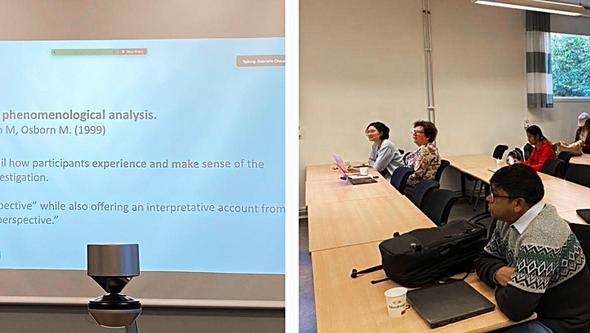
March 16, 2023
Kristina Jakobsson and Felipe Pacheco Zenteno
Sahlgrenska academy, lecture hall Mammuten, Medicinaregatan 18A.
January 19, 2023
Ingrid Svensson presenter
School of Business, Economics and Law, lecture hall B44, House B, floor 4, Vasagatan 1
May 25, 2023
A workshop was also held May 25, 2023 at School of Business, Economics and The workshop consisted of 6 presentations of ongoing research spanning on different questions related to the organization of health care.
Program
13.30: Randi Hjalmarsson (University of Gothenburg) “ADHD, Prison Healthcare, and Crime”
14.00: Niklas Jakobsson (Karlstad University) ”When do Default Nudges Work”
14.30: Henning Øien (Oslo University) “Out-of-pocket prices and rationing of care services:
Evidence from price discontinuities”
15.00: Coffee
15.20: Annika Lindskog (University of Gothenburg) “Historical pathogen prevalence and government response to COVID-19”
15.50: Jens Wikström (Stockholm University) “Does it matter who cares? Formal vs. informal care of the elderly”
16.20: Mio Fredriksson (Uppsala University) ”The development of universal health coverage and equal access in Sweden: A century-long perspective”
16.50: Conclusions
August 17-19, 2022
Nordic Health Economists' Study Group
The University of Gothenburg and the Centre for Health Governance at the University of Gothenburg (CHG) hosted the 41st Nordic Health Economists’ Study Group (NHESG) meeting on the 17th-19th of August 2022. The conference was held in person at Wallenberg Conference Center in Gothenburg. The meeting aimed to bring together researchers who are working in the area of health economics and to promote continuous development of health economics as a sub-discipline of economics.