
Environment and Sustainable Development
This section describes how sustainable development is integrated into the activities of the Department of Education and Special Education (IPS), within the framework of the University of Gothenburg’s vision.
Education for sustainable development
Education is a fundamental prerequisite for sustainable development. Education strengthens people's opportunities to participate, influence and change society in a sustainable direction.
The Department of Education and Special Education (IPS) contributes to this by educating the teachers, school leaders, special educators and researchers of today and tomorrow, as well as students who want to deepen their theoretical understanding of education as a science.
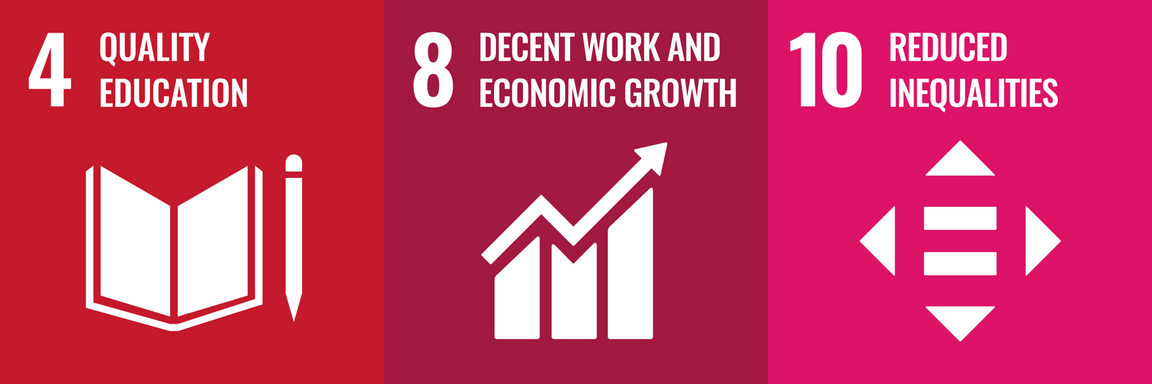
The range of courses covers the entire education system and equips students with the knowledge, values and skills required to promote quality, equality and inclusion in education. The work relates to several sub-goals within Agenda 2030, including Goal 4 (Quality education for all), Goal 8 (Decent work and economic growth) and Goal 10 (Reduced inequalities).
Based on pedagogy as a discipline, the transformative power of education is highlighted as a key contribution to sustainable development – not through environmental technology solutions, but by developing people's ability to understand, act and collaborate in complex societal challenges.
Research for change
IPS staff conduct research that contributes to understanding and developing the role of pedagogy in promoting equality, inclusion and quality – both nationally and internationally.
Research activities cover areas such as school segregation, mental health among young people, leadership, professional development and quality work in the education system.
Through this breadth, IPS research is linked to several sub-goals within Agenda 2030, such as Goal 4 (Quality education for all) and Goal 3 (Good health and well-being), particularly in research concerning the mental health of children and young people, equal education and inclusive learning environments.
A central part of the department's social mission is its testing activities, which are responsible for the development, administration and research of national tests. This work contributes to legally secure and equitable assessments in the school system and to knowledge about how tests can be used to support the quality of teaching and student learning. The testing activities thus serve as a concrete example of how research and practice work together to promote sub-goal 4.1 – free, equitable and quality education for all.
Research environments and collaborative projects at IPS also contribute to goal 8 (Decent work and economic growth) through studies on professional conditions, skills supply and sustainable leadership, and to goal 10 (Reduced inequalities) through research on inclusion, accessibility and anti-racism work in the education system.
Through research and collaboration, IPS contributes to society's ability to adapt by providing knowledge that is directly applicable to the development of education and education systems.
Sustainability in practice – transforming everyday work
In addition to its core activities, the department conducts systematic work to reduce its own environmental and climate impact.
Sustainability work is carried out through a Sustainability Council – an advisory body to the department management, with representatives from the organisation, education (including student and doctoral student representatives), the deputy head of department with responsibility for environmental issues, the environmental economist, and the sustainability coordinator. The Council coordinates and drives the department’s work to translate the University’s sustainability goals into practice.
The department follows the University of Gothenburg’s environmental policy and is also guided by the University’s carbon budget, which specifies how emissions are to be reduced over time. IPS is further ahead in the transition than the University as a whole, with a total reduction of approximately 40 per cent since 2019. This progress has been made possible through local procedures for sustainable purchasing, travel and resource management. An active travel policy and investments in digital meetings have also led to a substantial reduction in emissions from business travel. Transforming a large organisation is complex work, and IPS’s head start towards 2030 shows that sustainability goals can be achieved when they are broken down and translated into practices close to everyday operations. For this reason, experiences and examples from IPS’s transition work are actively shared with other parts of the University, contributing to learning and development across the organisation.
A concrete example of how this transition work is put into practice is the international research project MapIE – Longitudinal Data for Studies of Inequality in Education. In the project, steering group meetings are planned in connection with major conferences that project members are already attending. This enables the international research team to meet without generating additional air travel, reducing the project’s climate footprint while maintaining collaboration.

What does sustainable development mean at IPS?
Sustainability work at IPS is based on the Climate Framework, which guides the University of Gothenburg’s efforts to reduce its climate impact and contribute to a fossil-free society.
To highlight the department’s broader contribution to sustainable development, Agenda 2030 and the Sustainable Development Goals are also used. This framework makes it possible to conceptualise how education, research, collaboration and daily operations contribute to socially, economically and environmentally sustainable societal development.
Sustainable development is therefore something that IPS contributes to both indirectly – through research and education – and directly through its day-to-day operations.
The Climate Framework
The Climate Framework for higher education institutions is a joint initiative in which Swedish universities collaborate to reduce their climate impact and contribute to society’s climate transition.
The Framework entails a commitment to:
- integrate a climate perspective into education, research and collaboration
- reduce emissions from their own operations
- contribute to the transition through knowledge, cooperation and leading by example.
Work on the Climate Framework is coordinated nationally by the Swedish University of Agricultural Sciences (SLU). More information is available at slu.se/klimatramverket.

Are you visiting us at IPS?
The University of Gothenburg has established that we should strengthen our relevance as a societal actor and collaborative partner in order to contribute to the Sustainable Development Goals. At IPS, this means putting research-based knowledge into practice – including in how we travel, meet and carry out our work.
In collaboration with IPS, you have the opportunity to contribute to a more sustainable university environment by:
- Considering travel-free meetings as your first option. Hold the meeting digitally whenever possible. The University of Gothenburg uses Teams and Zoom as reliable platforms for this purpose.
- Choosing train travel or other sustainable transport options whenever possible. When travelling to Gothenburg, there are good opportunities to choose the train or other sustainable alternatives.
- Planning your journey carefully if you need to fly. In cases where air travel is necessary, there are still ways to limit climate impact, for example by reducing the number of stopovers and, where possible, combining air travel with train travel for parts of the journey.
When travel to IPS is booked and paid for by the department, IPS’s local process for air travel applies. The process aims to reduce climate impact and to provide a better basis for monitoring and understanding travel patterns.
IPS hopes that you share the ambition to contribute to a sustainable and considerate university environment – both during your visit and in your continued work.