
Study Facilities on board R/V Skagerak
R/V Skagerak is Gothenburg University's state-of-the-art research vessel. The vessel is part of the Skagerak Facility marine research infrastructure. Skagerak is equipped for teaching in all marine science disciplines: biology, geology, chemistry, and physical oceanography.
Teaching on R/V Skagerak
Studying aboard the R/V Skagerak is like stepping straight into marine science. Lessons aboard include collecting various samples that students either examine on board or analyse later on land. There is a large aft deck where students can clearly see what is going on, for example, water sampling with CTD or sediment core sampling. The lab spaces are large and there is room for groups of ten students in the lab.
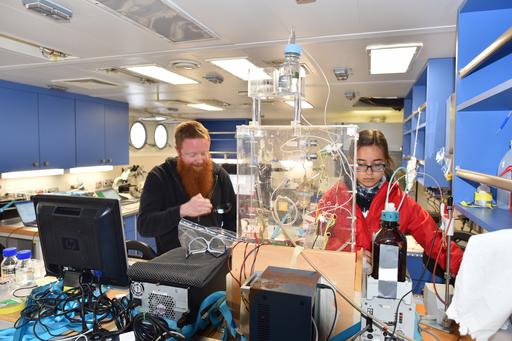
The shortest trips last a few hours, during which the R/V Skagerak travels a short distance from the harbour. Some courses, however, last for several days at a time. Meals are then served in the mess hall and students sleep overnight in the cabins.
R/V Skagerak is used for education in marine biology, marine geology, marine chemistry and physical oceanography. How much the research vessel is used in education depends on which courses the student chooses to take – either within the educational programme or as independent courses.
Skagerak in the Master’s programmes
Skagerak is used in course modules in several Master’s programmes at the University of Gothenburg, such as Marine Science, Physical Oceanography, Geology, and Chemistry.
According to student evaluations, one of the most popular master's level courses in marine sciences is ‘Marine Project – From Idea to Action,’ where students create their own research projects and are responsible for their execution on board the R/V Skagerak.
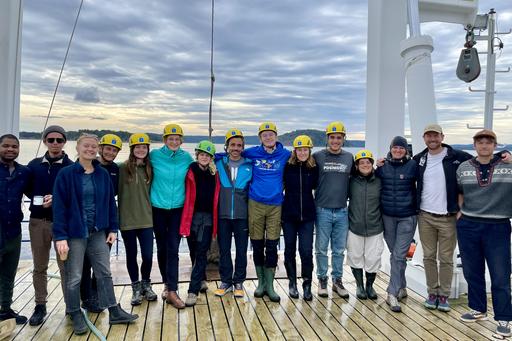
How much of your programme is taught on-board depends on your choice of Master’s programme and specialisation.
R/V Nereus is used for students taking the Master’s programme in Sea and Society.
Skagerak in Free-standing courses
Skagerak is also used in free-standing courses with a marine focus at both ground and advanced level, where students can come from a background in, for example, geology, chemistry, or technology.
Examples of such courses are: Marine geology, Marine environmental geology, and Applied analytical chemistry in marine science.
Research on Skagerak
Since its inauguration in 2021, R/V Skagerak has been used for both education and research and is now an established platform within Swedish marine science. Research in biology, chemistry, physical oceanography, and geology is conducted on board.
The ship operates both in Swedish coastal areas and in more distant marine environments. Expeditions regularly travel to the Arctic, for example Svalbard and Greenland, often in collaboration with international universities and research institutes.
Using advanced equipment, samples are collected from water, sediments and air for analysis to increase knowledge about ocean processes and climate development.
R/V Skagerak also serves as a base for remote-controlled and autonomous systems, such as benthic landers, AUVs, ROVs, sail buoys and ocean gliders, enabling research even in demanding environments.
Virtual tour
Other marine study facilities
Read more about the study facilities, such as research stations on the west coast of Sweden, and our labs in Gothenburg.
