
Sustainability & PRME: Reporting the School’s Recent Progress
This page serves as the School’s platform for communicating our recent work to advance sustainable development. The information presented here builds on our annual Sharing Information on Progress (SIP) report to PRME, and is complemented by recent additional data from other institutional sources. To ensure clarity and coherence, the page is structured around the seven principles of PRME.
What is PRME?
The Principles for Responsible Management Education (PRME) is a United Nations-supported initiative established in 2007 at the UN Global Compact Leaders’ Summit in Geneva. It serves as a global platform for collaboration among business schools dedicated to embedding sustainability and responsible leadership into education, research, and institutional practices. PRME’s core mission is to equip current and future business leaders with the skills and mindset needed to align economic goals with sustainable development — promoting ethical, inclusive, and socially responsible leadership. With more than 800 signatory institutions worldwide, PRME represents the largest coordinated effort between the United Nations and business schools.
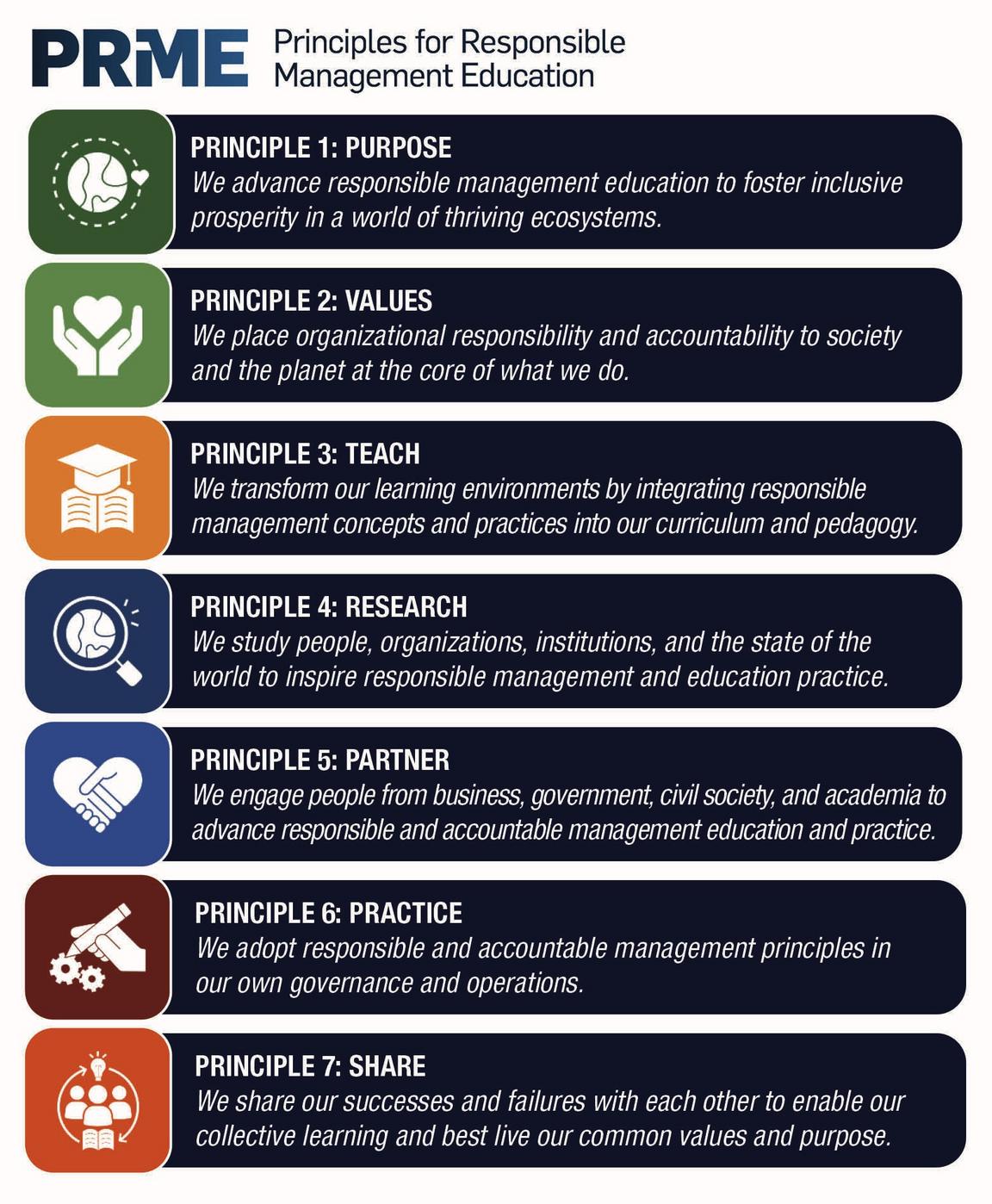
PRME is based on seven principles, which guide institutions in shaping curricula, research, and partnerships in support of sustainable development. See definitions of each principle below.
Navigating This Page
As we begin presenting the School’s progress in relation to the seven PRME principles, it is helpful to note that the first two principles — Purpose and Values — describe the School’s long-term foundations: our mission, commitments, and overall approach to sustainability. These areas remain relatively stable over time. The remaining principles focus on education, research, partnerships, and operations, where activities develop and change from year to year. The sections below therefore combine stable, overarching commitments with more dynamic updates in areas where continuous progress is taking place.
Principle 1: Purpose
We advance responsible management education to foster inclusive prosperity in a world of thriving ecosystems.
Sustainability at the Core of Our Operations
Guided by the School's mission — “To develop knowledge, educate, and foster independent thinking for a sustainable world” — we are continuously working to deepen the integration of sustainability into our education, research, and societal engagement. This work is supported by dedicated academic leadership, with the School’s sustainability profile further developed under the responsibility of Deputy Dean Lena Gipperth, Professor of Environmental Law.
Contributing to Global Agendas
The School of Business, Economics and Law has been a PRME signatory since 2010 and our continued commitment to PRME is reflected in how we prepare students and professionals to address global challenges and contribute to sustainable development.
As a signatory, we are committed not only to advancing the principles of PRME, but also to actively support the United Nations 2030 Agenda and the 17 Sustainable Development Goals (SDGs). These goals also guide our strategic priorities and inform how sustainability is embedded in all of our operations.
Principle 2: Values
We place organizational responsibility and accountability to society and the planet at the core of what we do.
Reporting on Progress With Transparency
A core part of the School’s commitment to PRME is demonstrating how our values are translated into action. As a signatory, we are required to regularly report on our progress in integrating the seven principles, ensuring transparency and accountability in our work. This is done through the Sharing Information on Progress (SIP) reports — formerly submitted every two years, now annually.
In 2024, the School submitted its sixth SIP report, which present recent achievements, ongoing initiatives, and future challenges in advancing responsible management and sustainability across the School. Below, we present selected highlights from the latest SIP report, complemented by additional data from institutional sources such as faculty reports, project data, and sustainability performance indicators from recent years.
All of our previous SIP reports in full length are available for download in the menu to the right.

Principle 3: Teach
We transform our learning environments by integrating responsible management concepts and practices into our curriculum and pedagogy.
Pedagogical Approach
The societal relevance of the School hinges on our efforts to understand and address the societal challenges facing Sweden and the world through research and education. Working to fulfill the School's mission to "contribute to a better world" involves educating responsible students with knowledge and skills in economics and law, enabling them to tackle challenges faced by society and individual organizations, whether related to climate transition or the role of businesses in human rights, corruption, and poverty. Achieving this requires an understanding of context as well as expertise. Employ-ability is largely about learning how to learn.
The School of Business, like the Swedish university system in general, is characterized by a high degree of autonomy, where course coordinators and individual teachers are entrusted with significant responsibility to develop course content. This necessitates delegated responsibility and continuous trust building between the faculty and departmental levels to achieve the School's sustainability goals. Our strategy for enhancing sustainability aspects in the School’s educational offerings can be summarized as a combination of measures focused on broad integration, complemented by targeted efforts in specific priority areas. Broad integration means offering as many students as possible more and better sustainability related elements throughout their education. Sustainability should be an inherently integrated part of the School’s educational offerings.
Targeted efforts involve supporting individual courses and course components, providing students with opportunities for greater specialization within various sustainability themes. This specialization is made possible through the faculty’s extensive knowledge and experience in a wide range of relevant sustainability aspects, allowing for the delivery of research-driven education. Building on the bottom-up development tradition that characterizes the Swedish university system is essential. A key distinction in this context is between sustainability-related knowledge and sustainability-related skills. Tailored educational components are crucial for training students to apply their theoretical knowledge in different fields, demonstrating how knowledge and skills complement each other. Sustainability issues can thus serve as an entry point to relating education to ethical questions.
The School of Business considers it a fundamental part of its mission to train and empower students to identify, discuss, and manage ethical issues in relation to their future professions. This is a component of the sustainability work that has begun but where much remains to be done.
On a more practical level, our pedagogical approach is based on constructive alignment. This means there should be a clear and coherent connection between general degree objectives, program-specific and course-specific learning outcomes, and finally, the specific assessment tasks. Working with constructive alignment is thus an effective way to continuously evaluate and improve the integration of sustainability goals within the educational offerings.
The School of Business has a long and strong tradition of collaborating with the surrounding society, including private enterprises, public authorities, and nonprofit organizations. These collaborations are particularly important for sustainability related themes in education, as external partners often contribute guest lectures and thesis topics directly linked to current sustainability issues that resonate with students.
Sustainability Related Programmes and Courses
The course directors and teaching staff ultimately determine the content of the School's courses. Given that sustainability is a central element not only in the School’s strategy but also in its research efforts, it is natural that a wide range of topics are introduced, explored, and practiced across the more than 100 courses offered each year.
Most students encounter a diverse array of sustainability-related themes or issues during their studies. Below is a selection of key areas addressed across programmes:
- Climate-related challenges and solutions, including business-related policies and frameworks at the national, EU, and international levels.
- Sustainable consumption, resource use, resource efficiency, and circular economy.
- Ethical dilemmas and corporate responsibilities toward stakeholders such as employees, customers, local communities, and the environment.
- Sustainability accounting, reporting, and compliance.
- Sustainable finance.
- International development, economic growth, and poverty reduction.
- Legal aspects, including humanitarian law, environmental law, and international governance.
- Sustainability issues related to professional knowledge and skills such as Responsible leadership, Organizational decision-making, Sustainable economic growth, Environmental impacts of global trade, Human rights law, Corporate social responsibility, Climate change legislation etc.
The Sustainability Days
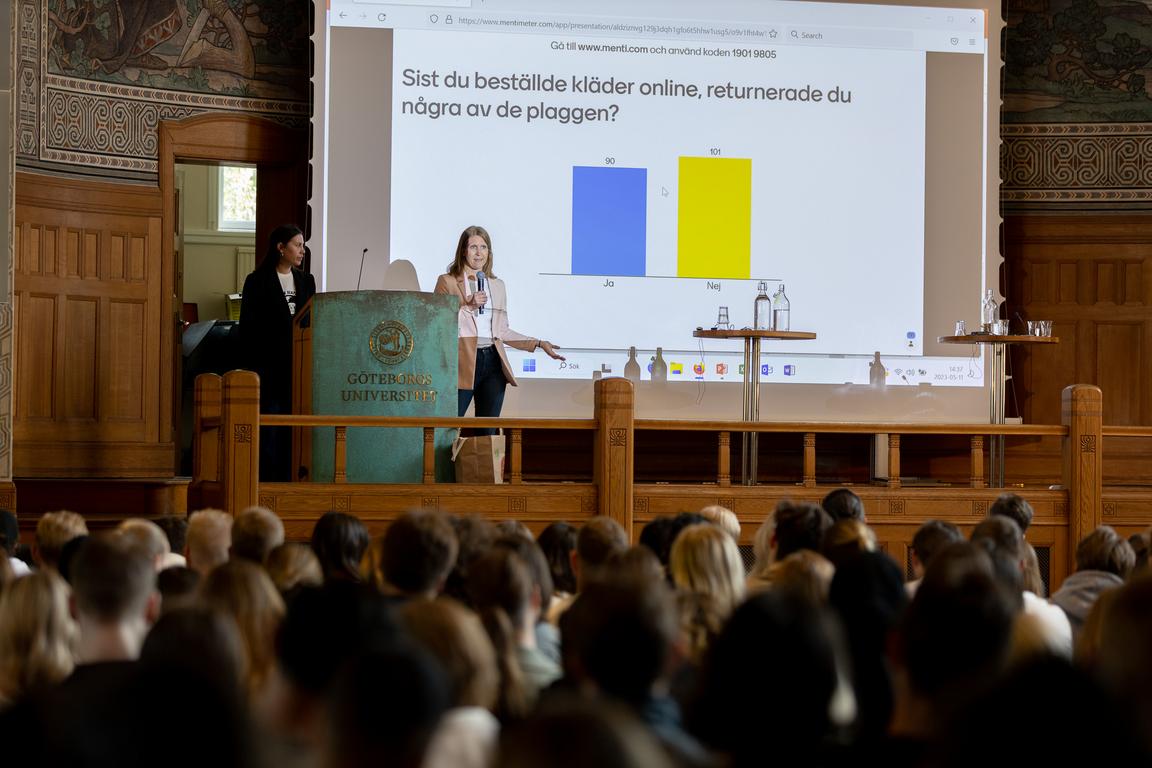
The School organises five yearly occurring Sustainability Days for all programme students. These days complement the sustainability content embedded in our courses and offer a platform for students across programmes to engage in dialogue with companies, civil society, and public sector representatives on key societal issues. The latest programme for each of these five thematic days respectively are continuously uploaded here on our website.
Sustainability Related and Sustainability Focused Courses and Programmes
According to the sustainability labelling criteria of the University of Gothenburg, over 40 courses at the School of Business, Economics and Law include learning outcomes explicitly related to sustainability, and the absolute majority of the Schools degree programmes (10 out of our 13) are either Sustainability related or Sustainability focused.
Courses on Bachelor's level
Programmes on Bachelor's level
Courses on Master's level
Programmes on Master's level
Principle 4: Research
We study people, organizations, institutions, and the state of the world to inspire responsible management and education practice.
Sustainability related regular research seminars
Sustainability-related seminars are held weekly. At the Department of Economics alone, we have three weekly lunch seminar series often focusing sustainability (Environmental, Development, and Behavioral Economics seminars), organized most weeks. In addition, other seminar series, such as Finance and Applied Microeconomics, sometimes also include sustainability-related themes. The Department of Business Administration, the Department of Law, and the Department of Economy and Society also host several seminars, though not in weekly series. Open Research Seminars The School hosts several annual open research seminars with a wide target audience, in 2024 this included a seminar with the Nobel laureate Simon Johnson. See a compilation of responsibility-related regular research seminars held at the School during 2023.
Examples of PhD-level course syllabi
All PhD Students take the overall Research Ethics Course (organized by the Faculty). The course enable students from different discipline to discuss ethics, responsibility in relation to different aspects of research ethics.
Published research related to the SDG:s
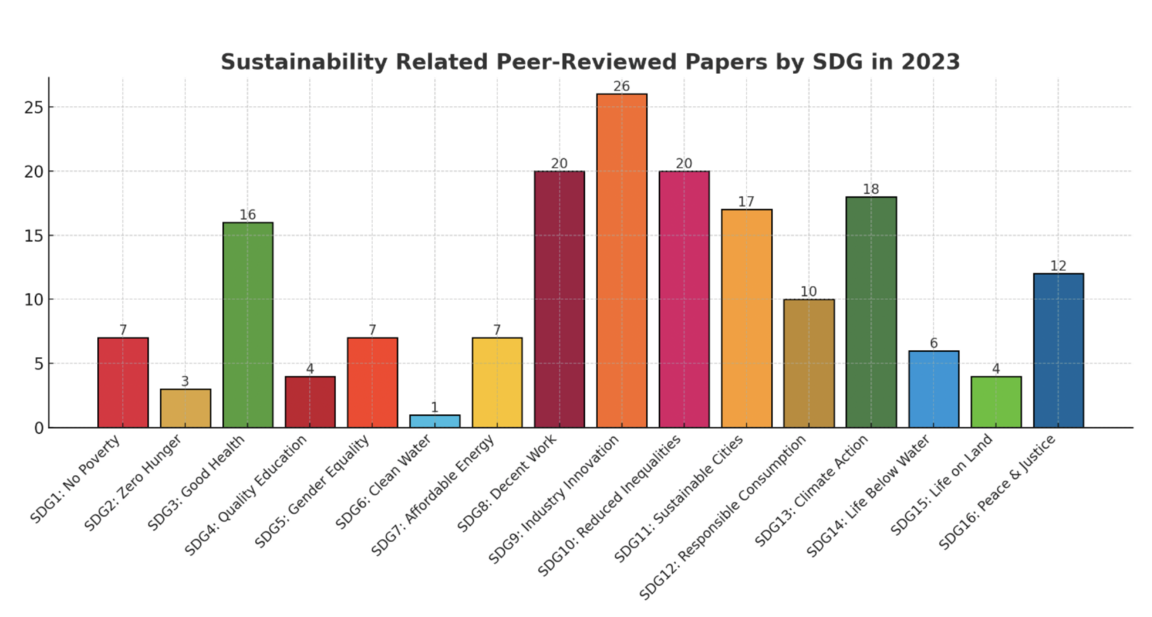
During the 2023 calendar year researchers from the School published in total 248 peer-reviewed papers in academic journals. Almost half (115 papers or 48%) related to at least one of the SDG. The figure below displays how the SDG-relevant papers relate to specific SDG' s. As each paper can relate to more than on SDG (e.g. poverty and climate change) the number of hits in the figure below exceed the number of papers. On average an SDG-related paper relate to 1,5 SDG's (115 papers generated 178 SDG “hits”).
Principle 5: Partner
We engage people from business, government, civil society, and academia to advance responsible and accountable management education and practice.
Two examples of joint problem-solving
The school engages in many initiatives in joint problem solving, two such examples are Gothenburg Green City Zone and Urban Futures at Wexus.
Gothenburg Green City Zone is an innovative collaboration initiated in 2021 by the City of Gothenburg in partnership with actors such as Volvo Cars Chalmers and RI.SE (Research Institutes of Sweden). The initiative aims to create a climate-neutral urban environment by 2030 by developing and testing sustainable solutions for transportation and urban development. The City of Gothenburg leads the project but relies on close collaboration between industry, academia, and public sector actors. The zone encompasses several areas in Gothenburg and serves as platforms for implementing new technologies and innovations that can be scaled globally.
Within a zone, the focus areas include vehicle electrification, autonomous driving, the sharing economy, and the development of smart infrastructure. Participants in the project include major companies such as Göteborg Energi, ABB, and Västtrafik, along with small and medium-sized enterprises, startups, and research institutions.
The School of Business, Economics and Law at the University of Gothenburg plays an important role by contributing research and education in areas such as sustainable business models, behavioral science, and urban planning. The school is actively involved in analyzing how innovative technologies and business models can be implemented effectively and also supports companies and policymakers in developing strategies for sustainable growth. A concrete example is research projects on circular economies and how sharing services can contribute to reduced emissions and increased resource efficiency.
This type of collaboration between academia, industry, and the public sector strengthens Gothenburg's position as a leading city in sustainable urban development and innovation while addressing global challenges in climate and mobility.
Urban Futures at Wexus is a research and collaboration initiative focusing on sustainable urban development. The goal is to create innovative solutions to address urban challenges, such as climate change, social inclusion, and sustainable infrastructure. The initiative is built on collaboration between academia, industry, the public sector, and civil society, serving as a platform to test and develop new models for the cities of the future.
The School of Business, Economics and Law at the University of Gothenburg plays a central role in Urban Futures by contributing research and expertise in sustainable business models, policy development, and socio-economic analyses. The school works closely with other stakeholders in the project to ensure that the solutions are not only environmentally sustainable but also economically and socially viable. By linking academic expertise to practical challenges, the School of Business helps shape long-term sustainable strategies for urban environments.
The Executive Faculty Program
Executive Faculty (EF) is part of the School of Business, Economics and Law's Partner Program. Researchers from the school are matched with senior employees from the school's senior partners. The researchers receive compensation (paid by the Partner Program) for participating in the program, which spans three terms and includes networking as well as partner and individual coaching opportunities. During the first half of the year, EF included nine pairs, who graduated in August. A new cohort of EF started in August 2024 with six pairs, with participants from SEB, SKF, Volvo Cars, Stena Metall, Handelsbanken, and Hogia.
Principle 6: Practice
We adopt responsible and accountable management principles in our own governance and operations.
The National Climate Framework
As part of the University of Gothenburg, the School of Business, Economics and Law participates in the Swedish Climate Framework for Higher Education Institutions. This framework aims to reduce the climate impact of higher education institutions (HEIs) through strategic actions. By joining, participating universities commit to setting measurable goals, implementing systematic measures, allocating resources, and transparently reporting their climate-related results. The framework aligns with the UN’s Sustainable Development Goals (SDGs) and encourages collaboration among institutions to address both direct emissions (e.g., energy use, transportation) and indirect emissions (e.g., education and research).
The University-Wide Climate Targets
The University of Gothenburg introduced a carbon budget for its operations, requiring all departments, faculties, the university library, and central administration to reduce their carbon emissions in two stages:
- A 25% reduction by the end of 2023, compared to the 2019 baseline
- A 50% reduction by the end of 2029, compared to the 2019 baseline
These milestones support the broader commitment to achieving net-zero emissions by 2045, aligning with Sweden’s national climate goals.
Short-Term Progress for the School of Business, Economics and Law
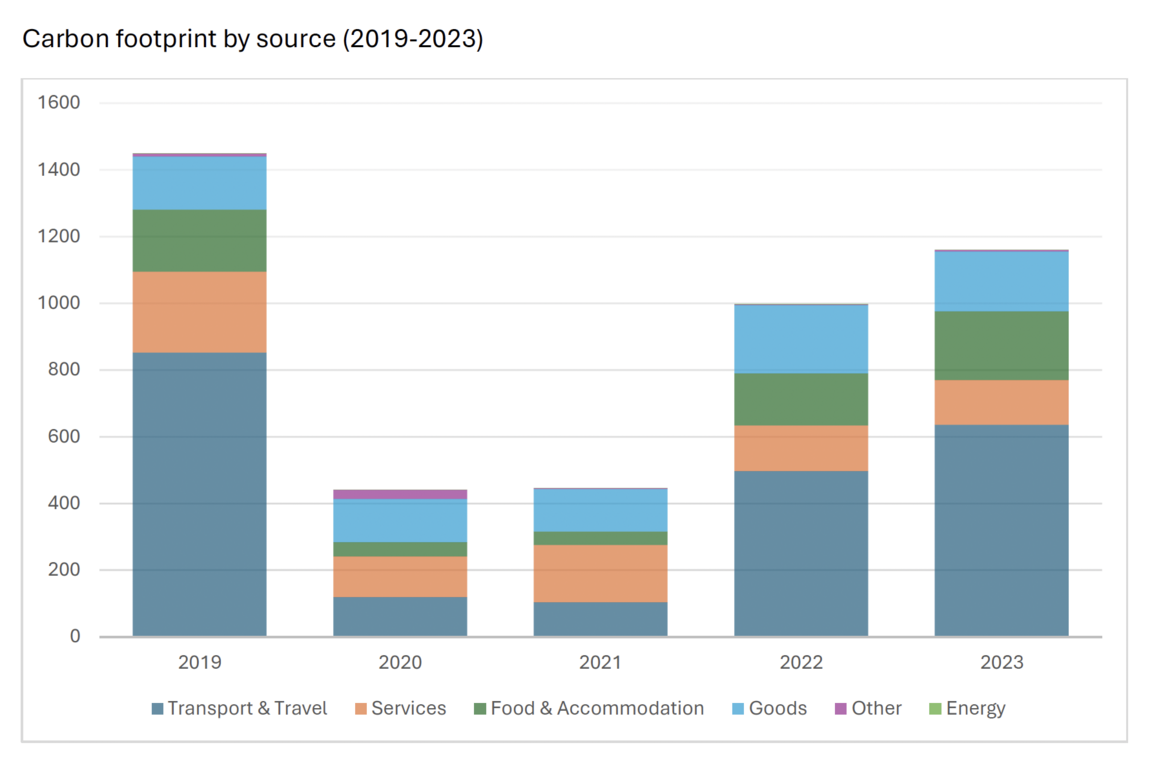
The University of Gothenburg’s climate data are based on estimates for transports and business travel, energy use (heating and electricity), food & accommodation, purchase of goods, purchases of services, and “other sources.”
Scope 1 emissions are very small since the University of Gothenburg is a city university without onsite fuel combustion and with very few vehicles. Scope 2 emissions consist mainly of electricity and district heating for university buildings. Because the School (mandated by law) cannot own buildings, all energy efficiency investments must be carried out in cooperation with the property owner.
The majority of the School’s emissions derive from Scope 3 sources, with business travel as the main contributor. Estimates from Svalna, a carbon calculation tool procured by the University, suggest that business travel accounts for more than 50% of the Schools current emissions. While these travel-related emissions are relatively straightforward to estimate, data on the purchasing of goods and services are rough approximations based on categorization by value and product type.
According to Svalna’s statistics, the School reduced its carbon footprint by approximately 20% in real terms between 2019 (the baseline year) and 2023. Considering the School’s growth and the increasing number of employees, measuring climate impact per employee shows a roughly 24% reduction. However, these figures are estimates and should be interpreted cautiously due to the complexity of Scope 3 emissions and the limitation of the tool. Finally, it should be noted that we see an increase in emissions between 2022 and 2023, by a rise in business travel, likely reflecting a rebound effect following the Covid-19 pandemic.
Principle 7: Share
We share our successes and failures with each other to enable our collective learning and best live our common values and purpose.
PRME Global Forum
The School participated in the PRME Global Forum in New York in June 2023, represented by Anders Sandoff, teacher and researcher in business administration and member of the School’s Sustainability Office.
