Historical aspects of pollution of pre-production plastic pellets and linking the pollution to changes in regulations by using sediment cores
This is a suggestion for a Degree Project for Bachelor's and Master's levels at the Department of Marine Sciences. Degree projects at the Department of Marine Sciences are done independently and must be written and assessed individually.
Subject: Interdisciplinary, chemistry & geology
Project level: MSc, 45 or 60 hp
Supervisors: Karin Mattsson, Irina P. Asteman
Introduction
Sediment cores will be taken outside Stenungsund, a city on the Swedish west coast where Sweden’s largest producers of plastic pellets are located.
There are two industries, one producing PE and most likely PP pellets and one that is producing PVC pellets. The production of PE started in 1963 with an increase in production since then. At the moment they produce around 0.75 million tons of PE pellets corresponding to 5% of the European market. Calculated emissions of PE pellets are between 3 and 36 million pellets annually. There have been some changes in the environmental regulations regarding their allowed emissions.
The PVC particles are a bit smaller in size. The industry has been in the area since 1968, however, exactly when they started to produce PVC at this site is not clear. They produce around 0.23 MTons of PVC pellets.
Methods
Sampling sediment cores
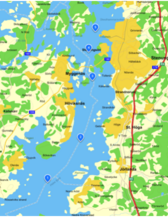
Sediment cores will be collected with a Gemini corer at 3-5 different strategical points in the Hakefjord outside Stenungsund.
Slicing and dating the cores
For micro and nano plastic analysis, 3-4 sediment cores will be taken per sampling site and will be sliced into 1-2 cm sampling resolution. The individual slices will be pooled together until we have a volume of 150 mL of sediment per core interval.
For radiometric dating, an additional sediment core will be taken and analyzed for 210Pb and 226Ra to establish the age model. By linking amount of micro and nano plastics in the sediment to temporal development, it will be possible to track the emission of plastic pellets since the production started.
By looking at changes of Ecological Quality Status in the fjord with help of benthic foraminifera in the dated sediment core we will be able to answer the question if there is an ecological effect of microplastic pollution on fjord communities.
Extraction of plastics from sediment
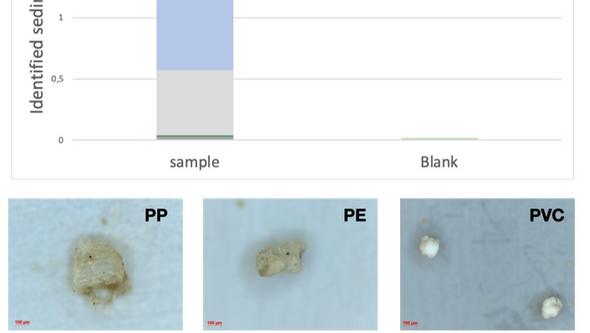
The sediment will be pre-treated with a chemical treatment, then, the particles will be extracted using the Kristineberg Microplastic Separator and ZnCl. The protocol has been tested for sediment in the area and shown to successfully extract PVC.
Expected outcome
The global production of plastics has increased yearly since the production in Stenungsund started.
The thesis will answer the following research questions:
- Does the amount of plastics found in the sediment layers follow the amount of produced pellets?
- How did changes in plastic pollution occurred over years?
- Is there a difference in level of degradation between the oldest and the youngest pellets found in the sediment cores? And can we measure it?
Contact
Karin Mattsson,
Researcher, Marine Chemistry
Email: karin.mattson@gu.se
Irina P. Asteman,
Senior Lecturer, Marine Geology
Email: irina.polovodova@marine.gu.se
References
K. Mattsson, E. Ekstrand, M. Granberg, M. Hassellov, K. Magnusson, Comparison of pre-treatment methods and heavy density liquids to optimize microplastic extraction from natural marine sediments. Sci Rep 12, 15459 (2022).