Greenhouse gas emissions from coastal marine sinks
This is a suggestion for a Degree Project for Bachelor's and Master's levels at the Department of Marine Sciences. Degree projects at the Department of Marine Sciences are done independently and must be written and assessed individually.
Subject: Marine Biology
Project level: Master and/or bachelor
Contact people: Maria Asplund, BioEnv, Göteborgs universitet, Mats Björk, DEEP, Stockholm universitet, Martin Gullström, NMT, Södertörn Högskola
Background
Within the international climate debate on strategies to mitigate climate change, there is a key focus on natural carbon sinks such as vegetated coastal ecosystems and their reduction of greenhouse gas emissions.
Our research aims to understand the carbon sink function, the greenhouse gas exchange, to identify hotspots of carbon sequestration within the coastal seascape environment, and to understand the fate of stored carbon as potential sources for greenhouse gas emissions.
Project description
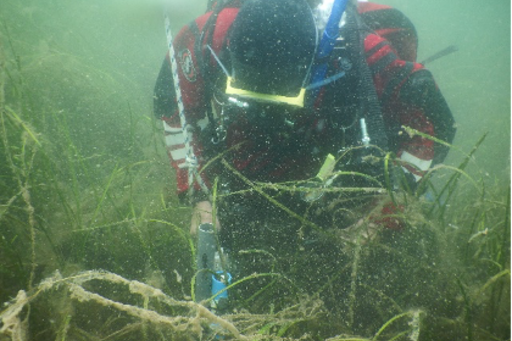
This project includes field and experimental studies in coastal shallow-water environments, with focus on seagrass meadows and other vegetation-covered habitats.
The aim of the project
The project aims to assess greenhouse gas emission from different shallow-water habitats which are natural carbon sink hotspots. An additional focus will be on different aspects influencing the greenhouse gas emissions, such as the influence of drift algae belts, epiphytic filamentous algal mats, seasonality and changing temperature and seascape configuration.
The project has a wide approach and can include several different projects.
Contact
Maria Asplund, BioEnv, Göteborgs universitet
Email: maria.asplund@gu.se
Mats Björk, DEEP, Stockholm universitet
Email: mats.bjork@su.se
Martin Gullström, NMT, Södertörn Högskola
Email: martin.gullstrom@sh.se