
Hyperpolarization
NMR is an excellent method for applications in material science. We offer advanced NMR instrumentation and expertise for both solid state DNP and dissolution DNP applications.
Hyperpolarization - what is it?
NMR is powerful for studying materials and molecules, but it often suffers from low sensitivity because nuclear spin polarization at thermal equilibrium is tiny. Hyperpolarization refers to a family of methods that boost nuclear polarization far above thermal levels, increasing NMR signal intensity by orders of magnitude. This makes experiments faster to acquire and makes it possible to detect surfaces, dilute species, defects, transient intermediates, and low-gamma nuclei that may otherwise be invisible. Several hyperpolarization approaches exist (e.g., DNP, parahydrogen-based methods, optical pumping), but they share the same goal: create non-equilibrium polarization and convert it into enhanced NMR signal. Depending on the method, hyperpolarization can be applied to solids (often at low temperature) or liquids (often after a transfer step), supporting applications from materials and catalysis to chemistry, pharma, and biomedical studies.
MAS DNP for solids
Magic Angle Spinning (MAS) improves spectral resolution in solids by averaging anisotropic interactions through rapid sample spinning at 54.7° relative to the magnetic field. Even with MAS, many solid-state experiments remain sensitivity-limited. MAS DNP addresses this by transferring the high polarization of unpaired electrons to nearby nuclei using microwave irradiation at cryogenic temperature (commonly 100 K). Typically, a sample is impregnated with a radical-containing solution, cooled and spun under MAS, and irradiated with microwaves. The result is a large gain in NMR signal, commonly described as an enhancement factor, which can reduce experimental time dramatically (since time scales roughly with the inverse square of signal gain).

At SNC, the 400 MHz magnet is equipped with a low-temperature cryocabinet allowing one to perform solid-state NMR experiments from 100 K to 300 K, with spinning rates from 1 to 15 kHz.
Bruker 400 MHz Ascend DNP NMR spectrometer
• AVANCE Neo Bruker Console
• 263 GHz Gyrotron
• LT-MAS cryocabinet with automatic refill system
• sweep field unit
• 2 NMR probes : 3.2 mm RTMAS HXY, 3.2 mm DNP LTMAS HXY
Dissolution DNP for liquids
Dissolution DNP is designed to produce highly polarized liquid-state samples. Polarization is first generated in the solid state at low temperature (typically 1 K) under a strong magnetic field using microwaves in the presence of a polarizing agent (unpaired electrons). After building up polarization, the sample is rapidly dissolved with a hot solvent and transferred to an NMR spectrometer for measurement in the liquid state. Because the sample ends up as a liquid, dissolution DNP combines very high sensitivity with high spectral resolution, enabling studies of reaction kinetics, metabolism, and low-concentration species. A key constraint is that the enhanced polarization decays with the nuclear T₁ relaxation time, so experiments must be performed quickly after dissolution and transfer. Dissolution DNP is widely used with nuclei like 13C (but also 15N, 31P, etc., depending on chemistry and relaxation).
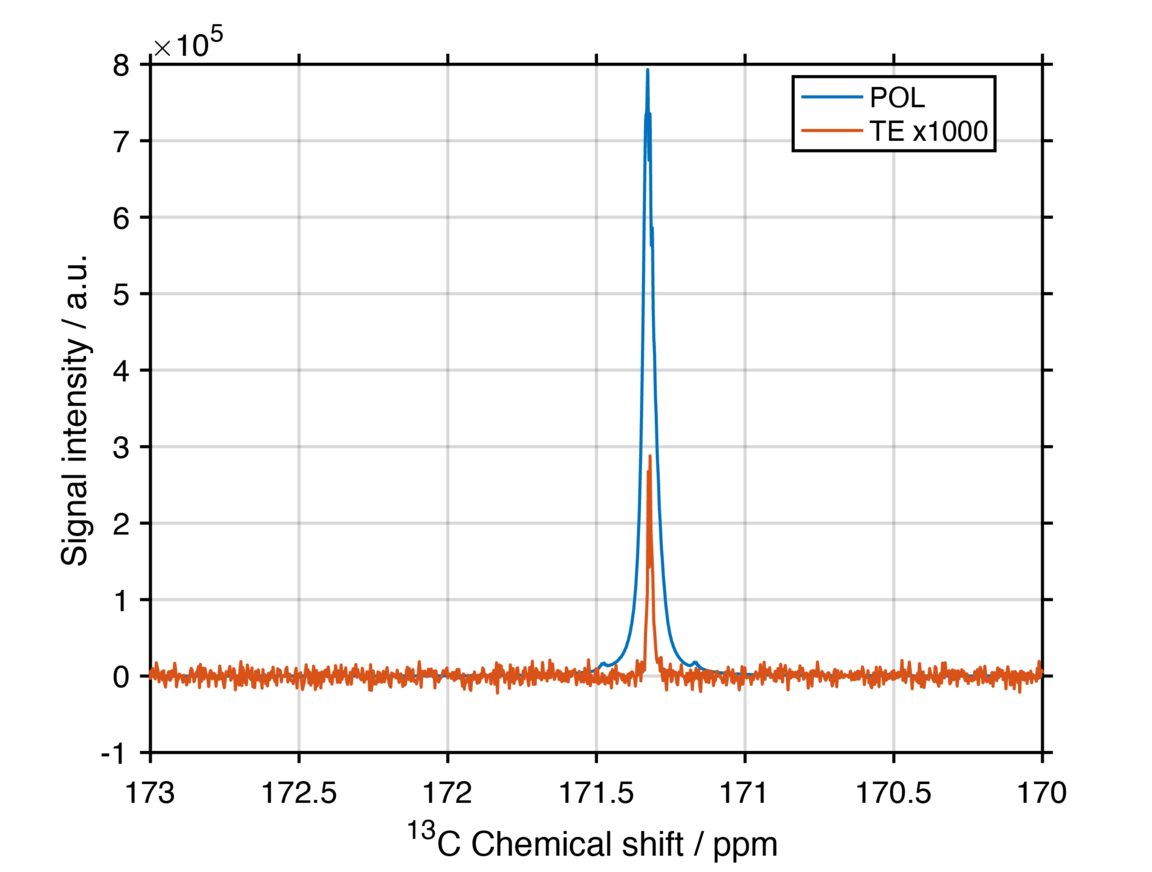
At SNC, the 800#2 MHz magnet is connected to a dissolution DNP polarizer performing DNP at 1 K and 5 T.
Leiden Cryogenics Polarizer
• Tecmag Console
• 139 GHz Microwave source
• ULT cryocabinet with automatic refill system
• sweep field unit
• 1 NMR probe to detect a wide range of frequencies.
Access to infrastructure
Do you want to do a hyperpolarization experiment? You can! Just write an email to cesar.sjalsjo@gu.se to discuss the possibility of analyzing your sample with MAS DNP or dissolution DNP.
Costs
Go here for the current information on user fees.