PhD Program in Conservation
As a doctoral student, you will conduct independent research under supervision. Once admitted, you will become both a student and an employee at the University of Gothenburg. You also have the opportunity to study as an industry-based doctoral student, where your studies are conducted within the framework of a position outside the university.
About the PhD program
The field of Conservation is a broad subject area that allows you to immerse yourself in research on the care and development of the cultural environment. You can, for example, conduct research in the conservation of cultural heritage objects, craft sciences, or the built environment and the landscape. Our diverse field makes it possible to use a range of different methods, working methods, and scientific perspectives, drawn from the natural sciences, humanities, and social sciences, as well as artistic research.
The doctoral program comprises 240 credits, equivalent to four years of full-time study, and concludes with the presentation of a thesis at a public defence. It is also possible to obtain a licentiate degree after completing 120 credits.
Being a doctoral student means conducting independent research within the framework of a project, which means that you are both a student and an independent researcher at the same time. The program includes both courses and writing your scientific thesis.
As a doctoral student, you are part of the department's faculty and doctoral student group. The department consists of around 65 employees who work in Gothenburg or Mariestad.
More information about the doctoral program is found in the general study plan.
Specific entry requirements
In order to be eligible for the doctoral program in Conservation, you must, in addition to the general entry requirements, fulfill the specific entry requirements.
You must have completed a degree at master's/second-cycle level in Conservation, or completed course requirements of 60 credits at master's/second-cycle level in Conservation, or obtained the equivalent degree/knowledge within or outside Sweden.
Supervision
As a doctoral student, you will have a principal supervisor and one or more assistant supervisors. At least one of the supervisors must have completed the university's training in supervision or equivalent training at another higher education institution.
Thesis
The thesis is an independent research project that is reported on in the form of a monograph or a compilation thesis. You will discuss with your supervisors and examiner which form is most appropriate for you and your doctoral project.
During the study programme, you present your thesis at the department’s Higher seminar on at least three occasions: an introductory seminar, a midway seminar, and a final seminar.
Future careers
The doctoral program aims to provide quality-assured and qualified education for those who want to work with research and development issues, within or outside the university. After completing your doctoral studies, you will be well-equipped to pursue a research career. You will learn how to conduct research independently and how to apply for funding for your own research projects.
The University’s Job Application Portal
Courses
In addition to writing a thesis, you will also take mandatory, recommended, and elective courses. Each doctoral student has an examiner who is responsible for reviewing and grading the courses included in the study program. The composition of courses is tailored individually to suit your needs for broadening and deepening your knowledge. It is also possible to choose courses offered at other departments and higher education institutions, as well as at universities abroad.
Search for doctoral courses by filtering by department in the course catalogue FUBAS.
Find PhD courses
Defending your thesis
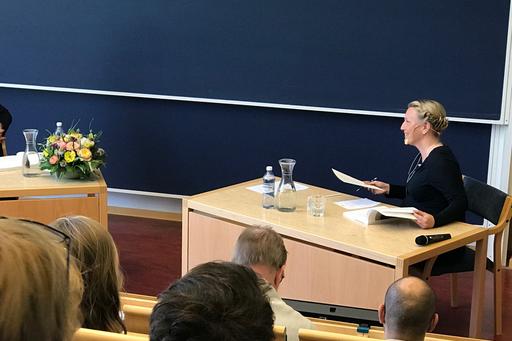
A public defence is an event where you present and defend your doctoral thesis before a committee. During the defence, the thesis is reviewed by an opponent and assessed by an examination board.
The Department of Conservation is a part of the Faculty of Science and Technology. Our doctoral program is also part of the faculty's doctoral program.
Combine doctoral studies with external employment
It is possible to complete our doctoral program as an industry-based doctoral student. This means combining doctoral studies with external employment in the field of conservation.
As an industry-based doctoral student, you are employed by an organisation other than the University of Gothenburg. You complete your doctoral studies within the framework of your occupation and continue to work in the organisation where you are employed. The pace of study and funding is regulated by an agreement between the funding employer and the University of Gothenburg.
To be admitted, an assessment is made of your academic suitability and ability to benefit from the program.
Would you or your colleague like to become an industry-based doctoral student? Contact Katarina Saltzman, Director of Studies, for more information.