
GUIDE days: Focus on microplastics onboard R/V Skagerak
The world is grappling with how to solve the problem of microplastics in our oceans. Could part of the solution be found aboard R/V Skagerak? During the upcoming GUIDE-days, representatives from the plastics industry will meet with researchers to exchange knowledge and ideas – and it all begins with a voyage on the University of Gothenburg’s research vessel.
From the smallest plankton to the largest marine mammals – microplastics can now be found throughout the ocean. At the same time, there is still much we do not know about how microplastics spread and what consequences they have for marine ecosystems.
GUIDE-days: Microplastics and Marine Health – Challenges and Solutions
To better equip ourselves to tackle the problem, the Faculty of Science and Technology is now organising the event GUIDE-days: Microplastics and Marine Health – Challenges and Solutions.
On 25–26 November, researchers will meet with representatives from the plastics industry to discuss what knowledge is still missing when it comes to microplastics in the marine environment.
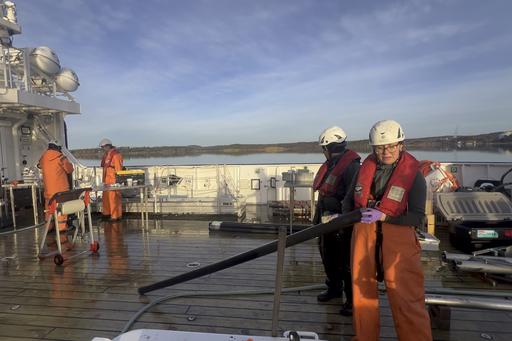
And the event may quite literally get off to a rocking start – as everyone will head out to sea on day one aboard R/V Skagerak, where participants will experience first-hand how scientists study the presence and spread of microplastics in the ocean.
“I believe it’s important to show just how complex research on marine microplastics really is,” says Karin Mattsson, a marine chemist specialising in micro- and nanoplastics. She highlights R/V Skagerak as a unique asset in this context:
“It’s often not until you’re actually out at sea, watching the work being done with the advanced equipment on board, that you realise just how much effort it takes to collect reliable data,” she explains.

Demonstrating marine research in action
Among the participants are researchers in marine chemistry, geology and ecotoxicology, together with representatives from some of Sweden’s largest plastics producers – Borealis, Inovyn (INEOS), and Hexpol TPE AB. Other organisations taking part include the Swedish Agency for Marine and Water Management, Zephyr, FRAM Centre for Future chemical Risk Assessment and Management, Chalmers University of Technology, and the Port of Gothenburg.
“One of the strengths of R/V Skagerak is that it allows us to clearly demonstrate how marine research is carried out in practice,” says Agnes Faxén, Communications Officer at the Skagerak Facility, part of the Department of Marine Sciences.
“Collecting reliable data on microplastics requires time, planning and interdisciplinary collaboration. The voyage aboard R/V Skagerak offers a unique opportunity to show this process up close – and to highlight the complex scientific work behind every piece of new knowledge,” she adds.
Research that benefits both the environment and industry
Karin Mattsson sees GUIDE-days as a much-needed forum for dialogue with representatives from the plastics industry:
“If we can identify plastic leakage or emissions together with companies, we can also suggest targeted measures – which can reduce environmental impact and, in some cases, even save money. In the longer term, we can be involved already at the planning stage when operations are being expanded or modified, and help assess the environmental risks,” she says.
However, Karin Mattsson also emphasises the importance of scientific integrity in collaborations with industry.
“Our responsibility is to stand by the results – and that benefits everyone. If companies want to do the right thing, we’re here to help them do it better.”

Microplastics in the seabed – an overlooked part of the problem
Irina Asteman, a marine geologist and micropalaeontologist at the University of Gothenburg, studies how microplastics spread and accumulate in seabed sediments. She will also demonstrate her research methods on board R/V Skagerak during GUIDE-days.
“We still lack long-term studies on how microplastics behave in seabed sediments. To understand how the problem develops over time, we need to improve our methods and build a more robust knowledge base,” she says.

Speed-dating for future solutions
On day two, GUIDE-days continues with a focused half-day session at Nya Varvet in Gothenburg, featuring speed-dating between researchers and industry representatives, short presentations, and forward-looking discussions.
“We hope that GUIDE-days will result in a meaningful exchange – so we can gain input on what kind of research is needed, and explore ways to collaborate and help each other move forward,” says Karin Mattsson.


