
Exploring the pressures on Bratten’s cold-water corals
How do Sweden’s cold-water corals cope in areas exposed to commercial fishing? A research team recently carried out an expedition to the Bratten marine protected area aboard the research vessel R/V Skagerak to study the long-term consequences — and how these vulnerable coral communities can be better protected in the future.
In steep underwater ravines and across undisturbed seabeds in Bratten — the largest marine protected area in the Skagerrak — several species of cold-water corals thrive.
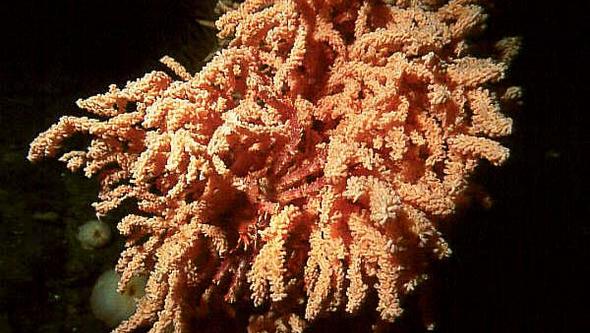
“These aren’t hard corals that build reefs, but gorgonian corals,” explains marine biologist Rhian Waller, based at the Tjärnö Marine Laboratory, University of Gothenburg. “They form garden-like communities that serve as important nursery habitats for many fish species.”
Corals in the deep sea
Despite their ecological importance, much is still unknown about these deep-dwelling corals. To learn more, Rhian Waller recently led an expedition aboard R/V Skagerak, together with a team of researchers from the University of Gothenburg, to study cold-water corals in fully protected no-fishing zones, areas where recreational fishing is permitted, and locations exposed to commercial trawling.
The expedition is part of the research project REEFS – Research on Ecosystem Function in Vulnerable Marine Habitats: Cold-Water Corals in Bratten.
The expedition is part of the research project REEFS – Research on ecosystem function in vulnerable marine habitats: Cold-water corals in Bratten.
The goal is to understand how human activity affects three key species — Paramuricea placomus (known in Swedish as sjöris), Primnoa resedaeformis (risgrynskorall), and a species of Swiftia — particularly in terms of their reproduction, food availability, and long-term survival.
“At the moment, we simply don’t know enough about the corals in Bratten to assess their condition,” says Rhian Waller. “What we do know is that they grow very slowly and are sensitive to the effects of trawling.”
They form garden-like communities that serve as important nursery habitats for many fish species.

R/V Skagerak – an ideal platform
On board R/V Skagerak, the team used a deep-sea remotely operated vehicle (ROV), plankton-sampling equipment and a CTD rosette to build a comprehensive picture of the environments where the corals live.
“R/V Skagerak was the ideal platform for this research. The ship has the deck space, laboratories and technical support needed to work effectively in environments that often lie several hundred metres deep," says Rhian Waller.

An unexpected obstacle in the deep
In Bratten’s protected zones, fish and other marine life are abundant — something that led to an unexpected incident threatening the entire expedition.
During one of the first ROV dives, a curious pollock swam too close to the thruster system and became lodged in the machinery.
“In 25 years of expeditions, I’ve never had a mission halted by a fish like this,” Rhian Waller says.
In 25 years of expeditions, I’ve never had a mission halted by a fish like this

The fish could not be saved, and the damage to the ROV could not be repaired at sea. Thanks to strong support from the crew, the researchers were still able to complete all remaining sampling.
“At sea, something always goes wrong,” Waller notes. “What matters is the collaboration between scientists and crew — and on this expedition, that collaboration worked exceptionally well.”
Supporting sustainable management
In the long term, the project aims to contribute to ecosystem-based management that protects corals while also supporting sustainable fisheries.
“Cold-water corals may seem remote, but they structure entire ecosystems on the sea floor,” says Rhian Waller. “To protect these environments, we need to understand how they work.”

The expedition aboard R/V Skagerak is part of a long-term study funded by the Swedish Environmental Protection Agency (Naturvårdsverket). The team will return to Bratten in just over a year to complete a second expedition, providing a full picture of the cold-water corals — from the deep seabed to the surface waters.
Text: Agnes Faxén
Listen to Rhian Waller in the Expedition Skagerak podcast
In the new podcast Expedition Skagerak, Rhian Waller talks about her passion for corals and Bratten — and why you should always expect the unexpected during a marine expedition.

