
Recreating unique piano instruments
Accurate replicas of four musical instruments from the Renaissance to the Romantic period, this is what the pioneering REM@KE project will be building. Among other things, they will be building a claviorgan. Anyone who does not know what that is can visit the German Church which houses a newly created copy in its chancel.
– Combination instruments were not uncommon during the Renaissance and Baroque periods. They were prevalent at several royal courts as well as in monasteries and churches, says Joel Speerstra, Senior Lecturer at the Academy of Music and Drama. He will be principal investigator in the research project, together with Massimiliano Guido, Università di Pavia, and Andrea Schiavio, University of York.
– A claviorgan is a combination of a harpsichord and an organ. The strings are like those of a harpsichord, and it has pipes and bellows like an organ. You can either only play the harpsichord part or the organ part, or both at the same time.
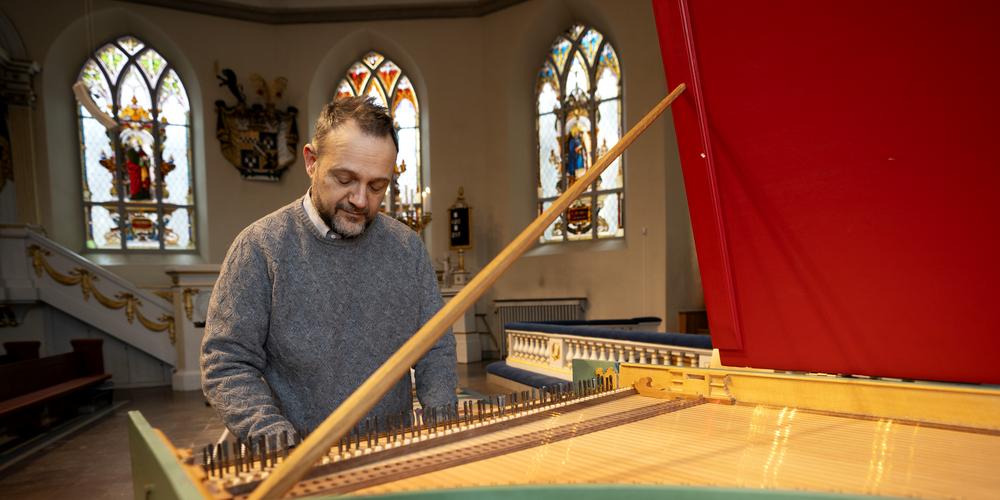
The claviorgan in the German Church was built for the Göteborg Baroque Ensemble and was completed in 2019. It was part of the research project "Gamla" instrument med ny affordans (‘Old’ Instruments with New Affordance), Joel Speerstra explains.
– Within the scope of the newly formed REM@KE we plan to build yet another claviorgan. This time it will be a replica of an instrument constructed in 1781 in Augsburg by the prominent keyboard instrument maker Johann Andreas Stein (1728–1792). It was none other than Patrick Alströmer, Director of the Swedish East India Company, founder of the Royal Swedish Academy of Music as well as a member of the Swedish Academy of Sciences, who some time at the end of the 1700s imported the instrument, which was later purchased by the wealthy Hall family.
Today, this claviorgan resides in the Museum of Gothenburg, which is a partner in the project, says Eleanor Smith-Guido, Assistant Researcher at the Academy of Music and Drama.
– The instrument is quite special, partly because it has several tones per octave, and partly because the organ part can be placed behind the musicians, which projects the music toward the audience. Stein was a creative instrument maker who made significant developments to the fortepiano, making it more expressive, and contributed to what would eventually become our modern piano. We know that Mozart visited Stein’s workshop, so he probably also played his instruments, even though this has not been corroborated. As far as we know, there are only three Stein combination instruments left: the claviorgan here in Gothenburg, as well as two harpsichord-piano combinations in Naples and Verona.
You can either only play the harpsichord part or the organ part, or both at the same time.
But no music written specifically for claviorgans has been preserved. In all probability, the musician would improvise the music or rearrange known pieces for the instrument, says Eleanor Smith-Guido.
– In partnership with the Museum of Gothenburg and the Gothenburg Research Infrastructure in Digital Humanities (GRIDH) I will develop a sociogram, i.e. a map detailing where in the city the instrument has resided and who has played on it. And I will also try to solve the mystery of what music was performed on it.
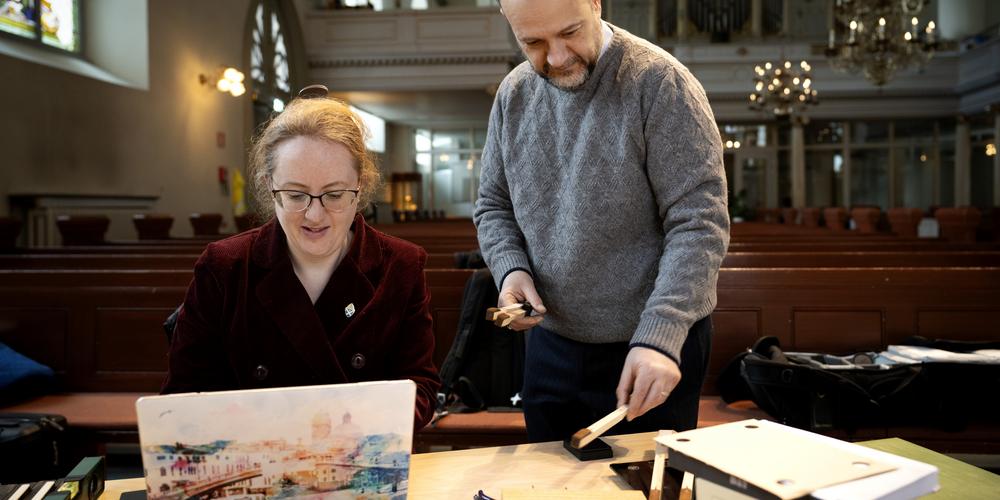
One important aspect of REM@KE is to build replicas of instruments that have not been copied before, which will lead to entirely new types of knowledge, Eleanor Smith-Guido explains.
– For example, we will investigate the meaning of embodied knowledge, where you learn how an instrument operates by working with the material, figuring out different solutions and personally experience what is easy or difficult, instead of just reading the literature. The same goes for the audience who will of course have a completely different experience when they listen to music played on an actual instrument, which they are also able to touch and feel, instead of merely seeing it in a museum. What happens in the mind, both with builders, musicians and audiences, is something that cognition scientist Andrea Schiavio, University of York, will be studying in depth.
In addition to the claviorgan, the project also includes a pianino built by the Parisian piano company, Pleyel.
– These instruments were known throughout the 1800s for their subtle dynamics and excellent sound. For example, Chopin complained in a letter about his Pleyel piano being delayed: “I dream of music but am unable to make any”.
The project also includes an Italian spinet, with its typical curved side and built by prominent keyboard instrument maker Girolamo Zenti (circa 1609–1666), says Joel Speerstra.
– The instrument is often associated with Bach. We will be making two copies to examine how having different instrument makers can affect the end product. The fourth instrument is a harpsichord, build by the German master Christian Zell (circa 1683–1763).
The project has several parts to it, such as a gender aspect, says Eleanor Smith-Guido.
– These types of expensive instruments were often played in the opulent lounges of the well-to-do classes, often by the wives or daughters of wealthy landowners or merchants. So there are probably many interesting stories to unearth.
Text: Eva Lundgren
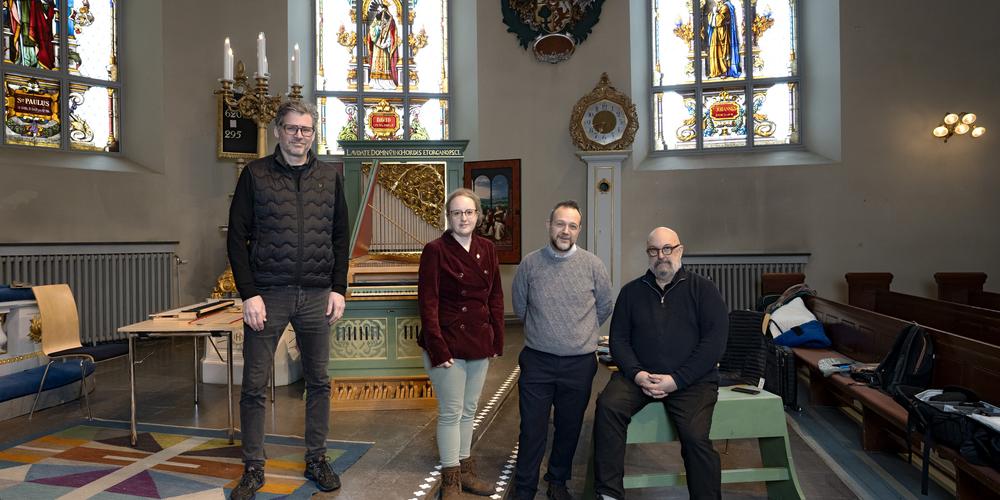
REM@KE — Reconstructing Embodied Musical Knowledge at the Keyboard was officially launched on 20–21 November 2025. The unique project will build replicas of four historical keyboard instruments: a claviorgan, a spinet, a harpsichord and a pianino.
It is not only about recreating the objects themselves but also about understanding how the instruments interact with everyone, from instrument maker and musician to teachers and listeners. The six-year project brings together expertise within organology, musicology, cognitive science, artistic research, restoration, applied cultural heritage, computer science, digital humanities and acoustics.
The project is a partnership between the Academy of Music and Drama (lead researcher Joel Speerstra), Università di Pavia (lead researcher and project coordinator Massimiliano Guido) and the University of York (lead researcher Andrea Schiavio). The European Research Council provides over 8 million euro in funding.

