
Frans Stålfelt: Measuring airborne particles in the operating room can improve patient safety
Surgical site infections after orthopaedics implant surgeries can lead to serious complications, significant suffering, prolonged recovery, and increased mortality. Reducing the number of airborne bacteria in the operating room can help lower the number of affected patients. The doctoral thesis identifies and evaluates risk factors and highlights the importance of continuously monitoring airborne contamination.

FRANS STÅLFELT
Dissertation defense: 24 october 2025 (click for details)
Doctoral thesis: Detection and surveillance of exogenous contamination in orthopaedic surgery
Research area: Orthopaedics
Sahlgrenska Academy, The Institute of Clinical Sciences
During surgery, there is always a risk that bacteria may enter the wound and cause a postoperative surgical site infection (SSI). In orthopaedics, this becomes particularly serious if bacteria adhere to the surface of the protheses or implants, where they can form biofilm which makes it difficult for both antibiotics and the patient’s own immune system to eliminate them. In many cases this requires the implant to be surgically removed, which causes significant suffering for the patients, as well as a burden on the healthcare system.
Frans Stålfelt’s research focuses on how to reduce the risk of postoperative infections. These infections are often caused by bacteria from external sources, so-called exogenous contamination, which may be spread by particles from staff or introduced when doors are opened during surgery.
– By measuring airborne particles from the environment in real time and understanding these risks, we hope to prevent infections and thereby improve patient safety, says Frans Stålfelt, biomedical engineer at the orthopedic research unit at Mölndal Hospital, and a doctoral candidate at the Institute of Clinical Sciences.
Feedback from sensors improves routines and workflows
Existing conventional methods for measuring airborne contamination are both time- and resource-intensive. In one of the doctoral thesis’s sub-studies, a newly developed monitoring system was evaluated for its methodology and efficiency in measuring exogenous contamination in the operating room.
Another sub-study focused on evaluating three variables: the number of staff present during surgery, the frequency of door openings, and the duration of the procedure.
– The results show that it is possible to monitor the risk of infection by using sensors that measure airborne particles, door openings, and the number of people in the operating room. These measurements can provide real-time feedback, making it possible to quickly detect risky situations and improve routines and workflows. This in turn reduces the risk of bacteria spreading to the patient.
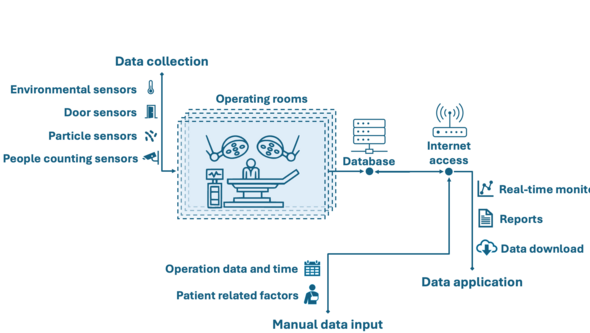
Illustration from the doctoral thesis: The monitoring system collects information from different sensors during surgery and stores everything in a shared database. With secure connectivity, the data can be accessed remotely and used in several ways, for example to track particle levels and door openings in real time, or to analyze patterns and trends afterwards. In addition to the data collected by the sensors, staff can also enter supplementary information about each surgery, which is then stored in the database.
Troubleshooting and improvements have taken much time
What has been the most rewarding and most challenging part of the PhD project?
– The most rewarding part has been to step into a clinical environment as a biomedical engineer. It also feels meaningful to work on something that, in the long term, could help strengthen patient safety, a thought that makes the work especially motivating. The most challenging part has been getting everything set up and functioning properly. Since this is a newly developed surveillance system in a prototype stage, a lot of time has been spent on troubleshooting and making improvements along the way.
Text: Susanne Lj Westergren