
Camilla Wallmander: nutritional problems, malnutrition and reduced quality of life common in head and neck cancer
The research in Camilla Wallmander’s doctoral thesis focuses on the nutritional challenges faced by people with head and neck cancer, even many years after completing treatment. The aim was to improve and further develop nutritional care for affected patients and thereby enhance their quality of life.

CAMILLA WALLMANDER
Dissertation defense: 20 March 2026 (click for details)
Doctoral thesis: Nutritional aspects and challenges of head and neck cancer
Research area: Otorhinolaryngology
Sahlgrenska Academy, The Institute of Clinical Sciences
Patients with HNC (head and neck cancer) often experience eating difficulties due to treatment side effects and the tumor’s location, often in the oral cavity and throat. Common nutritional problems include pain, dry mouth, chewing and swallowing difficulties, difficulty opening the mouth, changes in taste and smell, and loss of appetite. The disease and its treatment may also cause inflammation that accelerates the breakdown of the body’s own tissues, primarily muscle mass.
– The nutritional problems make it difficult for patients to eat enough energy and nutrients, which can lead to weight loss and loss of muscle mass. Patients with head and neck cancer are therefore at high risk of developing disease-related malnutrition, says Camilla Wallmander, dietitian at the Department of Otorhinolaryngology at Sahlgrenska University Hospital and a doctoral student at the Institute of Clinical Sciences.
High risk of developing disease-related malnutrition
– The aim of the research has been to contribute new knowledge in the field of nutrition in head and neck cancer in order to improve and develop nutritional treatment for these patients. Among other things, we examined the effects of radiotherapy combined with chemotherapy or antibody therapy, focusing on weight loss and quality of life in patients with advanced head and neck cancer.
The researchers also mapped changes in body composition and the prevalence of malnutrition at five time points over the course of one year.
– We also investigated whether an exercise program could reduce the loss of muscle mass and alleviate fatigue, that is, extreme tiredness. Finally, we mapped nutritional problems, dietary adjustments, body composition, and quality of life in head and neck cancer survivors more than five years after diagnosis, when tumor follow-ups at the specialist clinics had ended.
Possible to regain muscle mass
A high proportion of patients who underwent radiotherapy combined with chemotherapy or antibody therapy developed malnutrition, particularly toward the end of the treatment period, when approximately 70 percent were assessed as malnourished.
– At the end of the treatment period, patients also experienced the greatest loss of muscle mass. However, at the follow-up three months after treatment initiation, this decline had stopped, and a recovery of muscle mass was observed. This recovery continued until the final follow-up one year after treatment initiation.
Combination treatment negatively affected quality of life
In line with previous studies, patients with malnutrition reported poorer quality of life both before and after combination treatment compared with well-nourished patients. However, no differences were observed at the end of the treatment period, when all patients reported a markedly reduced quality of life regardless of nutritional status.
– We also found that an exercise program led to increased physical activity among patients with oral cavity cancer, and we observed a trend toward reduced fatigue compared with a control group.
The researchers also found that survivors more than five years after diagnosis reported poorer quality of life and more head and neck–related symptoms – such as dry mouth, sticky saliva, and swallowing difficulties – compared with reference values from a Swedish general population.
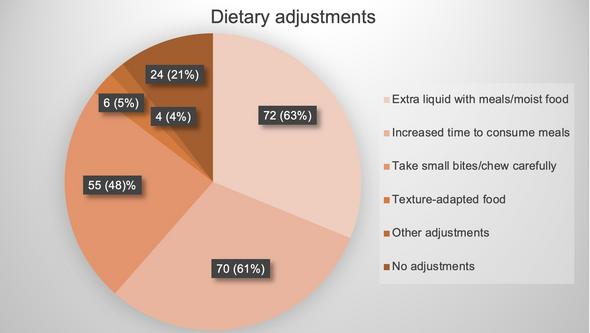
Figur from thesis: Among the 114 survivors, 87 reported a need to adjust their food to facilitate intake. These 87 survivors reported a total of 207 adjustments. “Other adjustments” included the use of saliva gel and not eating warm food.
Dietary adjustments to make eating easier
The majority of long-term survivors needed to adapt their diet to facilitate eating. The most common adjustment was drinking additional fluids with meals, followed by meals taking longer to eat and the need to take small bites and/or chew food carefully.
– For healthcare professionals, knowledge about nutritional problems and dietary adjustments among head and neck cancer survivors is valuable in order to identify patients in need of nutritional rehabilitation.
In summary, patients with head and neck cancer experienced many nutritional problems, both in the short and long term. Treatment negatively affected energy intake, body composition, and quality of life, and malnutrition was common. Evaluation of muscle mass may contribute to improving nutritional care and the assessment of malnutrition. Early initiation of nutritional treatment, continuing during and after treatment, is important, and rehabilitation may need to continue for a long time.
Meeting the study participants
What has been the most rewarding and the most challenging aspect of the doctoral project?
– The most rewarding part has been meeting the study participants, who took the time to contribute to the research and shared their experiences during a difficult period in their lives. It has also been rewarding to deepen my knowledge in areas related to my clinical work and to participate in all parts of a research project, from planning to final publication, Camilla Wallmanders says, and continues:
– Conducting a study is an extensive process that requires careful planning. Many things happen along the way that require decisions and test one’s knowledge, which has been challenging.
Text: Susanne Lj Westergren