
With love for microalgae – The Algal Culture Bank a key resource for microalgal research and learning
They produce half of the Earth’s oxygen, they play a huge role in the climate, and they can even create clouds in the sky.
“Microalgae are fascinating. They are so small, yet so important,” says Olga Kourtchenko, curator of the Algal Culture Bank at the University of Gothenburg.
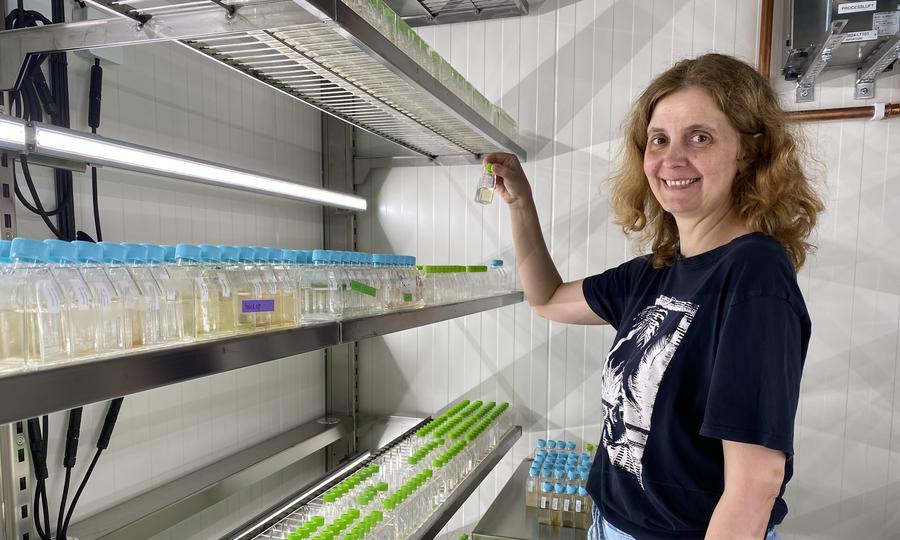
Olga Kourtchenko opens an unassuming grey door in the laboratory on the fourth floor. Next to the door is a sign stating that the temperature in the room is 10 degrees. She takes a small bottle from a shelf and shakes it delicately. Immediately, the water in the bottle turns greener than green. Chlorophyll green. The green colour of life.
”They live in the sea, but they actually produce half of the oxygen we breathe on Earth through photosynthesis. We’ve been taught that trees produce oxygen, but they’re nowhere near as efficient as microalgae. Microalgae reproduce constantly and so, in a sense, they regulate the climate,” she says.
450 unique algae in culture
Olga Kourtchenko puts the bottle back on the shelf. The whole room is filled with small bottles, each bearing clearly numbered labels: Nephroselmis minuta 44, Porphyridium purpureum 25, Tetraselmis sp 19, Prymnesium parvum 37. The Algal Bank holds 450 unique strains in culture.
The colours range from a muted lime green and withered straw yellow to earthier golden browns; other algae in the collection feature warm red hues, from sunset apricot to serene terracotta.
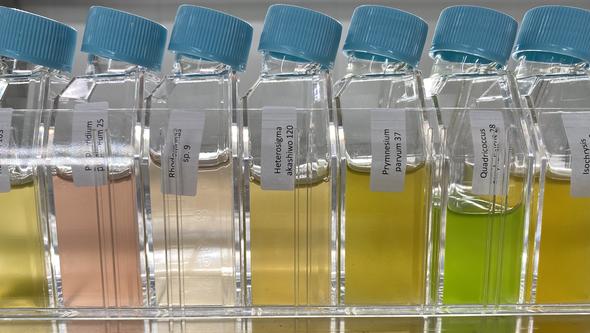
For 30 years, the Algal Bank at the University of Gothenburg has been supplying various marine microalgae for research and teaching. The collection now comprises 450 different species, with new ones being added all the time.
It's a diverse collection from a taxonomic and evolutionary perspective, comprising both free-living and parasitic – as well as toxic – species. For example, it includes Heterosigma akashiwo, a species that causes harmful algal blooms all over the world. However, almost 80 per cent of the collection consists of local species from Scandinavian waters, primarily diatoms.
“Our oldest alga is a diatom, ‘Phaeodactylum tricornutum’, from Plymouth, UK, which is over 100 years old. It dates back to 1910. This species is the first genetic model for diatoms. The most recent alga was collected in 2026 off the coast of Tjärnö and has not yet been added to the list.”
Resource review highlights the importance of the Algal Culture Bank
Invisible to the naked eye, they drift aimlessly about in the sea without any particular direction – yet microalgae are of great importance to the Earth’s environment and climate. Microalgae are key organisms on Earth, and scientists still know only a fraction about their various properties and how they interact with their surroundings.
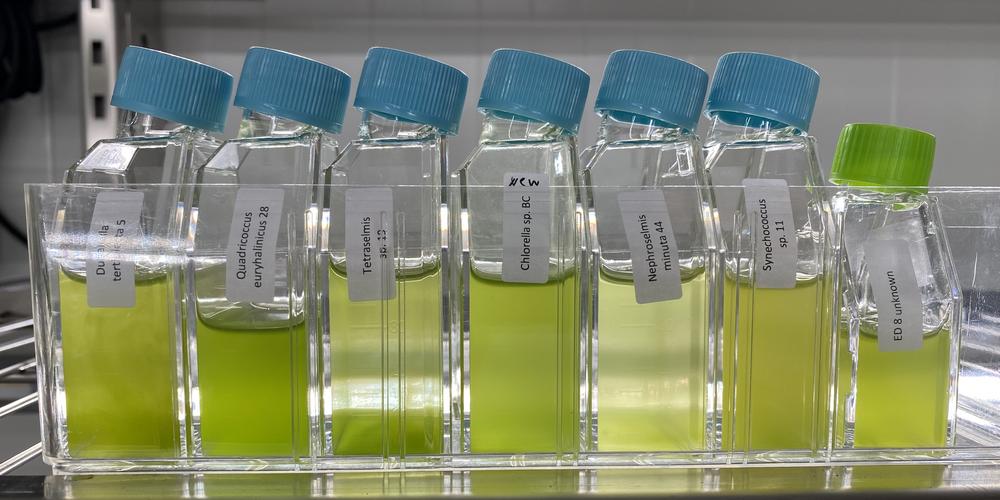
“Microalgae are truly fascinating. They are single-celled organisms, represented in all branches of the tree of life. They play a fundamental role in ecosystems and in the Earth’s climate. They can purify wastewater, reduce eutrophication and mitigate climate change. They can also produce organic compounds that contribute to natural cloud formation and can consequently have an impact on the weather,” says Olga Kourtchenko.
A resource review was recently published in the scientific journal Algal Research on the importance of the Algal Culture Bank. It shows that the strains have contributed to research in taxonomy, pigment analysis, ecophysiology, climate change biology, genomics, environmental monitoring, biotechnology, and bio-inspired materials.
Teacher training course raised interest for algae in schools
The resource review also highlights the importance of Algbanken in ensuring that algae are used to increase ocean literacy in schools and museums.
“Interest grew enormously when Professor Angela Wulff launched the university courses ‘The Sea in the Classroom’ and ‘Algae in the Classroom’, which attracted teachers from all over Sweden. Nowadays, 75 per cent of our orders fall into this category. I find it rewarding that pupils ask questions about eutrophication and climate change and are interested in marine life,” says Olga Kourtchenko.
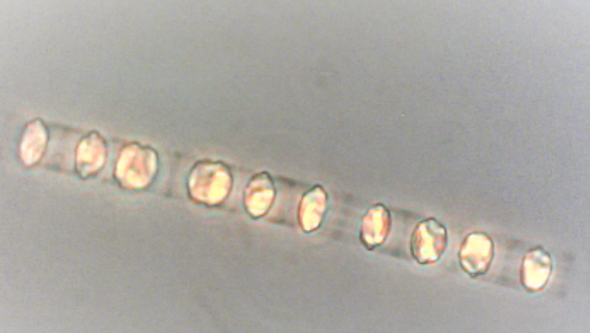
The biggest museum partnership is with the Universeum science centre. In the activity ‘Plankton Under the Microscope’, children and adults learn about the crucial role microalgae play in the Earth’s oxygen production, carbon dioxide uptake, and as the basis of the marine food chain.
“Universeum displays our algae on huge screens. All of a sudden, our microscopically small algae – which we usually keep tucked away in remote closets – find themselves in the public eye, depicted in large photographs. It’s awesome!”
Algae need love and care
The algae in the culture bank are living organisms. They require constant monitoring in accordance with strict procedures in order to survive and grow. This is also one of the major challenges facing the Algal Culture Bank. It's labour-intensive, resource-demanding and requires both love and care, sterile plastic culture flasks and climate-controlled rooms.
Olga Kourtchenko relentlessly feeds the algae with light, nitrogen, phosphorus, vitamins and various trace elements such as iron.
Despite all the love, the cultures are vulnerable. To contamination, for example. Sometimes a strain of algae simply dies, without it being possible to understand why. In that case, there is no choice but to start again, collect new samples, and then isolate them cell by cell under a microscope. A time-consuming effort.
“A single drop of water can hold several thousand microalgae. It may be dominated by one or more species of microalgae, sometimes as many as 10–12. It takes time and persistence to sort them, and it’s easy to lose track of time when looking at them under the microscope because they’re so fascinating with their amazing shapes and different colours,” says Olga Kourtchenko.
Link to the resource review in Algal Research: The Gothenburg University Marine Algae Culture Collection (GUMACC): A Nordic resource for marine microalgal research, biotechnology and education
Writer: Annika Wall
The Algal Culture Bank was founded in 1996. The main purpose is to provide researchers and teachers at the University of Gothenburg with marine microalgae for use in teaching and research. External researchers and organisations may also order cultures from the collection at a fixed cost. It is free of charge for schools and museums in Sweden.
The Algal Culture Bank’s public database contains detailed information on the strains currently listed. The database includes search and ordering functions.
The Algal Culture Bank holds 450 unique strains of marine microalgae, with a focus on Scandinavian waters. The diatom Skeletonema marinoi is one of the most common, with 285 strains.
The resource review in Algal Research is a joint effort between researchers directly involved in The Algal Culture Bank either isolating or studying the strains at The Department of Marine Sciences and The Department of Biology and Environmental Sciences at the University of Gothenburg: Olga Kourtchenko, Giorgia Carnovale, Angela Wulff, Ana Tronholm, Adil Y. Al-Handal, Monica Appelgren, Cornelia Spetea Wiklund


