
Researchers Explore the Role of Social Work in Democracy
What role does social work play in a democratic society? Researchers at the University of Gothenburg explore this question in a new book.
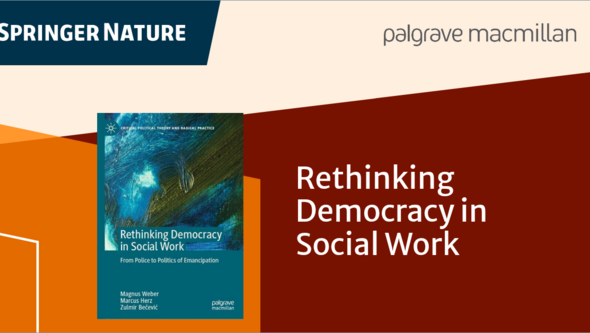
In the book Rethinking Democracy in Social Work: From Police to Politics of Emancipation, researchers Magnus Weber, Marcus Herz and Zulmir Bečević examine the relationship between democracy and social work.
What is the book about?
Social work is an enormously important force in building and safeguarding democracy. Its primary role is not to integrate people into the democratic system, which has been a fairly common approach in democracy-promoting work, for example in efforts to address violent extremism. We argue that democratic social work is instead about enabling people to make their voices heard and to influence, and perhaps even challenge, the system – within the relatively broad boundaries of democracy.
What does it mean to challenge the system?
In practical terms, it means supporting people both economically and socially so that they have the conditions they need. Social workers can also support people with similar experiences in organising around shared problems, such as housing shortages, cutbacks or discrimination.
By showing that what is sometimes interpreted as individual failure is actually the result of structural disadvantage, and by encouraging people to organise collectively, social work can become a force for a stronger democracy.
How should social workers work differently?
Social workers should not focus solely on solving individuals’ problems within existing systems. They should also reflect on how power, inequality and social structures affect people’s lives.
The book calls on social workers to create the conditions for people to make their own voices heard, participate in democratic processes and influence decisions that affect them.
Why are these issues particularly urgent now?
Democracy is in decline around the world, and anti-democratic forces are gaining ground in many democratic countries. This makes questions about how to build a strong democracy, and the role social work should play in that process, particularly urgent.
How do we build a strong democracy today?
Democracy is never finished. It requires openness to criticism and disagreement, and it cannot be separated from questions of social and material justice.
For social work, this means that democracy is not only an ideal to defend, but a practice that must be enacted and renewed every day.
How did the book come about?
After completing my doctoral thesis, I had a strong desire to explore the question of democracy in greater depth, something there had not been room for in my thesis. I therefore contacted my colleagues Marcus Herz, Professor of Social Work, and Zulmir Bečević, Associate Professor and Senior Lecturer in Social Work.
Together, we began exploring the concept of democracy from the perspectives of social work and political theory.
About the Book
Rethinking Democracy in Social Work: From Police to Politics of Emancipation
The book explores the relationship between social work and democracy. The authors discuss how social work can give people greater opportunities to make their voices heard and influence the decisions that affect them, and why democracy needs to allow room for criticism, disagreement and change.
Authors: Magnus Weber, Marcus Herz and Zulmir Bečević, Department of Social Work, University of Gothenburg
Publisher: Palgrave Macmillan, 2026
Read more about the book at Springer
Publishing and Text Editing: Louise Älgne
Social work involves supporting people who need help in their everyday lives and addressing social problems. This includes work in the social services, where social workers meet people who need support with issues such as finances, housing, substance use problems or family problems.
Master's Programme in Social Work and Human Rights, 120 credits
A master's programme in social work and human rights, addressing issues including welfare, poverty, rights and participation.


