
Red algae dulse thrives in fish wastewater
Faster growth and increased protein content – that is the result when red algae dulse is cultivated in process water from the Swedish herring industry. In addition, the algae absorbed some of the nutrients that otherwise contribute to eutrophication of the sea.
"A very good result," says Kristoffer Stedt, researcher at the Department of Marine Sciences.
The dark red alga Palmaria palmata, also known as dulse, is perhaps most closely associated in appearance with red cabbage, to choose one example from the traditional Swedish Christmas buffet. But it is herring—another classic dish—that plays the central role in experiments conducted by Dr. Kristoffer Stedt in recent years.
The research has now yielded clear results: cultivating dulse in process water from the Swedish herring industry gave its growth a significant boost.
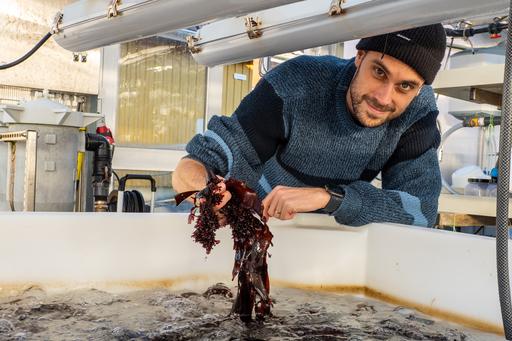
"Dulse is a very exciting algae with high potential to become a more attractive foodstuff in the future. Unlike many other algae species, it does not have a distinct marine flavour; instead, it is known as the bacon of the sea. When dried, it takes on a smoky umami flavour," says Kristoffer Stedt, who cultivates dulse in 1,000-litre containers in one of the labs at the Tjärnö marine laboratory.
"And if we are to be able to sell algae as food, it is obviously an advantage if it tastes good."
Shocked dulse with nutrients
He wrote his doctoral thesis at the University of Gothenburg on algae as a future source of protein, but did not have time to test the cultivation of dulse at that time. There was also some uncertainty about how it would react to the high nutrient content in process water from the herring industry.
"Unlike the more opportunistic green algae, which have the ability to adapt to different environments, dulse in Sweden usually grows in a more stable environment. We didn't know if it would be able to cope with such a shock. There is around twenty times more nutrition in this water after we have diluted it compared to what they have in the sea," says Kristoffer Stedt.

However, the results of the experiment, which are also described in a recently published scientific article, speak for themselves. The growth of dulse was more than twice as high when it was cultivated in herring water. In addition, the protein content increased by up to 76 per cent compared with algae grown in seawater
"This is very positive. If we are to use this as a future food source on a larger scale, we obviously want it to have as high a protein content as possible."
Can counteract eutrophication of the sea
Another effect was that the content of potentially toxic substances, such as heavy metals, decreased in the dulse grown in herring water.
"We believe that there may be a dilution effect, as it grows so quickly. The iodine content in dulse is not a problem either; you would have to eat 200 grams of fresh dulse to reach the recommended daily intake of iodine, which is quite a lot," says Kristoffer Stedt.
The cultivation also helps to reduce eutrophication of the sea, as the algae absorb some of the nutrients in the process water.

The next step is to test whether mussels and oysters can be cultivated in the same water. They can filter out the larger particles of nutrients that algae cannot absorb through their cell walls.
Today, process water is purified in the conventional manner before being discharged.
"The hope is that we will be able to build a pilot plant with a circular system for purification and production in collaboration with Sweden Pelagic in Ellös. We want to see that it works in practice, not just in a laboratory environment," says Kristoffer Stedt.
Text: Mikael Andersson
Found along the Atlantic and northern Pacific coasts, it is the only species of the genus Palmaria found along the Atlantic coast of Europe, from Portugal to the Baltic Sea, as well as along the coasts of Iceland and the Faroe Islands.
It grows on hard substrates such as rocks and stones, as well as epiphytically (on other larger algae) down to a depth of 20 metres.
Dulse is perennial and has cells that allow it to grow continuously. The algae can be cultivated and harvested year-round in land-based tanks by dividing the side shoots.
The algae has a high vitamin content, especially vitamins A, B1, B2, B3, B6, C and E, and also contains minerals such as calcium, magnesium, phosphorus, chromium and zinc. It also contains a lot of iodine, iron, protein and fibre.
It is mostly sold as a supplement or spice, but historically it has been used as food to a much greater extent than today, for example in Ireland.


