
Jellyfish season begins – scientists ask for help
Last season, thousands of jellyfish sightings were reported to the “Spot a Jellyfish” project. The citizen science initiative is continuing this year, and the researchers are calling for further help from the public.
“Now is the time to get out and look for jellyfish,” says Christin Appelqvist, a marine biologist at the Department of Marine Sciences.
In spring, the moon jellyfish begin to bud off from the polyps, small tube-shaped creatures that attach themselves underwater to rocks, jetties or seaweed. The polyps are the fixed stage of the jellyfish’s life cycle and can live for several years. The second stage is the free-swimming medusa, what we call a jellyfish.
In April, the moon jellyfish are very small, just a couple of centimetres in diameter. But as May approaches they grow in size and begin to appear in large shoals near the coast when the winds and currents are favourable.

Christin Appelqvist, a marine biologist at the Tjärnö Marine Laboratory, has been keeping records for several years of when moon jellyfish appear, and they usually turn up as early as the end of March.
But by mid-April, she hadn’t seen any.
"I think they’re a bit late this year. However, I have seen blue jellyfish," she says.
"Spot a jellyfish" needs help from the citizens
Last year, Christin Appelqvist launched the citizen science project “Spot a Jellyfish". The project stems from her concern – and several reports in recent years – that moon jellyfish, in particular, are dying much earlier in the summer than they used to.
"I’m worried. For the past ten years, I’ve seen the moon jellyfish dying as early as the start of summer. And that shouldn’t happen in northern Bohuslän. It should feed and reproduce, and then die naturally in September or October. We don’t know what’s causing this mass die-off, and that’s what we want to try and find out."
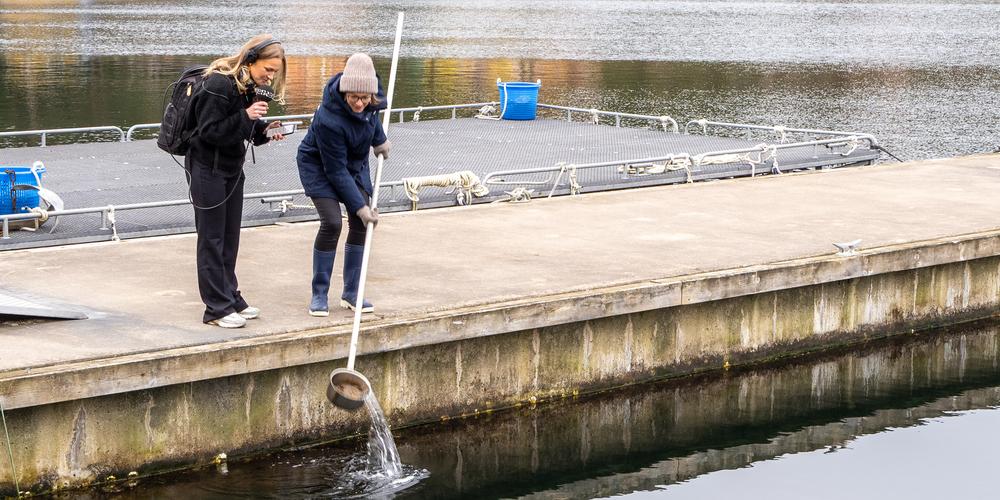
Christin Appelqvist has also, over several years, noted more and more moon jellyfish with more "ears" than the usual four. The ears are the jellyfish’s reproductive organs, and the researchers want to find out more about what might be causing this change. To gather enough data to carry out scientific studies, the researchers need help from the general public.
Looking for photos of various species
"This early in the season, it’s great if people can take photos and submit reports, as this gives me data on when they appear and when the season begins. Many people might take their dogs for a walk along the coast, and in that case, every report that jellyfish have arrived are extremely valuable. It’s not just about moon jellyfish – please feel free to send photos of any jellyfish that turn up."

The citizen science project “Spot a Jellyfish” launched last year and has received a huge response, with over 2,500 jellyfish sightings reported from all along Sweden’s coastline. Several jellyfish ambassadors have also expressed an interest in helping out.
"Generally speaking, it’s about understanding the distribution and occurrence of jellyfish, but also their general health. I can analyse this based on the photos we receive," says Christin Appelqvist.
Text: Mikael Andersson
Take photos of the jellyfish with your camera – a mobile phone is fine.
Upload the photos and details to the Inaturalist or Artportalen websites (or both). Please also note the location and time. Inaturalist is also available as an app, and you can take and upload photos directly within the app.
Researchers will then retrieve the information from there to use in their work.
The information is open to all researchers.

