
Compass jellyfish more common along Sweden's west coast
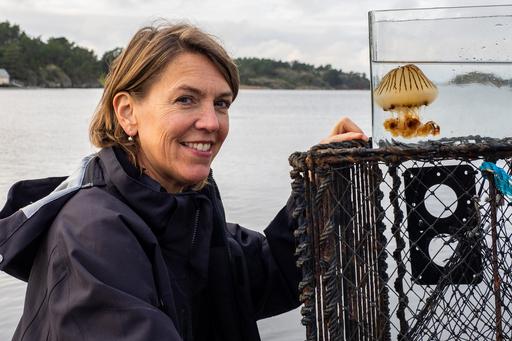
More and more sightings of compass jellyfish are being reported to Artdatabanken and Inaturalist, where anyone can submit images and text about animals and plants. Among other places, it was found at the Tjärnö Marine Laboratory during the autumn.
Christin Appelqvist, marine biologist at the University of Gothenburg, tells us more about the species.
How common is it really in our waters?
"So far, relatively uncommon. I'm not surprised to see it here in autumn, as it's usually visible at this time, but this year there have been an unusually large number. We received many reports as early as July, and it's unusual for it to visit us so early. At the same time, it's not a foreign species; it's found in the north-eastern Atlantic, from the Mediterranean up to Norway.
The Artportal has 75 reported sightings of compass jellyfish from July to early November 2025, from Gothenburg to Strömstad. In 2024, there were no reports, and in 2023, there were eight. The website Inaturalist also has significantly more reports this year compared to previous years.
What could be the reason for the increase in sightings?
"We don't really know what the cause is. In many places around the world, jellyfish seem to be increasing in general. Whether it has to do with temperature changes or that we have disrupted the ecosystem with predatory fishing and removed many predators, there are many theories, but no one really knows. They can swim but also drift with the currents, and if there is any change in them, it can also lead to more of them coming here."
Can they cause any harm?
They sting, but they have fewer tentacles than the red jellyfish. The red jellyfish can have up to 1,200 tentacles, while this one only has 24 around the edge of the medusa. So it doesn't sting on top or on the mouth arms. Its strength is similar to that of a jellyfish, but as I said, it has significantly fewer tentacles.

It´s the season for cold bathing, should winter bathers be wary?
– You can always take a look around so that you don't jump straight into it, and try to avoid swimming into it. But they are not dangerous to humans.
What will happen to this specimen?
We'll keep it here at the Tjärnö Aquarium for a while and see how long it survives. It may be in poor condition after drifting all the way here, so we'll see how it fares.
Text: Mikael Andersson
Characteristic appearance with brown V-shaped rays on the upper side of the white/yellow bell, making it resemble an old-fashioned compass. Up to 30 cm in diameter, but most commonly around 20 cm. Four long, curly mouth arms hang down below the bell.
Has 24 tentacles (up to 60 cm long) with stinging cells that can cause painful burns.
Eats small animals such as other jellyfish and marine bristle worms, which are paralysed by the poison in the stinging cells.
It changes from being male to female later in life. It is a so-called protandric hermaphrodite.
It is found in the Atlantic and Mediterranean. It sometimes occurs along the Swedish west coast. In autumn 2018, there were many sightings of this otherwise rare jellyfish.
Please report any sightings to Artportalen or Inaturalist.

