
Five Years at Sea – R/V Skagerak Heads into Dry Dock
Since its inauguration in 2021, R/V Skagerak has supported research in some of the world’s most remote marine environments. The vessel is now undergoing its mandatory five-year survey in Falkenberg. Further expeditions to Greenland, Iceland, the Baltic Sea and Svalbard are scheduled later this year.
Five years have passed since the University of Gothenburg’s research vessel R/V Skagerak was inaugurated in Gothenburg. It is now time for the vessel’s mandatory five-year class survey.
“This is something we are required to do under the regulations. All certificates must be reviewed and we need to ensure everything is in top condition,” says Richard Olsson, one of the two captains of R/V Skagerak.
In mid-February, the vessel left Nya Varvet in Gothenburg and set course for Falkenberg.
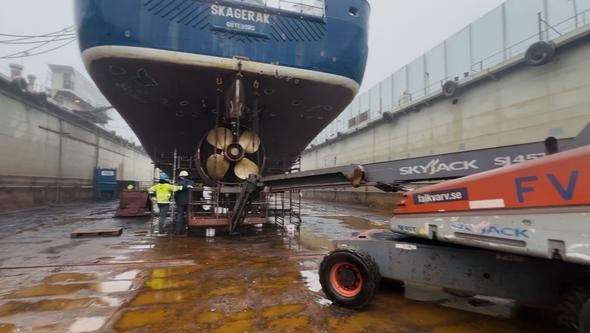
The dry docking is being carried out at Falkvarv shipyard — the same yard where R/V Skagerak was completed after being built in Poland. Delivered to Sweden just before the pandemic, the vessel was inaugurated by the University of Gothenburg in 2021.
The survey is conducted under the rules of the classification society Bureau Veritas.
“We have a five-year requirement which means the propeller shaft must be withdrawn, measurements taken and bearings likely replaced. That is the main part of the work. The hull and ballast tanks are also inspected,” says Richard Olsson.
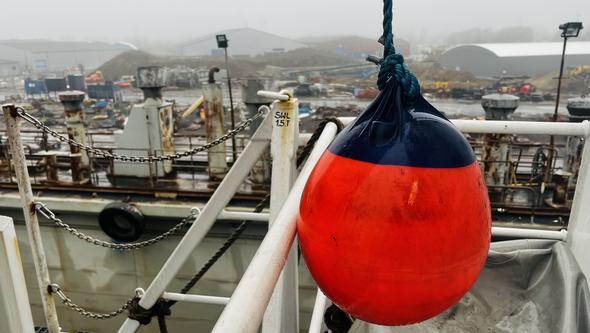
“It’s a bit like taking your car in for a full inspection, only on a much larger scale. Everything has to be checked and approved.”
The main task: the propeller shaft
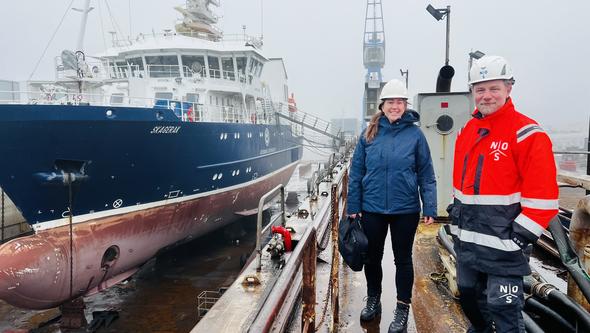
R/V Skagerak is currently supported on blocks in Dock No. 2 at Falkvarv, a facility capable of accommodating vessels up to 120–130 metres in length and lifting approximately 7,500 tonnes.
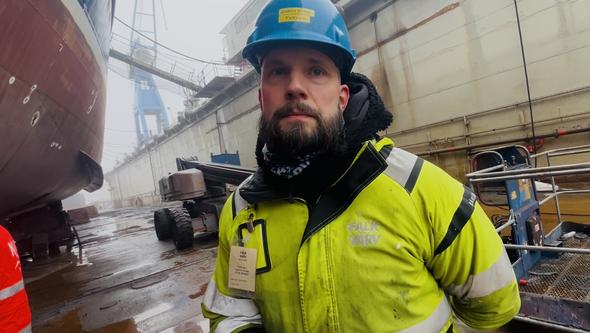
It’s a bit like taking your car in for a full inspection, only on a much larger scale
“Skagerak is actually a little small for this dock, but we dock every vessel that comes here,” says Joakim Winter, Production Manager at Falkvarv.
The work is progressing according to plan.
“We have blasted the hull and are preparing it for painting, along with carrying out other tasks typically done during dry docking. So far, everything looks good.”
The most extensive part of the operation is the removal of the propeller shaft at the stern.
“The main job is to withdraw the propeller shaft, renew the seals and have the surveyor inspect it. The shaft is taken to the workshop for cleaning and thorough examination. That is the largest part of the docking,” says Joakim Winter.
He emphasises that the vessel remains in very good condition.
“The surveyor inspected the ballast tanks and everything looks very good. It is, essentially, still almost a new vessel.”
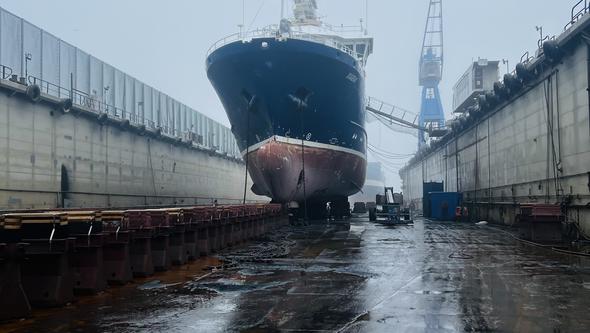
A young vessel with an impressive track record
Despite its young age, R/V Skagerak has already supported extensive research. Expeditions have taken the vessel to Greenland, Svalbard and Iceland, as well as the Baltic Sea and along Sweden’s west coast, including the Bratten area.
When R/V Skagerak returns to Nya Varvet, an intensive period awaits. The research vessel is scheduled to operate in the Baltic Sea, around Svalbard and Iceland, along Sweden’s west coast and in Greenlandic waters.
“It will be a long and exciting season — good for the vessel, for the crew and for the science,” says Captain Richard Olsson.
Longer expeditions require careful preparation.
“We mobilise all scientific equipment, load provisions and bunker fuel. In Norway and Iceland we can restock if necessary, but in Greenland there are no opportunities for us to purchase what we need. That is why we have to be thoroughly prepared from the outset.”
Ready for new research expeditions
Once the dry docking is completed, the vessel returns to operations this spring and summer.
“It feels reassuring to know the vessel is in excellent condition ahead of the upcoming expeditions,” says Richard Olsson.
With its propeller shaft serviced, hull inspected and certificates renewed, R/V Skagerak is ready to continue delivering world-class research — from Sweden’s west coast to the Arctic.
Text: Agnes Faxén


