
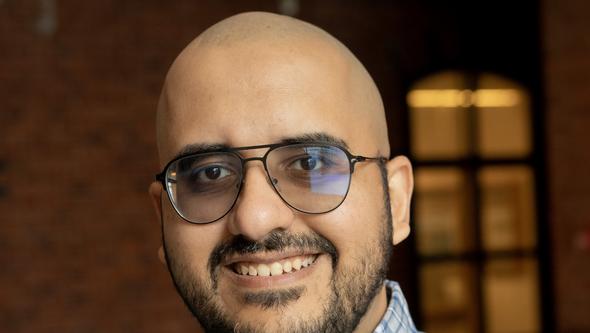
Muhammad Arif builds bridges between cells and data
He began his career developing computer networks. Today, he maps the body’s biological networks. His goal is to understand how cardiometabolic diseases develop over time and how they can be treated — long before symptoms appear.
Imagine a future where a simple blood test can reveal whether you’ve started developing a cardiometabolic disease such as fatty liver, type 2 diabetes, or coronary artery disease. Where doctors can consult AI, offer personalised lifestyle advice, and prescribe medication to the exact stage of disease progression—tailored just for you. It may sound like science fiction, but according to Muhammad Arif, this scenario is closer than we may think.
“The pace of development in systems biology, data analysis, and AI is astonishing. If you’d asked me just three years ago, I would have said it’s at least 20 years away. Now, I wouldn’t be surprised if we see the beginnings of such development, at least pilot projects, within ten years,” he says.
Untangling “data hairballs”
We meet at the Wallenberg Laboratory for Cardiovascular and Metabolic Research, where he has been appointed Associate Senior Lecturer since January. He is currently building his own research group and has just hired an associate researcher and a postdoc. His aim is to recruit his first PhD student this autumn.
“It’s challenging to recruit, to adjust into a new research environment, and to settle the family in a new city – all while trying to push my own research projects forward. But it’s also very exciting,” he says.
Understanding Muhammad Arif’s research isn’t entirely straightforward. He jokingly describes his job as untangling massive hairballs of data. In a world where data is being generated at an increasingly rapid pace, his kind of expertise is essential. People who can analyse and identify patterns using advanced data analytics. His field of expertise is network analysis and machine learning.
“In the past, it could be difficult to get biologists and clinicians to understand the value of the data-driven approach — that it can enable faster research results and offer a broader perspective. But after the COVID-19 pandemic and the record-speed development of vaccines, no one doubts it anymore,” he says.
Creating a holistic map
Muhammad Arif collaborates with a wide range of experts, from clinical researchers to systems biologists and AI specialists, to understand how cardiovascular diseases develop. His goal is to find new ways to diagnose and treat these diseases earlier, and to develop more personalised treatments.
“Cardiometabolic diseases develop over a long period and affect many tissues and organs in the body—from blood vessels and the heart, to the liver, kidneys, muscles, and gut microbiota. We’re creating a map of the entire biological system and observing how it changes over time as these diseases progress.” he says.
Muhammad Arif works with in-silico frameworks, which are computer-based models used to study biological processes. These systems can analyse vast amounts of biological data to simulate how molecules, cells, or different tissues interact. This enables researchers to study disease progression and identify biomarkers and drug targets more quickly and cost-effectively than traditional methods.
“We analyse biological data from metabolites, proteins, DNA, and RNA —from tens of thousands up to millions of data points simultaneously. Traditional research is often hypothesis-driven. We start with the whole picture and zoom in on specific parts. That way, we can generate hypotheses that can be tested both within the computer model and in more traditional preclinical research,” he says.

An unexpected opportunity
As a network engineer, it was far from obvious that he would end up in biomedical research. Muhammad Arif grew up in Indonesia and studied engineering at the Bandung Institute of Technology, located on the western side of Java. As a child, he had two major interests: football and computers.
“But I realised quite early that football wouldn’t take me anywhere, I wasn’t good enough. So, I chose computers instead,” he says with a laugh.
Since then, his interest in computers has taken him around the world. His first job as an engineer was at a data communications company in Singapore. Four years later, he moved to Europe to pursue a double master’s degree in IT, offered by the Royal Institute of Technology (KTH) and a university in Barcelona.
He had no plans to work in the biomedical field, but an unexpected opportunity arose when he met a professor at KTH in Stockholm.
“He was interested in applying network analysis to biological systems, which I found exciting. I became a research assistant in his lab for about eight months. Eventually, he offered me a PhD position and became my supervisor. Since then, research has been a part of my life.”
From the US to Gothenburg
Muhammad Arif earned his PhD in 2021 from KTH, with a thesis on systems and network analysis in cardiometabolic diseases. Among other things, he studied what happens in different tissues during a heart attack.
Before moving to Gothenburg, he spent three and a half years as a postdoctoral researcher at the National Institutes of Health (NIH) in the United States, located in Maryland just north of Washington DC. He worked in two different labs—one focused on cardiovascular diseases and the other on pulmonary fibrosis.
His decision to take the next step in his career in Gothenburg was largely influenced by the Wallenberg Laboratory, which he describes as a unique research environment.
“It felt right for me and my family to move back to Sweden. We really enjoy living here. There’s a good balance between work and leisure. I believe perseverance is one of the most important qualities in a researcher, and I enjoy working hard. But to be persistent, you also need to be able to relax,” he says.
Open to new ideas
For Muhammad Arif, relaxation means spending time with his family, watching football, going for walks, and playing games. He feels that research has changed him in several ways, including his lifestyle.
“I used to smoke and was a real couch potato. Research helped me understand more deeply how it was impacting my body, and that scared me. I quit smoking, started dieting and working out, and lost about 30 percent of my body weight,” he shares.
He also believes research has made him more open-minded. If he could give one piece of advice to his younger self ten years ago, it would be to be less stubborn.
“When I was younger, I tended to be quite self-centred, which made me stubborn. So, one piece of advice would be to be more flexible. There are many people with great ideas—sometimes better than your own. So listen, take it easy, process all impressions, and try to be more accepting of new ideas.”
TEXT AND PHOTO: KARIN ALLANDER


