Jincy Philip: How bubbles and extracellular vesicles shape peri-implant healing
How does the body decide whether to integrate an implant or trigger inflammation? Jincy Philip studies the tiny interface where materials meet soft tissue, revealing how gas bubbles and extracellular vesicles influence immune signals and tissue repair.

JINCY PHILIP
Dissertation defense: 12 December 2025 (click for details)
Doctoral thesis: : Inflammation and immunomodulation related to materials and extracellular vesicles
Research area: Biomaterials
Sahlgrenska Academy, The Institute of Clinical Sciences
At the Department of Biomaterials, Sahlgrenska Academy, Jincy Philip investigates how cells communicate at the narrow interface where prosthetic implants meet soft tissue. Her research focuses on material-derived gas bubbles and small signaling particles called extracellular vesicles (EVs), and how the signals they carry influence healing or trigger chronic inflammation.
Cells acting like a conducted orchestra
Cells closest to implant surfaces appear to sense the properties of the material. Jincy Philip likens this to cells “reading the script,” then passing signals on to more distant cells – “like directing the orchestra.” She explains that this interplay can lead to tissue regeneration or chronic inflammation, “like nice or awful pieces of music.”
“This may seem simple to uncover, but getting details from such tiny environments in living tissue is challenging,” says Jincy Philip, molecular biologist at the Department of Biomaterials and doctoral student at the Institute of Clinical Sciences.
Bubbles that activate healing pathways
One part of the thesis examined the effect of gas bubbles formed as degradable magnesium implants break down. These bubbles trigger a complex local response that contributes to tissue repair.
“The bubbles provide mechanical cues and activate pathways linked to inflammation and cytoskeletal organization, including interferon regulatory factor-7 (IRF7). Spatial transcriptomics and other techniques helped us map these responses in detail,” she says. “The results are important for the future implementation of spatial omics and device development in both industry and clinical settings.”
How EV signals shape tissue response
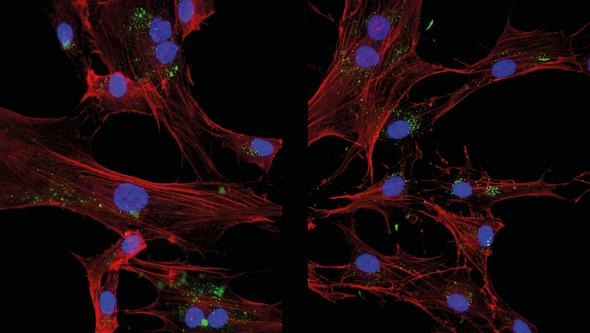
Another part of the research focused on how EVs derived from macrophages (immune cells that coordinate inflammation) affect mesenchymal stem cells and tissue responses around titanium implants.
“MSCs efficiently internalized M1 macrophage-derived EVs and showed strong IRF7 expression. In vivo, these EVs promoted a transient pro-inflammatory state, while M2 macrophage-derived EVs led to a less inflammatory, but more pro-fibrotic response. The findings contribute to the development of EV-based and implant-adjunct therapies across regenerative medicine.”
What has been enjoyable, rewarding, and challenging about your doctoral project?
“There have been challenges in finalizing some parameters in the experimental plan, such as EV dose and time points. We did some pilot studies that helped address this,” says Jincy Philip, and continues:
“The most rewarding aspect is the thesis itself, which took shape after working through various challenges in both the practical lab work and the writing process.”
Text: Jakob Lundberg