
Henrik Sjövall: Performing arts, medical arts, and “the Magic If”
Listening, changing roles, and finding the right tone all take practice. In this column, Henrik Sjövall argues that healthcare has much to learn from the performing arts.

Every patient conversation should begin with empathy; understanding the patient’s situation forms the foundation for any analytical work. When it comes to training in shifting between empathic immersion and distant analytical perspectives the theater is actually on the leading edge. On stage, one must both establish clear boundaries and be able to improvise within them.
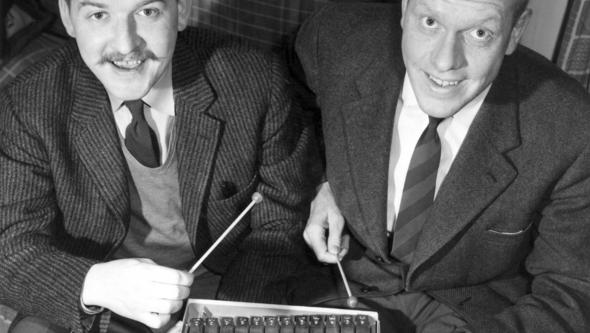
Do you remember Hasse and Tage? They often didn’t know exactly what would happen once they got on stage. When Hasse said something particularly odd, Tage would sometimes respond, “Oh, so that’s the mood you’re in today?” This phenomenon – when what happens on stage is carefully rehearsed yet still unpredictable – is referred to in theater as “the Magic If.”
I am reading Victoria Brattström’s impressive doctoral thesis, “Putting Healthcare Centre Stage ” (När livet står på spel – En treaterkonstnärlig studie av Partnerskap i hälso- och sjukvården). As I interpret it, her work explores how to create a “magic if” in our patient encounters.
She describes how she first got the idea while reading about person-centered care, and began to wonder whether her experience as a theater director – interpreting a play script – could be used to understand what happens in a clinical conversation.

A play script contains only the words – the dialogue – of the situation performed on stage. This means the text leaves significant room for interpretation by both actors and director. It is this process of interpretation – trying to understand the text – that actors and directors engage in during rehearsal. Brattström’s research idea was to apply that model to patient conversations: record a few real consultations, transcribe them, and then give those texts to actors to see what would happen.
How is a “Magic If” created? And could it also occur in our patient encounters?

In her dissertation, Victoria combines the Russian teorist and theater practitioner Konstantin Stanislavski’s methods with the French philosopher Paul Ricoeur’s theory of text interpretation. She describes her work as a reading of Stanislavski’s acting techniques in light of Ricoeur’s philosophical anthropology – his reflections on what it means to be human. According to Victoria, Stanislavski can be seen as a sort of “Carl Linnaeus of the theater.”
By developing his system of acting techniques, Stanislavski sought to renew the theatrical aesthetics of his time, which he found overly mannered and artificial. He wanted audiences to recognize what they saw on stage as something drawn from real life. To achieve that, both directors and actors, he argued, needed to focus on genuine human interaction – on what happens between people outside the theater. They should invest time and energy in truly inhabiting a scene and its situation “as if” it was real, and then observe what emerges from that process – rather than starting with a predetermined presentation of the role to be neatly packaged for delivery to the audience.
Stanislavski also emphasized the director’s dual role as leader and interpreter of the text. As director, Victoria explains she imagines several possible developments within a text before deciding on the path the performance will take. In essence, Stanislavski’s method asks the actor to enter the role with body and soul and then observe what happens. To manage this process systematically, and to recreate a scene that is performed night after night while still feeling alive and spontaneous, Stanislavski developed a tool he called “the Magic If.”
As a physician reading this, without any formal training in theater, I wonder: does a “Magic If” ever occur in our patient encounters? Do we dare to leave that kind of open space? And perhaps most importantly – could medicine learn something essential from the performing arts?
In her dissertation, Victoria also highlights one of Ricoeur’s intriguing concepts: the “surplus of meaning.” It reminds us that the script is only a skeleton that must be fleshed out through tone, gesture, pauses, and movement. Interpretation – the meaning of the text – varies widely depending on who interprets it and in what context. A new interpretation of the same text can completely change the tone of a conversation – as in the earlier example, “So that’s the mood you’re in today?” – and sometimes such a shift is precisely what is needed for a good patient encounter.
We simulated nearly everything that could go wrong in a conversation
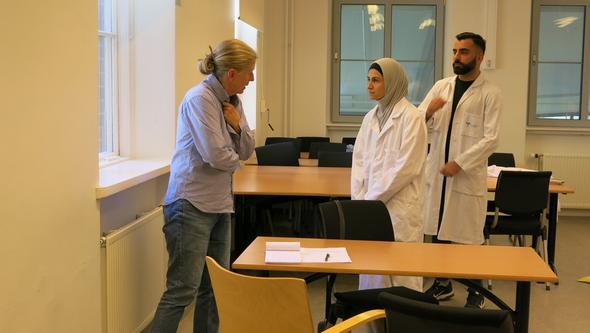
You may wonder how I came to be interested in theater theory. A few years ago, I met Victoria on a bus after a narrative medicine workshop, and we began to talk. I was lamenting that some of my medical students struggled to handle external pressures – such as time constraints or demanding staff. “I wish there was a way to simulate that,” I said. “Then you’ve met the right person,” she replied. The result was an unforgettable forum theater exercise, in which we simulated nearly everything that can cause a conversation to go wrong – time pressure, anxious relatives, multiple illnesses, psychiatric considerations. And on that improvised stage, the Magic If definitely was in play – none of us who had prepared the cases, not even the actors or Victoria, knew what would happen. But something truly did happen.
Back to the dissertation. At the Sahlgrenska Academy, doctoral candidates are generally expected to conduct some form of empirical study, collecting observations of some kind. Victoria did that too – but in a rather unorthodox way. She recorded three authentic healthcare encounters, distilled and transcribed the dialogue, and gave it to a group of actors. With a minimum of stage directions, the actors interpreted and embodied the text, switching roles between patient and healthcare professional. Victoria observed, recorded, and later interviewed them about how they experienced the emersion and embodiment of their characters. She could then compare what unfolded on stage with what had occurred in reality – with or without a “Magic If.”
A role that inhabits an actor’s body and soul
The final third of the dissertation consists of a critical discussion of the findings and their relevance for improving communication between patients and healthcare professionals. When an actor embodies a role on stage, Victoria writes, we say the actor “makes themselves available” to the role. But it can also be seen the other way around – the role makes itself available to the actor. When things go well in the theater, the role inhabits the actor’s body and soul. Neither the actor nor the director knows exactly what will happen next, and that uncertainty brings a vital sense of immediacy to every performance.
What does this have to do with patient encounters? As Shakespeare wrote, “All the world’s a stage, and all the men and women merely players.” We have our professional roles, our patient roles and our personalities; along with our knowledge, these are the tools we use to navigate medical situations – what theater calls “the given circumstances.” None of these personal factors are fixed; like Hasse Alfredsson, we have our moods and day-to-day variations. So do our patients. Victoria Brattström writes that healthcare professionals must listen in a way that creates mutual understanding and trust, yet within their professional role also be able to step back, reflect and analyze what the patient is saying based on their expertise.
Sometimes we need to change roles for things to work. Trying to enter the patient’s role can often clarify a situation. The ability to shift between analytical perspectives and empathic engagement is a skill cultivated in acting. As Brattström shows, that is equally relevant to healthcare encounters. Providing care requires a complex interaction between patients and professionals. And where does one train such skills? In theater school, of course. My reflection after reading her dissertation is that perhaps we should ask for their help more often when teaching communication.
Finally, a comment on why this matters. In my view, healthcare’s weakest point is how we handle patients for whom we find no clear physical cause. Conditions such as post-COVID syndrome, cognitive fatigue, burnout, chronic pain, and IBS – all present significant symptoms but often only allow for supportive conversations with the patient Delivering a credible, reassuring message in such cases is difficult, and it is not uncommon for patients to leave still worried.
Perhaps, then, we should try a different strategy – creating a “Magic If” together with the patient – and see what happens.
Writer: Henrik Sjövall
Retired University Hospital Chief Physician and Professor Emeritus
Sjövall has read Victoria Brattström's thesis När livet står på spel – En teaterkonstnärlig studie av partnerskap i hälso- och sjukvården (When lives are at stake – A theatrical artistic study of partnerships in healthcare) The thesis is only available in Swedish.
