
Exploring the importance of language in biology education
Science education needs to become more accessible, and language may be key to achieving that. According to biology teacher Charlotte Lennartsdotter, subject-specific language plays an important role in students’ learning in biology. In her doctoral thesis, she explores this connection.
During her years as a lower secondary school teacher, Charlotte Lennartsdotter noticed that something was not quite working in her teaching. Her students were able to collect data in the field and carry out investigations, but found it more difficult to present their results in written reports. Many also struggled to read scientific texts and use the correct terminology.
“I began to wonder whether language itself was the obstacle. Biology is a concept-heavy subject, but we do not always teach students how to use subject-specific language,” says Charlotte Lennartsdotter.
Differences between high- and low-performing students
She noticed that students particularly struggled to move from the concrete to the abstract, where concepts and relationships are used to reason about biological processes.
“Assessments such as PISA and TIMSS show that there are wide gaps between high- and low-performing students. I believe language is a crucial factor. Some students grasp the language on their own and manage regardless of how the teaching is organised. But many do not and need support,” says Charlotte Lennartsdotter.
She adds that knowledge of subject-specific language in science is important beyond the classroom.
There is a risk that a lack of understanding of science can lead to resistance to facts in society, as people may struggle to take in research on issues such as climate change or biodiversity. Understanding the language of science can make these issues more accessible.”
Combining an interest in education and science
Charlotte Lennartsdotter is an upper secondary school teacher of biology and Natural science, but has worked as a lower secondary school teacher for more than 15 years. Her interest in research in biology was sparked during her Master’s studies in limnology – the study of inland waters – and her ambition to develop her teaching has followed her throughout her career. Through the Graduate School CUL (Centrum för utbildningsvetenskap och lärarforskning), she now has the opportunity to combine her interests in the two fields.
“One of the most rewarding aspects of pursuing a PhD is engaging with ongoing research in both education and biology.”
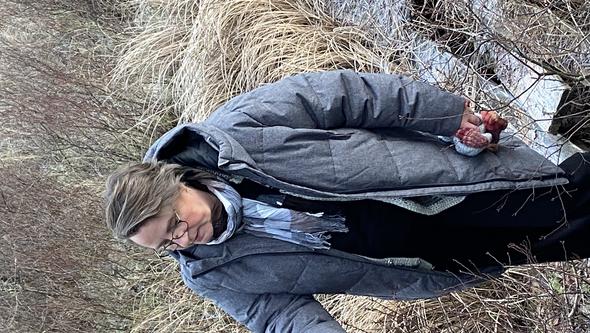
She describes her time as a doctoral student as both rewarding and demanding. At the same time, she highlights the value of the graduate school and the importance of being able to collaborate with other doctoral students.
“The graduate school functions as a large network where we support and help one another.”
Examining how teachers work with subject-specific language
In her thesis, Charlotte Lennartsdotter conducts a survey and interviews with biology teachers to examine how they work with subject-specific language in their teaching. The next step is to test this approach in a classroom setting, where she collaborates with teachers to explore how linguistic perspectives can be integrated into biology education.
“Above all, I want my research to benefit teaching and to contribute a different perspective on what science education can look like.”
Text: Natalija Sako
Age: 59
From: Jönköping
Interests: Natural sciences, nature, animals and literature
Fun fact: Spent 12 seasons as a volunteer at the music festival Roskilde festival

