
Ankur Pandita: The role of blood vessels in the growth of metastases
Ankur Pandita’s thesis investigates which immunotherapy-related side effects are associated with improved survival in people with malignant melanoma. It also examines whether intussusceptive angiogenesis occurs in melanoma metastases-that is, whether blood vessels within metastases split longitudinally, allowing faster access to the bloodstream and potentially facilitating spread.

ANKUR PANDITA
Dissertation defense: 22 May 2026 (click for details)
Doctoral thesis: Immune mechanisms for response and angiogenesis in metastatic melanoma
Research area: Oncology
Sahlgrenska Academy, The Institute of Clinical Sciences
Malignant melanoma is one of the most serious types of skin cancer. Most patients with localized disease are cured by surgery, while metastatic disease can be difficult to treat.
"Despite major advances in immunotherapy, treatment only works for about half of patients. Immunotherapy overstimulates the immune system so that it can detect and kill cancer cells. However, an overactivated immune system can also attack normal tissues and cause side effects," says Ankur Pandita, MD, oncologist at Sahlgrenska University Hospital and a doctoral student at the Institute of Clinical Sciences.
There are still important knowledge gaps regarding why only some patients respond to treatment, and which mechanisms influence survival.
"My research focuses on immunotherapy-related side effects and how they may signal treatment response. Some side effects appear to reflect a sufficiently strong immune activation to also effectively attack the tumor. By understanding these side effects better, we hope to help patients who currently do not respond to immunotherapy."
Tumors require blood vessels to survive
Tumors require blood vessels to survive, and if these vessels can be blocked, tumors can in principle be “starved.” However, despite melanoma being highly vascularized, it responds poorly to anti-angiogenic treatments.
"I have also studied how melanoma metastases form blood vessels. Current treatments target a form of angiogenesis where new vessels sprout from existing ones, but despite melanoma metastases being rich in blood vessels, these treatments are often ineffective."
One possible explanation is an alternative process in which a vessel instead splits into two by forming a so-called pillar bridge. This process is called intussusceptive angiogenesis (1), or splitting angiogenesis, and is a relatively understudied form of vessel formation.
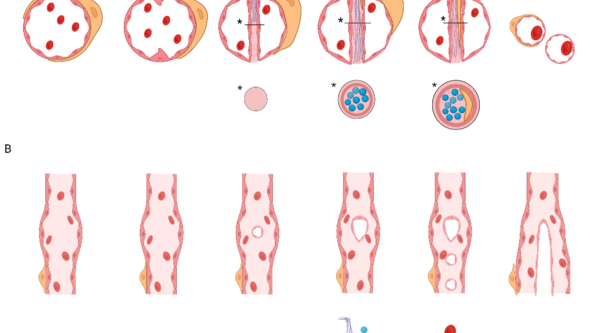
Figure from thesis: Schematic overview of intussusceptive angiogenesis. (A) Cross-sectional views of a blood vessel undergoing intussusceptive angiogenesis, illustrating pillar formation. (B) Longitudinal sections of the same vessel. Created with BioRender.com.
A beneficial side effect may be mistaken for tumor growth
"We also found that certain immune-related side effects are associated with improved survival. One particularly interesting side effect is sarcoid-like reactions (2), where all patients in our study were alive without signs of active tumor disease or relapse after seven years of follow-up."
This side effect is particularly interesting because it is mild and often asymptomatic but may be mistaken for tumor progression since it is often detected incidentally on imaging.
"Biopsies from these incidental findings show clusters of immune cells rather than tumor cells. The mild symptoms combined with an effective anti-tumor response made this side effect especially interesting for us to study using advanced laboratory techniques such as immunofluorescence (3) and single-cell RNA sequencing (4)."
Thanks to a unique biological material collected by the research group over a ten-year period, it is now possible to show that specific immune cells increase in the blood during active side effects and decrease once the side effects resolve. The same signals were identified in tissue biopsies from patients with these side effects.
Blocking the formation of new blood vessels in metastases
Another important finding in the thesis is that melanoma metastases can form blood vessels via intussusceptive angiogenesis, a process that has been less studied in cancer.
"In our study, we found that the immune system as well as specific enzymes in the supporting tissue—matrix metalloproteinases (MMPs)—are important for this process. We also showed that MMP inhibitors can block pillar formation in cell experiments, making them potential future treatments targeting intussusceptive angiogenesis."
What has been the most rewarding and challenging part of your PhD project?
"In my research, I have had the opportunity to work both with patient-centered clinical research and research in the lab at a very detailed level. Combining these perspectives has been very rewarding, even though it has sometimes been challenging to learn new methods and to remain patient when things do not go as expected," says Ankur Pandita, and continues:
"What has also struck me is how many people are working on similar questions from different angles. Being part of this network, where clinical work, laboratory research, and different scientific approaches come together, has been both inspiring and very enjoyable."
Text: Susanne Lj Westergren