
The hidden role of alternative religions
Henrik Bogdan conducts research on alternative religious traditions such as occultism, Freemasonry, esotericism, closed orders, and magic; movements long dismissed as heresies or pseudoscience, but which have had an enormous impact on our culture. In his latest book project, he gives a voice to Leah Hirsig, a female leader within occultism in a male-dominated world.
As a professor of religious studies, Henrik Bogdan works partly in the borderland between religion and science. He has a particular interest in alternative religious currents such as esotericism, new religious movements, and closed societies and orders.
– There have always been practices and traditions that challenge the religious or scientific norm. But not many have looked closely at these movements, since they have often been regarded as heresies, pseudoscience, or superstition. It is exciting to examine traditions and interests that previously received little attention.
Esotericism is an umbrella term for a wide range of currents that Bogdan studies, with alchemy, astrology, New Age, occultism, and modern witchcraft being just a few examples. These are very different types of spiritual practices, all involving elements of self-development, and they have influenced society more than many realize.
– Many of these currents were prominent and influential and made an impact in a wide range of fields. For example, Theosophy, which in the 19th century had great influence in intellectual circles and the spiritual landscape of Europe, the U.S., and even India. These movements were not reactions against modern society but rather part of it, as they were often shaped by ideals linked to democracy, human rights, or women’s suffrage.
Central figure in Thelema
If we hold too simplified a view of these movements, we risk missing important insights, Bogdan argues. He explains that there are strong connections between Western esotericism and many influential cultural figures of the 19th and 20th centuries.
– August Strindberg and William Butler Yeats were deeply involved in occult currents. If we ignore that, we miss much of the symbolism expressed in their literature. Another example is the artist Hilma af Klint, who had a strong interest in spiritual and occult movements, something clearly reflected in her paintings. Hilma af Klint is now part of our cultural canon. This shows that what was once criticized, mistrusted, and dismissed has today even become part of our cultural heritage.
Bogdan’s latest book project focuses on Leah Hirsig, who in the early 20th century was a central figure in the controversial religion Thelema. Together with Manon Hedenborg White at Malmö University, Bogdan has produced an annotated edition of Hirsig’s diaries and selected letters, offering a multifaceted portrait of one of the few female leadership figures within occultism.
Relationship with Aleister Crowley
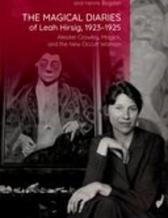
Leah Hirsig had a relationship with the poet and occultist Aleister Crowley, who saw himself as the prophet of the new religion, and together they founded a monastery in Sicily. She lived an unusually independent life, especially for a woman of her time. Yet until now, accounts of her life have been overshadowed by Crowley’s story.
– We wanted to let Leah Hirsig’s voice be heard, to highlight the importance of her spiritual leadership in a male-dominated world. She was active at a time when new ideals of ‘the new woman’ were emerging, and she asserted the right to her own sexuality, practiced yoga and meditation, used drugs, and created various rituals, entirely on her own terms.
But her life was not easy: as a woman who challenged social norms, she was highly vulnerable, and she and Crowley often struggled financially. At times, desperation shines through in her diary entries, including when she plans for her own death, which she is convinced will come soon.
– As long as Crowley was interested in her, she was elevated. But when he met another woman, she was replaced overnight. Hirsig eventually broke with Crowley and left the occult milieu, but her importance to the movement was immense and deserves recognition.
Editor for international book series
In addition to his research, Henrik Bogdan devotes much time to working as editor for two international academic book series, which have grown steadily in recent years: Oxford Studies in Western Esotericism (Oxford University Press) and Palgrave Studies in New Religions and Alternative Spiritualities (Palgrave Macmillan). This role gives him insight into the forefront of research in these fields but also influences how they develop.
– It’s important for Swedish scholars to be visible in international research environments, even though such work takes time and is not directly rewarded within academia.
Selecting among the many strong book manuscripts is no easy task, especially since interesting research alone is not enough; there must also be a market for the book.
– At first, I thought most manuscripts were good and should be published, but I’ve learned to look more at what the content contributes in a broader perspective. I think, in general, researchers need to get better at conveying the relevance of their research. That is one of many things I’ve learned from being an editor, he says.
Text: Ulrika Ernström
Texten publicerades ursprungligen i GU Journalen #6, december 2025
Henrik Bogdan is co-author with Manon Hedenborg White of The Magical Diaries of Leah Hirsig, 1923–25: Aleister Crowley, Magick, and the New Occult Woman, published by Oxford University Press.