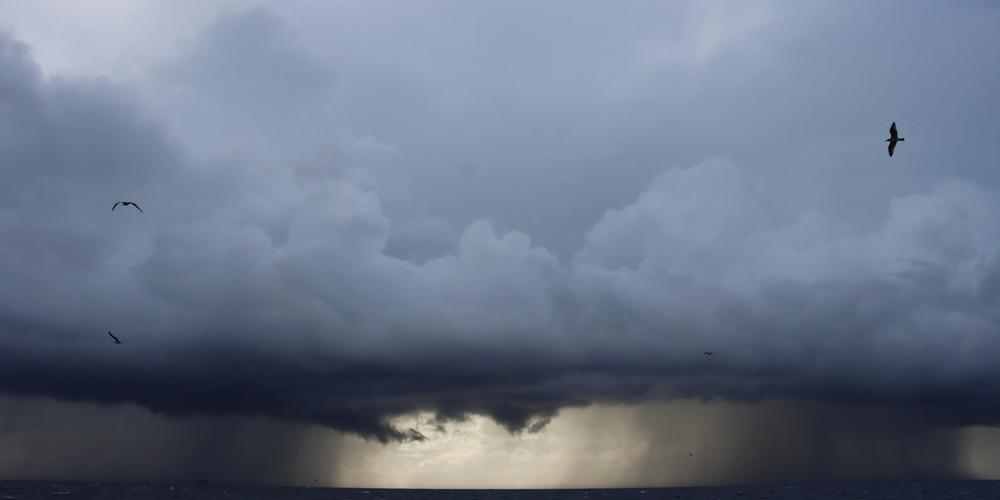
Expedition braved rough seas – success aboard R/V Skagerak
Strong winds, powerful currents and lost equipment – nothing could stand in the way of an ocean expedition in the Skagerrak.
Over eleven days, Swedish, German and Norwegian researchers worked together to investigate how different water masses mix – processes that influence the entire Baltic Sea’s ecosystem and circulation.
“We need more knowledge about how different water masses mix and change when they meet,” says Göran Broström, Professor of Oceanography and leader of the Swedish part of the international research project SkaMix@UGOT.
“These are processes of gigantic proportions, affecting everything from oxygen levels in the Baltic Sea to how nutrients are transported,” he continues.
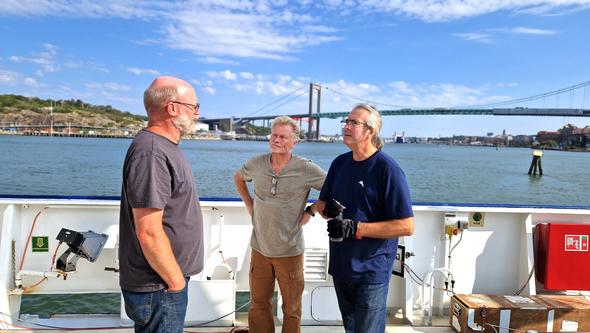
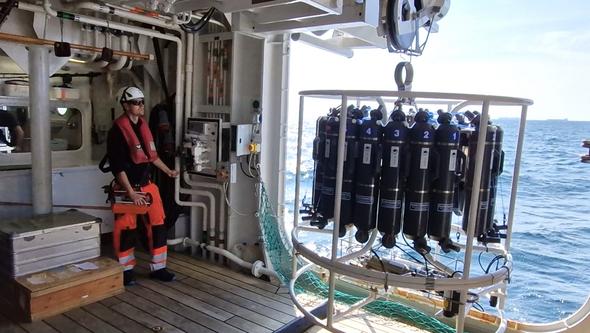
To study these complex systems, the expedition departed from Nya Varvet in Gothenburg on 10 September. On board, detailed measurements of temperature, salinity, currents and turbulence were carried out in the area between Skagen and the southern Norwegian coast.
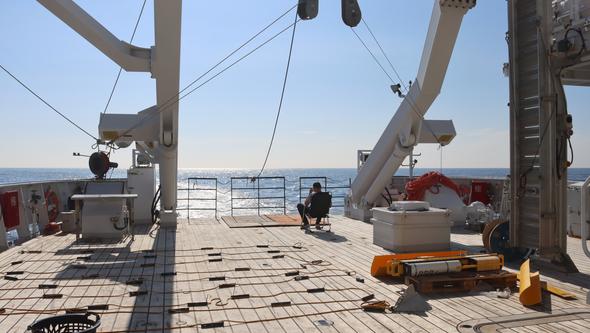
Two ships – one joint experiment
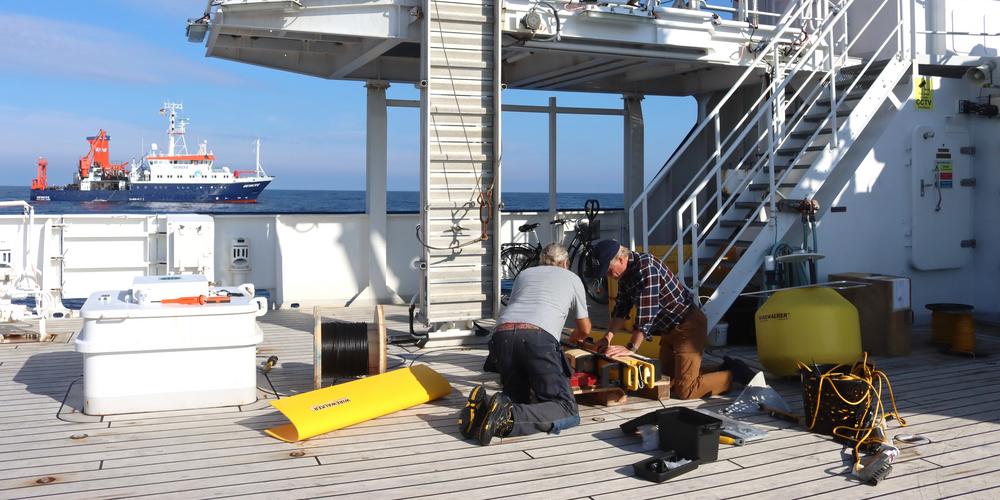
The expedition was part of an international collaboration with the Leibniz Institute for Baltic Sea Research (IOW) in Germany, whose vessel R/V Heincke conducted parallel measurements across the Jutland Current.
For several days, the two vessels sailed side by side to examine how mixing processes vary at very small scales.
“What’s unique here is that we can measure the same front with two ships simultaneously. This allows us to see how the sea changes on scales down to about one kilometre – what we call the submesoscale. Such details can’t be captured by models or with a single vessel,” explains Göran Broström.
The project also involves SMHI, Norwegian research groups working on ocean current modelling, and the Swedish initiative VOTO, which contributed a glider and a sail buoy measuring wind, temperature, salinity and chlorophyll in the surface water.
Rough seas – but valuable data
After a few days at sea, conditions became increasingly challenging. With winds reaching up to 15 metres per second and waves around two metres high, several planned measurements had to be cancelled, and one turbulence instrument was lost to the sea.
Despite these setbacks, the researchers managed to collect a large and valuable dataset using CTD profiles and microstructure sensors to map turbulence and water stratification.
“It was tough at times – we had to think on our feet and change plans several times – but we still managed to gather very good data,” says Broström.
Following a short stop in Lysekil for a crew change, R/V Skagerak continued north along the Swedish west coast to study the coastal current, while R/V Heincke operated closer to Denmark. Even when rough weather forced the ships to part ways, both managed to complete their missions.
International collaboration for greater understanding
The study is part of a three-year international project in which researchers from Sweden, Germany and Norway are now analysing the collected results. The work is expected to contribute to a better understanding of how the Skagerrak’s dynamic water systems affect circulation and ecosystems throughout the Baltic Sea region.
“Through this collaboration, we gain a much more detailed picture of ocean dynamics. For Sweden, it’s quite unique to take part in such high-resolution ocean measurements,” says Göran Broström with a smile.
“But don’t forget your seasickness pills before going on an expedition like this,” he adds.
Text: Agnes Faxén