
Researcher takes the spotlight for the sake of science
Despite setbacks, suspicions and direct threats, Professor of Ecotoxicology Bethanie Carney Almroth remains in the spotlight.
“If the researcher doesn’t take that place, someone else will.”
IT’S SUMMER IN GENEVA. Outside the UN’s European headquarters Palais de Nations, a large pile of plastic spreads out beneath the six metre high sculpture The Thinker’s Burden. The work, which depicts Rodin’s Thinker sitting atop Mother Earth with a plastic bottle in one hand and a baby in the other, has been installed in the context of the ongoing UN negotiations (INC 5.2) on a global plastics agreement.
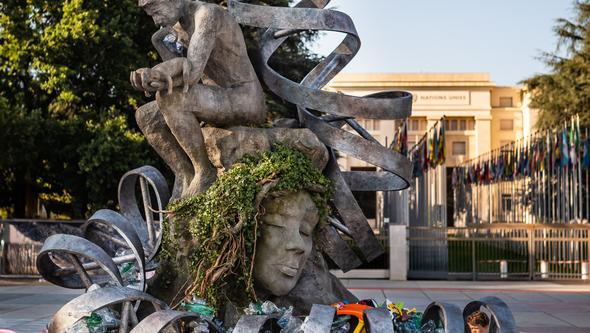
Inside the building, representatives from 184 countries have gathered to negotiate a legally binding agreement that will cover the entire life cycle of plastics. Professor of Ecotoxicology Bethanie Carney Almroth will be there to support negotiators with scientific expertise throughout the process. She also acted as a sounding board for the artist, who increased the amount of plastic under the sculpture on a daily basis during the negotiations.
What was intended as the culmination of three years of negotiations ended in an anticlimax. No agreement was reached, and the talks were postponed. Bethanie describes this as disappointing, but not a failure.
“Accepting an ineffective agreement would have been a failure,” she explains. “Now, more than 85 countries have stood up and said no to a bad agreement that was not in line with research and evidence. I see that as a win.”
Fifteen years ago, Bethanie became interested in microplastics and chemicals in plastics, having previously researched other types of pollution. At the same time, she started working with outreach, first as an advisor to decision-makers at municipal level and then at national and global levels. She also makes regular contributions as an expert in the media.
At the UN negotiations, she represented the Scientists’ Coalition for an Effective Plastics Treaty, a network she co-founded after the first INC meeting in Uruguay 2022 to support negotiators with facts and evidence. According to Bethanie, plastic pollution is a complex problem that requires several efforts in parallel.
“Plastic is literally everywhere on the planet: in the atmosphere, in the deep oceans and inside our children. It affects hormonal systems, metabolism, fertility, children’s development, the nervous system and IQ, and has been linked to various diseases.”
BETHANIE EXPLAINS THAT, in addition to the 1,200 toxic chemicals we know about in plastics, there are another 10,000 that we lack data for.
“So, we’re being exposed to substances that we have no knowledge about. The worst affected are people in countries that work with production, live near the factories or handle the waste. There are many inequalities in this respect, and people have different levels of protection, rights and security throughout the chain.”
For Bethanie, it goes without saying that the consequences of plastic pollution need to be made clear, and that the injustices which often affect people who are unable to raise the alarm themselves must be highlighted. For example, she might suggest policy measures such as reducing plastic production, but is careful to base all her statements on research.
However, being a strong voice in the public debate is not without its challenges, and Bethanie has encountered resistance from lobbyists and industry representatives who often want to play down the risks. She has been watched and attacked and has often been accused of being an activist.
“If research shows that there are harmful substances in plastics and I suggest that these substances should be removed, does that make me an activist? I don’t respond to the allegations in any other way than always making statements based on evidence and research. I’m also careful about the contexts in which I appear. I might meet with civil society organisations and review their information as an expert, but I never attend demonstrations, simply so that I don’t risk my credibility or give the industry an opportunity to accuse me of being biased.”
AT PREVIOUS UN NEGOTIATIONS in April this year, the attacks went so far that Bethanie and her colleagues were harassed by lobbyists shouting in their faces. The network reported the incident to the UN, which demanded an apology from those responsible. Since then, things have calmed down for Bethanie personally, but not for her colleagues from other countries.
“Threats and harassment against researchers are nothing new. We’ve seen it in connection with tobacco, pesticides and the climate, and now also with plastics. It’s a societal problem. Researchers must be able to contribute knowledge without risking reprisals.”
Within the network, researchers have created safety strategies in case they are exposed, such as moving in groups or being careful with information security. At the same time, Bethanie says that researchers have a responsibility to participate in the public debate and to contribute with a scientific perspective.
“If we aren’t there, the gap will be filled by actors without a scientific basis who risk spreading misinformation or, at worst, disinformation. Research must benefit society.”
Text: Natalija Sako
THEN: Even before the word ‘researcher’ was coined, many people questioned the established worldview and the view of knowledge. In the 16th century, people like Galileo Galilei were able to show that nature could be understood through measurable laws rather than theological interpretations. However, sharing their research was risky. Galileo was silenced and put under house arrest by the Church for his theories about the Earth revolving around the sun.
NOW: Researchers are now a natural part of public debate. Just like Bethanie Carney Almroth, many researchers participate not only in scientific journals but also in the media, on social media and in meetings with politicians. At the same time, increased visibility brings new challenges, and researchers are forced to navigate a media landscape where facts are questioned and the tone can be harsh. The debate about where the line between activism and research actually lies is also very much alive today.
THE FUTURE: Technologies such as AI are changing the conditions for both research and public debate. AI is already widely used in research, and at the University of Gothenburg and Chalmers University of Technology, for example, work is underway to create a robot that can produce Nobel Prize-worthy research. At the same time, AI-generated content is becoming increasingly common in both social media and traditional media. Perhaps the future role of the researcher needs to move away from producing knowledge, towards valuing knowledge and putting it into context?