Professor Bengt Kristensson Uggla receives HM The King's medal
Bengt Kristensson Uggla has been awarded H.M. The King's medal for meritorious research in philosophy and theory of science. In his role as philosophical advisor, he has been central to the Center for Person-centred Care GPCC and the development of person-centred ethics.
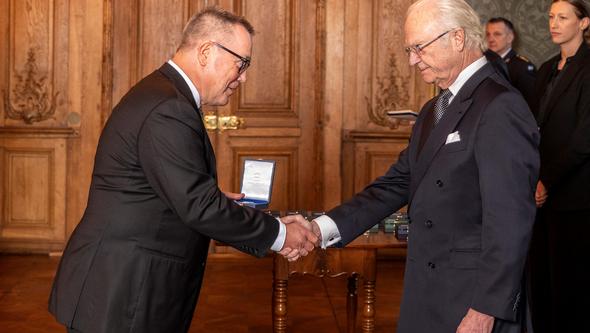
On Karl Day 2026, HM The King decided to award Professor Bengt Kristensson Uggla HM The King’s Medal (8th size, ribbon of the Order of the Seraphim) for meritorious research in philosophy and theory of science. He received the medal from HM The King at the Royal Palace on 4 February 2026.
Bengt Kristensson Uggla has served as GPCC’s philosophical advisor since the Centre’s inception and has contributed to the development of person-centred care as an ethics of practice with a clear foundation in philosophy of science and ethics. He is the author of several books on philosophy of the person and is one of the initiators of - and a teacher on - the postgraduate course Concepts of Importance for Person-centred Care – Philosophical Foundations. Bengt is also Amos Anderson Professor of Philosophy, Culture and Management at Åbo Akademi University.
Bengt Kristensson Uggla's significance for GPCC and person-centred ethics
Inger Ekman, Professor, founder and former Centre Director of GPCC, congratulates Bengt and highlights his invaluable contribution to GPCC and person-centred ethics. “Bengt Kristensson Uggla, as philosophical advisor, has been of fundamental importance to GPCC’s consolidation and development from its establishment in 2010 to the present day. Person-centred care is an ethics of practice guided by the philosophy of Paul Ricoeur, and Bengt has been an important support in the strategic leadership work on how person-centred ethics should be understood, applied and implemented. Together with GPCC representatives, he has led and contributed to a number of seminars on person-centredness and its philosophy-of-science grounding - both at Sahlgrenska Academy and across Sweden, including on several occasions during Almedalen Week. Bengt’s ability to move across different fields of knowledge has fostered innovative research within GPCC and collaborations across faculty boundaries, including projects involving both law, arts and medicine. Over the past ten years, Bengt has also been the principal lecturer on our doctoral-level course in philosophy of the person and has developed the course content. The course has been very popular, attracting applicants from all over Sweden as well as from other countries.”
Axel Wolf, Professor and current Centre Director of GPCC also congratulates Bengt Kristensson Uggla. “His expertise and long-standing experience within GPCC are central to our continued development of the ethical and action-philosophical foundation of person-centredness.. As we further develop person-centred health and social care at the intersection of precision health, digitalisation and governance, Bengt’s ability to connect philosophy of science, ethics and practice is particularly important - not least in continuing to evaluate the ethical potential of person-centredness on the system level.”
H.M. The King's Medal was first awarded in 1800 by Gustav IV Adolf and was previously called the Court Medal. It is awarded for special merit, for meritorious work within the Royal Court and H.M. The King's staff.
Bengt Kristensson Uggla on person-centred care:
Uggla, B. K. (2022). What makes us human? Exploring the significance of Ricoeur's ethical configuration of personhood between naturalism and phenomenology in health care. Nursing Philosophy, 23, e12385.
Putting Healthcare Centre Stage (collaborations with the Academy of Music and Drama)
Information about Bengt Kristensson Uggla:
Book published in English: Science as a Quest for Truth - Cambridge Scholars Publishing