
Martin Österbrand: When puberty comes too early – or too late
Martin Österbrand's doctoral research focuses on two groups of children: very young girls who show signs of puberty much earlier than expected, and boys with delayed puberty and how this affects their quality of life. His findings provide new insights into both conditions and may help improve clinical care.

MARTIN ÖSTERBRAND
Dissertation defense: 3 December 2026 (click for details)
Doctoral thesis: Pubertal disorders. Clinical and epidemiological aspects of premature thelarche and evaluation of testosterone treatment in boys with delayed puberty
Research area: Pediatrics
Sahlgrenska Academy, The Institute of Clinical Sciences
Martin Österbrand's thesis addresses two areas of pediatric medicine. The first concerns very young girls, between 9 and 48 months of age, who show unusually early signs of puberty. The second focuses on boys with delayed puberty who may benefit from testosterone treatment to accelerate pubertal development and improve their quality of life.
Very young girls with early signs of puberty
Early breast development before puberty is known as premature thelarche. It is common during the first six months of life, when girls experience a phase known as mini-puberty. Breast development usually subsides after this period. However, in some girls, it persists or appears later in childhood, often prompting a visit to the doctor. In most cases, the condition is harmless, but occasionally it may be an early sign of precocious puberty, which can be treated with medication that delays further pubertal development.
– Early breast development in very young girls, before the onset of normal puberty, is a relatively unexplored area. When parents notice breast development in their one- or two-year-old daughter, they often become concerned. As a result, many of these girls are referred to a hospital for further evaluation, says Martin Österbrand, pediatrician at NÄL Hospital in Trollhättan and doctoral student at the Department of Pediatrics, Institute of Clinical Sciences.
The main aim of the studies on premature thelarche was to investigate estrogen levels in girls aged 9 to 48 months, since estrogen plays a key role in triggering normal puberty in girls. Another objective was to determine how common premature thelarche is at 18 months of age.
– One important goal was to establish an upper reference limit for estrogen levels in girls with breast development who do not go on to develop progressive puberty.
The results showed that girls with early signs of breast development had measurable estrogen levels comparable to those seen at the onset of normal puberty. However, breast development at 18 months of age was uncommon, affecting only 1.6 per 1,000 girls. Of these, approximately 1 per 1,000 girls was referred to a pediatric clinic for further investigation.
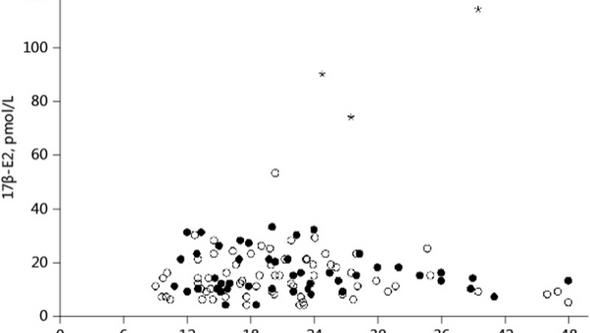
From thesis: For the 128 girls in the study, on the x-axis age in months is presented and on the y-axis estrogen levels. The 3 girls with early puberty are marked by * and the girls with discrete breast development are marked with ○. The girls with more advanced breast development are marked with ●.
Boys with delayed puberty
– Another important part of the research was to evaluate boys with delayed puberty or slow pubertal progression, both from a medical perspective and in terms of their quality of life. The study was particularly relevant because the testosterone preparation traditionally used for treatment, testosterone enanthate, is no longer available through regular prescriptions in Sweden and can only be prescribed under a special license. Testosterone undecanoate, which is used in adult patients, has not been adequately evaluated in children.
Boys who have a testicular volume of 4 mL or less at the age of 14 may be offered testosterone treatment to stimulate pubertal development. Traditionally, this has involved monthly injections of 75 mg of testosterone enanthate. In this study, the researchers compared testosterone enanthate with testosterone undecanoate.
Boys with delayed puberty often report emotional distress and low self-esteem, and many are eager to begin treatment as soon as possible. Evaluating only the medical effects of treatment, such as growth in height and pubertal development, is therefore not enough. After all, one of the main reasons for offering treatment is to improve quality of life.
Only two small studies had previously investigated quality of life in relation to testosterone treatment during puberty. In the present research, two testosterone preparations were compared in a randomized study, meaning that participants were randomly assigned to one of two treatment groups. Both testicular growth and quality of life were assessed.
– Both treatments accelerated pubertal development, and improvements were seen in two of the four quality-of-life domains assessed. This highlights the importance of continuing to include quality of life as an outcome measure when evaluating treatment success. However, the PRIBS* study was relatively small, and larger studies will be needed in the future.
One interesting finding was that most of the boys referred for evaluation had already begun puberty and were therefore not eligible to participate in the study.
What has been the most rewarding and challenging part of your doctoral research?
– The most rewarding aspect has been seeing that the results have had direct clinical relevance. The findings on estrogen levels in young girls have already been applied when evaluating estrogen samples submitted to the Growth Laboratory, and a clinical flowchart has been developed to guide the assessment of early breast development. Among boys with delayed puberty, we observed improvements in quality of life, and the newer testosterone preparation appeared to be no less effective than the traditional treatment. The main challenges have been the long duration of the studies and securing funding to carry them out.
Text: Susanne Lj Westergren
MORE INFORMATION
* PRIBS is an academically sponsored clinical study approved through EudraCT (the European Union Drug Regulating Authorities Clinical Trials Database) and by the Swedish Medical Products Agency.
* PRIBS is an academically sponsored clinical study approved through EudraCT (the European Union Drug Regulating Authorities Clinical Trials Database) and by the Swedish Medical Products Agency.