Maria Normann: How frailty affects outcomes in colorectal cancer
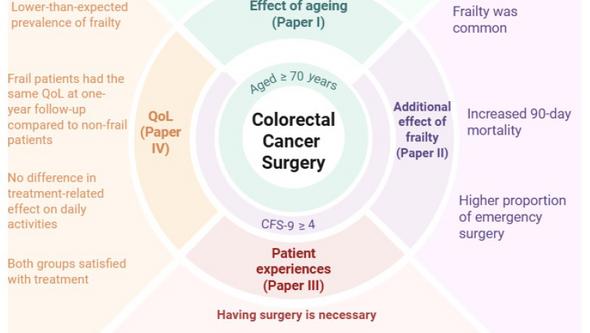
Frailty is common among older patients with colorectal cancer and is associated with increased risk after surgery. Maria Normann’s thesis shows that mortality is higher in this group, but that those who survive often report good quality of life one year after surgery.
MARIA NORMANN
Dissertation defense: 22 May 2026 (click for details)
Doctoral thesis: Impact of frailty on outcomes in colorectal cancer
Research area: Surgery
Sahlgrenska Academy, The Institute of Clinical Sciences
Colorectal cancer is a common disease that primarily affects older people.
“Advanced age and frailty are risk factors for poorer surgical outcomes, but the prevalence of frailty and its impact on outcomes have not previously been investigated in Sweden,” says Maria Normann, surgeon in the colorectal unit at NU Hospital Group and doctoral student at the Institute of Clinical Sciences.

Frailty as a measure of biological age
Frailty reflects a person’s overall physical capacity and resilience and can be seen as a marker of biological age. The thesis uses the established Clinical Frailty Scale (CFS-9), which is based on a person’s level of independence in daily life and the extent to which they are affected by disease.
“According to CFS-9, frailty is associated with several adverse outcomes, including further reductions in the ability to perform activities of daily living (ADL), such as eating, dressing, and personal hygiene, as well as confusion, repeated hospitalizations, and death.”
Increased risk – but good quality of life
Maria Normann’s research shows that frailty is common among patients with colorectal cancer and is a clear risk factor for increased mortality after surgery.
“Despite these increased risks, patients who survive are generally satisfied with their treatment and report comparable quality of life and ability to perform daily activities as non-frail patients one year after surgery,” says Maria Normann, continuing:
“These findings may help raise awareness of how frailty affects outcomes after surgery. At the same time, further research is needed to reduce this excess risk and to adapt treatment for this patient group.”
Multiple methods in one project
What have been the most rewarding and most challenging aspects of your doctoral project?
“The range of methods used – including registry data, patient-reported outcomes, qualitative approaches, and work on a randomized controlled trial – has been highly instructive. The most challenging part was conducting the interview study and trying to capture what participants expressed without overinterpreting their responses.”
Text: Jakob Lundberg