
Johan Gyllensvärd: An important balancing act when administering antibiotics to newborns
Johan Gyllensvärd’s thesis focuses on clinical research in neonatal care, with a particular emphasis on the use of antibiotics in newborns. He hopes that the findings will contribute to increased knowledge about early-onset sepsis and the importance of rational antibiotic use early in life.

JOHAN GYLLENSVÄRD
Dissertation defense: 21 May 2026 (click for details)
Doctoral thesis: Antibiotic use and early-onset sepsis in newborn infants
Research area: Pediatrics
Sahlgrenska Academy, The Institute of Clinical Sciences
Antibiotics save lives in newborns with early-onset sepsis (EOS), but administering antibiotics to infants without infection can cause harm and increase the risk of antibiotic resistance. Early in the course of illness, it is often difficult to distinguish infected from uninfected infants, which contributes to high antibiotic use.
"To optimize the balance between safe and effective sepsis care without overtreating uninfected infants, we need greater knowledge about how antibiotics are used in Sweden," says Johan Gyllensvärd, pediatrician and neonatologist at the Department of Pediatrics, Ryhov County Hospital in Jönköping, and a doctoral student at the Institute of Clinical Sciences.
As part of this effort, he has studied antibiotic use early in life in Sweden, how it varies between regions and hospitals, and how it relates to the incidence of early-onset sepsis, morbidity, and mortality.
"I have also evaluated whether new treatment guidelines can reduce unnecessary antibiotic use early in life without increasing risk."
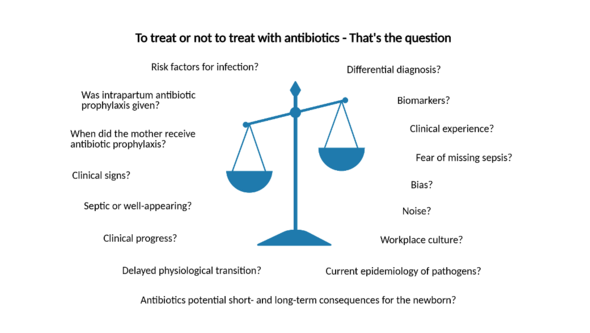
Figure 5 from thesis: As a physician one must reflect on several factors when deciding to treat or not to treat a newborn with antibiotics. Created with BioRender.com
Need to increase awareness of actual need
The research showed that Sweden has had relatively low antibiotic use during the first week of life (1.9 percent of all infants born at 34 weeks of gestation or later) compared with other countries. However, antibiotic use early in life has remained relatively unchanged over time, despite a significant decrease in the incidence of early-onset sepsis (1). There was also considerable variation in antibiotic use between regions and hospitals.
"Our interpretation is that antibiotic use is disproportionately high compared with the incidence of sepsis in several parts of the country, highlighting the need for future efforts to reduce unwarranted use of antibiotics."
The results also showed that antibiotic use can be reduced in a seemingly safe way following the introduction of new treatment guidelines, and that targeted interventions to optimize antibiotic use can contribute to better and more equitable care. Healthcare costs were also estimated to decrease significantly.
What has been the most rewarding and challenging part of your doctoral project?
"The doctoral period has been incredibly rewarding and stimulating, with several highlights. It has been very exciting to go from a research idea to implementation and then to communicate the results to colleagues and other researchers. Through networking at scientific conferences, the research has also opened new doors, leading to international collaborations, which feels promising for the future," says Johan Gyllensvärd, and continues:
"I am also very grateful for the excellent collaboration with my knowledgeable supervisors and co-authors, who have challenged me and enriched me intellectually. Hopefully, our findings can contribute to increased knowledge about early-onset sepsis and the importance of rational antibiotic use early in life."
Text: Susanne Lj Westergren
Studies II and III included more than one million late preterm and term newborn infants born at 34 weeks of gestation or later in Sweden between 2012 and 2020. Study IV analyzed infants born before 32 weeks of gestation in Sweden between 2017 and 2024.