
Emmanouil Terzidis: Understanding dose uncertainties in radiation therapy
As radiation therapy techniques become more advanced, precision and quality assurance become increasingly important. Emmanouil Terzidis’ thesis explores how uncertainties in absorbed dose occur, how they depend on treatment complexity, and how new visualization methods can support safer cancer care.
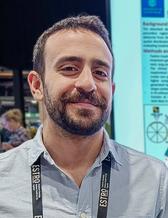
EMMANOUIL TERZIDIS
Dissertation defense: 13 March 2026 (click for details)
Doctoral thesis: Absorbed dose uncertainties in external radiotherapy in relation to treatment plan complexity
Research area: Medical Radiation Sciences
Sahlgrenska Academy, The Institute of Clinical Sciences
Radiation therapy is used in the treatment of around half of all cancer patients in Sweden, and its increasing technical complexity places high demands on precision and quality assurance.
“Uncertainties in how the absorbed dose is calculated or delivered can influence the intended treatment. My research addresses this challenge by studying how these uncertainties arise, their clinical impact and how they can be better understood,” says Emmanouil Terzidis, physicist at the department of therapeutic radiation physics at Sahlgrenska University Hospital and doctoral student at the Institute of Clinical Sciences.
When planned and delivered dose differ
The thesis focuses on how closely the absorbed dose delivered to a patient matches the dose that was originally planned. Several sources of uncertainty were studied, both those related to dose calculation models and those arising during the actual delivery of treatment.
The work also examines how treatment plan complexity influences these uncertainties.
“My overall goal has been to learn more about what affects the precision and accuracy of modern external radiation therapy and how it can be further refined.” (See the fact box on different types of radiation therapy below)
Distribution of dose uncertainties
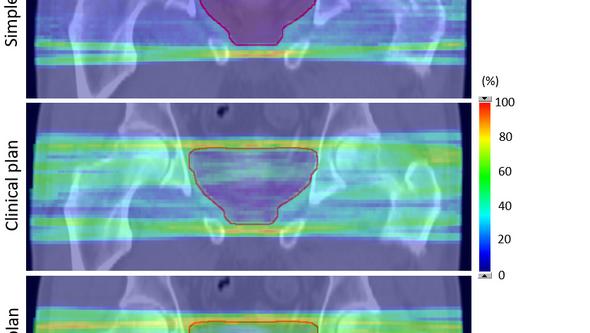
One of the main findings is that dose uncertainties are not evenly distributed throughout the patient body. Instead, they vary in different anatomical regions depending on the design of the treatment plan.
“We found that uncertainties linked to dose calculation models are generally larger than those related to the delivery of the treatment. That is important knowledge when evaluating where improvements will have the greatest impact.”
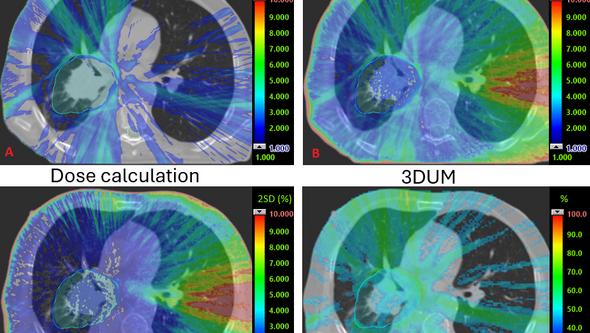
A new tool visualizes dose uncertainties
In the doctoral project, a new method was developed to generate a three-dimensional uncertainty map (3DUM). It visualizes where in the patient’s body uncertainties in absorbed dose are most likely to occur.
“This can help physicians identify regions that require extra attention during treatment planning, which can improve both safety and quality in radiation therapy.”
What has been the most rewarding and the most challenging part of your doctoral studies?
“One of the most rewarding aspects has been the process of solving research problems and how to overcome obstacles that appeared along the way,” says Emmanouil Terzidis, and continues:
“There were times when progress slowed down and finding the right path forward was challenging, but the satisfaction of finally finding a solution made it worth it. I also really valued the chance to meet other PhD students and researchers at conferences, sharing my research and exchanging ideas.”
Text: Jakob Lundberg
External radiation therapy involves delivering radiation from a machine outside the body and directing it towards the area where the tumor is located. The treatment is carefully planned using imaging and detailed dose calculations to deliver a high dose to the tumor while sparing surrounding healthy tissue.
Brachytherapy is based on placing a radiation source temporarily inside or close to the tumor, for example through needles or catheters.
Nuclear medicine radiation therapy uses a radioactive drug that is injected into the body. The compound is designed to seek out tumor cells as specifically as possible.
The technical conditions – and therefore the types of uncertainties that can arise in radiation dose calculation and delivery – differ between these treatment methods. Emmanouil Terzidis’ research focuses exclusively on external radiation therapy.