Charlotte Alverbratt: New drugs and improved overview in prostate cancer
Several new drugs have improved survival in metastatic prostate cancer. Charlotte Alverbratt’s research shows that these treatments yield similar outcomes in Swedish clinical practice as in clinical trials – and that a digital tool can enhance follow-up.

CHARLOTTE ALVERBRATT
Dissertation defense: 29 May 2026 (click for details)
Doctoral thesis: Treatment and monitoring of men with metastatic castration-resistant prostate cancer
Research area: Oncology
Sahlgrenska Academy, The Institute of Clinical Sciences
Prostate cancer is the most common cancer in Sweden, with more than 10,000 new cases each year. Over the past 15 years, several new treatments have been shown to prolong survival in men with metastatic disease.
“Patients enrolled in randomized controlled trials are often healthier overall than those treated in routine care. It is therefore important to examine whether these treatments are equally effective in everyday clinical practice,” says Charlotte Alverbratt, senior consultant in oncology at Varberg Hospital and doctoral student at the Institute of Clinical Sciences.

Outcomes in line with clinical trials
The thesis examines how three commonly used drugs – abiraterone, enzalutamide, and radium-223 – are used in Swedish healthcare and whether outcomes correspond to those observed in large randomized trials.
“We find that treatment duration and survival are broadly in line with randomized trials, suggesting that these drugs are used in a responsible and effective way in Sweden.”
The findings also suggest that early use of radium-223 does not provide a clear survival benefit compared with administering the drug at a later stage of the disease.
Digital overview improves insight
The thesis also examines the digital patient overview IPÖ-PC (Individuell patientöversikt prostatacancer), which compiles information on treatment and symptoms into a graphical view.
“It provides a clearer and faster overview of the patient’s disease and treatment than the electronic health record.”
One of the substudies presents a study protocol for a planned randomized trial investigating whether patient-reported symptoms (so-called PROMs), visualized in the patient overview, can improve communication between physicians and patients.
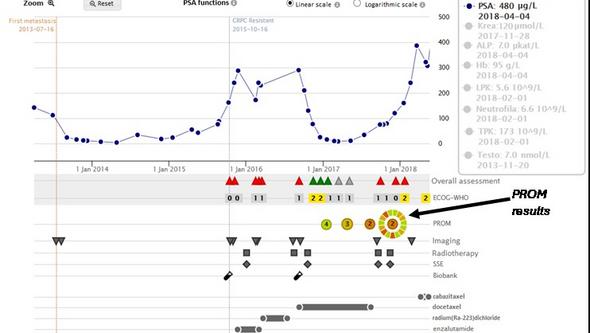
Patient-overview Prostate Cancer (IPÖ-PC) output, including PROM (example from a fictive patient). Reprinted from Scandinavian Journal of Urology, “Set-up and preliminary results from the Patient-overview Prostate Cancer. Longitudinal registration of treatment of advanced prostate cancer in the National Prostate Cancer Register of Sweden”, Franck Lissbrant, I. et al. (116), © copyright 2020, reprinted by permission of Informa UK Limited, trading as Taylor & Francis Group, https://www.tandfonline.com, modified with permission from the authors.
“It has been an exciting journey”
IPÖ-PC is used both in clinical practice and as a data source for research. The results show that a national digital structure can support both knowledge development and improved care.
“It makes it possible to track treatments and outcomes more systematically in everyday clinical work while also contributing to a detailed research database.”
What have been the most rewarding and the most challenging aspects of your doctoral project?
“It has been an exciting journey. A great deal has happened over these years, and the most rewarding part has been being able to connect my daily clinical work with research that has remained close to patients,” says Charlotte Alverbratt, continuing:
“The clinic, together with the patients, is where I feel most at home. The drive to ensure that what we do is effective, while also developing and improving care for men with metastatic prostate cancer, has motivated me throughout.”
Text: Jakob Lundberg