
Advancing blood-based biomarkers for neurological disease
Blood-based tau biomarkers can provide early and reliable information on both diagnosis and disease progression across several neurological conditions. In his award-winning thesis, Fernando Gonzalez Ortiz shows how these biomarkers can help make advanced diagnostics more accessible and clinically useful.
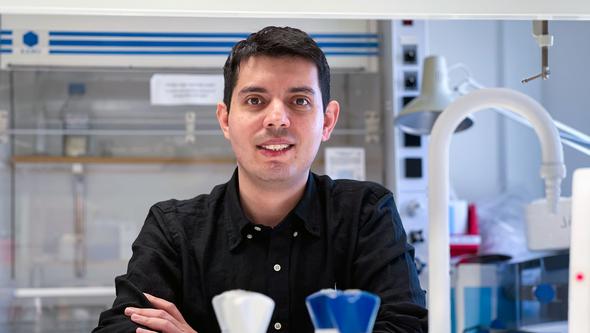
Fernando Gonzalez Ortiz, at the Institute of Neuroscience and Physiology, has been awarded the Sahlgrenska Academy’s 2025 Thesis of the Year for his work in Clinical Neurochemistry in Mölndal. His research focuses on developing and validating blood-based tau biomarkers that reflect pathological processes in the brain and can be used across multiple neurological conditions.
Fernando Gonzalez Ortiz is the latest in a series of PhD candidates from the same research environment to receive the award—something he believes reflects the strength of that environment.
“There is world-leading expertise here in biomarkers and Alzheimer’s disease, along with strong international collaborations. It’s an environment that encourages you to think creatively and test your ideas,” says Fernando Gonzalez Ortiz.
His mentor, Kaj Blennow, played a key role during his formation.
“We had a way of working where I tend to challenge the core ideas, and that was encouraged. I received a great deal of support in developing my own ideas further,” Fernando says.
From internal medicine to neurology
Fernando Gonzalez Ortiz is a physician from in Mexico, with training and experience in multiple countries including Scotland and Sweden. He has a background in internal medicine and now sees his broad clinical foundation as an asset in his research.
“Internal medicine is about understanding how the whole system fits together and avoiding tunnel vision. That has been extremely valuable when working with neurological diseases, where you need to place biomarkers in a broader context,” he says.
When he entered research, the biomarker field was new to him.
“At first, I didn’t really understand why everyone was so obsessed with tau and phosphorylated tau. But the more I worked with it, the clearer it became how unusual it is to have markers that so closely track the underlying disease processes and clinical symptoms. That’s what makes them so interesting,” he says.
Connecting research with clinical reality
During his PhD, he combined research with his clinical experience in the clinical neurochemistry department and in the memory clinic.
“Working clinically means you’re constantly connecting your findings to real patients and to the decisions that need to be made in healthcare,” he says.
His thesis, Pathophysiological mechanisms and clinical value of novel blood-based tau biomarkers, is based on seven articles in which Fernando Gonzalez Ortiz is first author, published in leading international journals. The work spans everything from the development of new assays to biological validation and clinical application in conditions including Alzheimer’s disease, stroke, and other neurological disorders.
A central contribution is the development of more brain-specific blood-based biomarkers, which have shown strong associations with pathological processes in the brain and can provide information on both diagnosis and disease course. The principles presented in his thesis have been taken by multiple groups and companies are now widely available
Emphasizes the limitations of biomarkers
At the same time, Fernando Gonzalez Ortiz underscores the importance of using biomarkers appropriately.
“It’s essential to understand both their strengths and their limitations. If biomarkers are used without a clear understanding of how to interpret them, there is a risk of misdiagnosis and of patients receiving treatments they do not need,” he says.
He describes receiving the award as a great honor.
“I’ve looked at the other theses that are being recognized, and they are very impressive. That makes it even more meaningful that my thesis was selected,” he says.
Aims to make advanced diagnostics more accessible
Looking ahead, he plans to continue combining research with clinical work. He is currently working on developing and applying biomarkers in additional contexts, as well as on questions related to making these methods more widely accessible.
“In my hometown in Mexico, the access to advanced biomarkers can vary widely between hospitals. In many places, diagnosis still relies heavily on clinical assessment, which can be uncertain,” he says.
“I would like to help ensure that these markers and methods become more widely available, even in settings with more limited resources.”
- Link to the thesis: Pathophysiological mechanisms and clinical value of novel blood-based tau biomarkers.
The Thesis of the Year Award is presented to seven theses at the Sahlgrenska Academy – one faculty-wide award and one award from each institute.
In 2025, the faculty-wide award is granted to Fernando Gonzalez Ortiz.
The award is funded by Dr Arnt Vestby’s Research Foundation.
**********************************************************************
RECIPIENT AT THE SAHLGRENSKA ACADEMY
Fernando Gonzalez Ortiz, Affiliated with the Institute of Neuroscience and Physiology
Dissertation: Pathophysiological mechanisms and clinical value of novel blood-based tau biomarkers
**************************************************************************
RECIPIENTS AT THE INSTITUTES
Institute of Biomedicine: Sebastian Valenzuela
Dissertation: Structural studies of mitochondrial DNA polymerase γ
Institute of Clinical Sciences: Ella Äng Eklund
Dissertation: Precision medicine in Non-Small Cell Lung Cancer, with a focus on KRAS mutations
Institute of Medicine: Michail Zoulakis
Dissertation: Improved Fracture Risk Prediction by Identifying and Integrating Novel Risk Factors
Institute of Neuroscience and Physiology: Andreas Göteson
Dissertation: Cerebrospinal fluid studies of major psychiatric disorders
Institute of Odontology: Divya Ganesh
Dissertation: Molecular Insights in Oral Leukoplakia: Epigenetic, Immunological, and Proteomic Perspectives
Institute of Health and Care Sciences: Veronica Lilja
Dissertation: Dribbling past chronic pain – Evaluating meaningful support through a remote person-centred care intervention