Young Sea trout face major challenges
When young sea trout leave their nursery streams to head out to sea, they embark on what may be the most dangerous journey of their lives. Instinctively, they seem to know the destination is worth the risk – but exactly when they leave, and why, are questions that researcher Madeleine Berry has explored in her PhD thesis “Who, When, Where: Migration Timing and Spatial Variation in Juvenile Sea Trout.”

A central question in the project was whether the timing of spring migration varies with latitude across Europe. Because the climate differs from north to south, with warmer temperatures further south, the hypothesis was that young sea trout there would migrate earlier.
”Warmer temperatures allow fish to grow faster and reach a suitable size for migration sooner. At the same time, rising spring temperatures act as a cue that triggers migration”, says Madeleine Berry, PhD student at the Department of Biological and Environmental Sciences.
To investigate this, hundreds of juvenile trout were tagged in five countries: Sweden, Norway, Denmark, France and Portugal. Madeleine Berry then tracked their movements as they migrated towards the sea. The results showed clear differences between countries, with migration peaks occurring between April and June.
”We observed a clear trend of earlier migration at lower latitudes and later migration at higher latitudes, but the relationship was not statistically significant. If we could expand the study in the future to include more streams across a wider range of latitudes, this pattern would likely become clearer”, she continues.

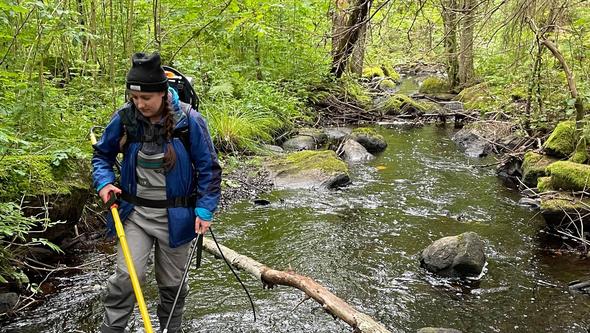
To follow the fish, researchers used advanced technology. Small PIT tags were surgically inserted into the fish, allowing each individual to be identified when passing antennas installed in the streams. This makes it possible to map exactly when and how fish move through the system.

A critical early phase
The transition from freshwater to the sea is a critical period in the life of sea trout. Mortality is very high, mainly due to predation from both fish and birds such as pike, cod and cormorants. To reduce risk, the fish often migrate in groups, at night, and during periods of high water flow when the water is more turbid.
”At the same time, they undergo major physiological changes to cope with life in saltwater – an energy-demanding process that can also be affected by factors such as pollution”, says Madeleine Berry.
Despite the risks, there is a major reward for those that survive. They can grow much larger in the sea and thus gain better reproductive success, for example because larger females can produce more eggs.
Another important part of Madeleine Berry’s research concerns how many smolts a stream produces. Since far from all individuals survive to adulthood, this number is crucial for the future of the population. By improving predictions of smolt production, managers can better target restoration efforts where they will have the greatest impact.
Differences depending on parent origin
In her thesis, Madeleine Berry also examined differences between offspring of sea trout that migrate different distances. Studies from, among other places, Haga å in Billdal show that these differences are both clear and complex.

Offspring of long-distance migrants can, for example, be more dominant and in better condition, while offspring of short-distance migrants sometimes show stronger stress responses. Interestingly, the patterns vary between streams – in some cases long-distance offspring are bolder, in others short-distance offspring are.
”This suggests that traits are not determined solely by inheritance, but also by the local environment. The combination of genetic and environmental factors creates variation that makes sea trout adaptable, but also vulnerable to change”, says Madeleine Berry.
Together, the results provide a more nuanced picture of sea trout ecology and the factors that shape their migration.
”This knowledge is crucial, especially at a time when climate change is likely to alter both temperatures and habitats in European rivers – and thereby the conditions for sea trout migration”, Madeleine Berry concludes.