
“You won’t regret it” – apply for ship time through SWERVE now
“It is a fantastic opportunity. You won’t regret it.”
Researchers at Swedish universities and research organisations can now apply for funded ship time in 2027 through SWERVE. Carina Bunse, researcher at the University of Gothenburg, has already taken her project to sea – and she would not hesitate to do it again.
The application deadline is 12 June.
“This expedition made it possible for us to collect samples, build networks between Swedish and international researchers, and provide valuable training for students and PhD students on board,” says Carina Bunse.
Very good support
Carina Bunse is based at the University of Gothenburg, where her research focuses on microbial ecology. She is one of the researchers who has been awarded ship time on board the research vessel Svea through SWERVE, Sweden’s national research vessel infrastructure. The expedition took place along the Swedish west coast in autumn 2025, with the aim of improving understanding of marine ecosystems.
“We collected many samples, which we are currently processing. The data will contribute to several publications and different projects,” says Carina Bunse.
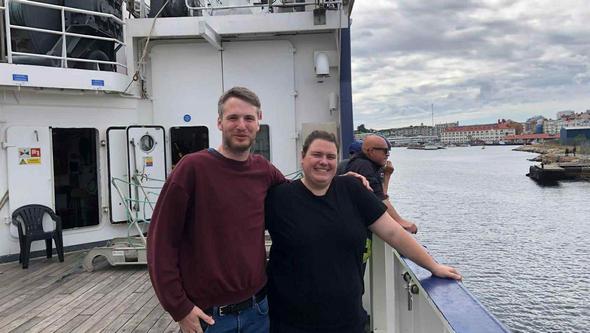
Carina Bunse has a clear message for other researchers who are considering applying for ship time through SWERVE.
“It is a fantastic opportunity. I also felt that the support was very good – from the vessel and from SWERVE. I would definitely do it again, and I encourage anyone who is thinking about applying to do so,” says Carina Bunse.
“You won’t regret it!”
Research vessel for studying ocean currents
Léon Chafik, oceanographer and climate researcher at the Department of Meteorology, Stockholm University, has also been awarded ship time through SWERVE.
In summer 2025, he conducted an expedition on board R/V Skagerak. The research project investigates deep-water currents between Iceland and the Faroe Islands – a region where major knowledge gaps remain.
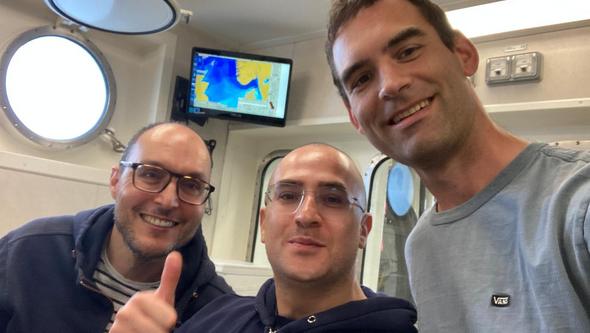
“We wanted to improve our understanding of the deep currents in the region, and how dense water masses cross the ridge and contribute to Atlantic Ocean circulation, popularly known as the Gulf Stream system. A research vessel was needed to make these measurements,” says Léon Chafik.
The awarded ship time enabled the research team to collect measurement data from a remote and challenging environment – data that cannot be obtained from satellites or existing monitoring systems.
"Go for it"
“It has provided us with a unique hydrographic dataset that may change how we view the deep waters in the region. But we need to go back and take further measurements to see whether our hypotheses hold,” says Léon Chafik.
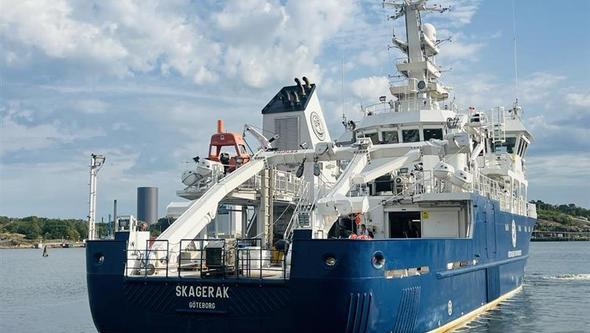
Léon Chafik says that being able to apply for ship time in this way is a fantastic opportunity – and one not to be missed:
“Go for it. Ship time provides an opportunity to collect unique observations, test new ideas and build valuable collaborations.”
Read more and apply via SWERVE by 12 June.
Text: Agnes Faxén
SWERVE stands for Swedish Research Vessel Infrastructure for Marine Research and is a national research infrastructure that gives researchers access to Swedish research vessels.
Through SWERVE, researchers at Swedish universities and research organisations can apply for funded ship time for marine expeditions and projects. The aim is to strengthen Swedish marine research by improving access to vessels, equipment and expertise.
In the current call, researchers can apply for ship time in 2027. The application deadline is 12 June.
Read more: https://swerve.se/en/ship-time

