Video-based training could improve life after brain tumors
An international study backed by a nearly SEK 9 million grant from the Swedish Childhood Cancer Fund will investigate whether home-based exercise delivered through video sessions can improve the health and quality of life of children and adolescents treated for brain tumors.
Many children treated for brain tumors experience long-term effects after treatment, including fatigue, reduced physical fitness, balance problems, and difficulties participating in everyday physical activities. Access to rehabilitation also varies widely depending on where families live.
The MOVE project (Medulloblastoma Online Video-based Exercise) aims to improve rehabilitation for children treated for medulloblastoma, the most common malignant brain tumor in children. The study will be conducted across several European countries.
“We hope the project can help make rehabilitation more accessible, equitable, and better integrated into pediatric cancer care. If this model proves effective, it could enable more children to receive support after treatment regardless of where they live,” says Magnus Sabel, researcher affiliated with the Institute of Clinical Sciences at the University of Gothenburg and pediatric oncologist at the Pediatric Oncology Center at Sahlgrenska University Hospital.
![[none]](/sites/default/files/styles/50_10_6_xmedium_1x/public/2026-05/duobild%2016x9%20Magnus%20och%20Aron%20foto%20Fredrik%20Jalhed%20och%20Paul%20Bj%C3%B6rkman_0.jpg?h=e6d74438&itok=7vZBqPok)
Training through video sessions
In the study, children and adolescents will train at home together with physiotherapists through video sessions. The exercise program will be tailored to each child’s abilities and day-to-day wellbeing, eliminating the need for families to travel to the hospital to participate.
“Children with brain tumors often face more severe and long-lasting difficulties than many other groups treated for cancer. At the same time, they often don’t have access to long-term exercise. We therefore see great potential in combining pediatric oncology rehabilitation with digitally delivered care approaches,” says Aron Onerup, adjunct senior lecturer at the Institute of Clinical Sciences at the University of Gothenburg and specialist physician at the Pediatric Oncology Center at Sahlgrenska University Hospital.
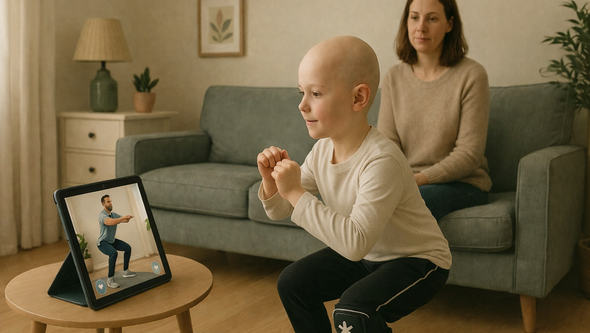
Researchers will follow participants over time and evaluate physical function, activity levels, and quality of life. The study is integrated into the major European treatment trials for medulloblastoma, making it possible to include more participants than in previous research.
Previous research shows promise
“The most important aspect is the opportunity to develop rehabilitation for a group of children who often live for many years with the consequences of their treatment, while post-treatment support remains limited. Our hope is that the project will not only generate new knowledge but also lead to concrete changes in how rehabilitation is offered after childhood cancer,” says Magnus Sabel.
Previous studies suggest that physical activity can improve fitness, motor function, and quality of life in children treated for cancer. As early as 2017, the research group conducted a smaller study in which children treated for brain tumors exercised at home using motion-controlled video games combined with remote coaching.
“During the pandemic, we saw that video-based care and exercise programs could work better than many had previously believed, both practically and socially. The technology has also advanced considerably in recent years. We now want to take the next step and evaluate this approach in a larger international study,” says Magnus Sabel.
