
Unusual barrel jellyfish found on Tjärnö
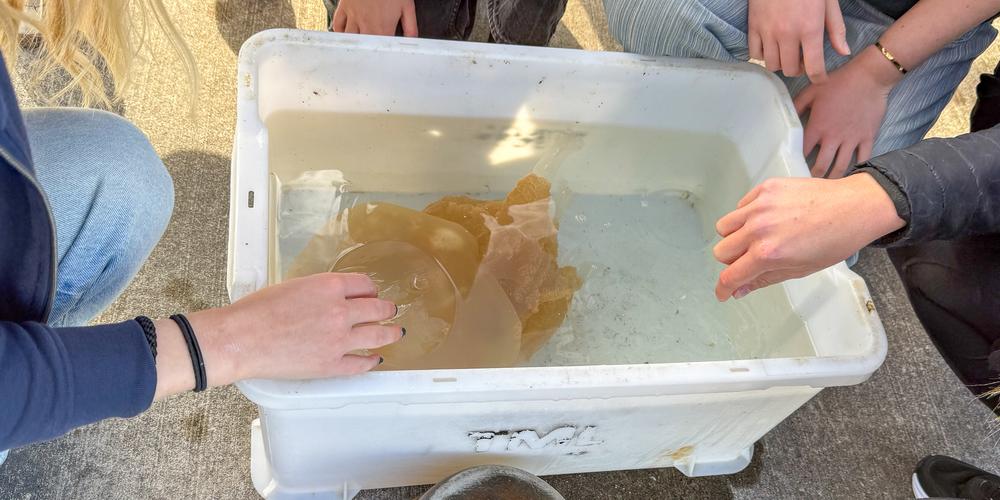
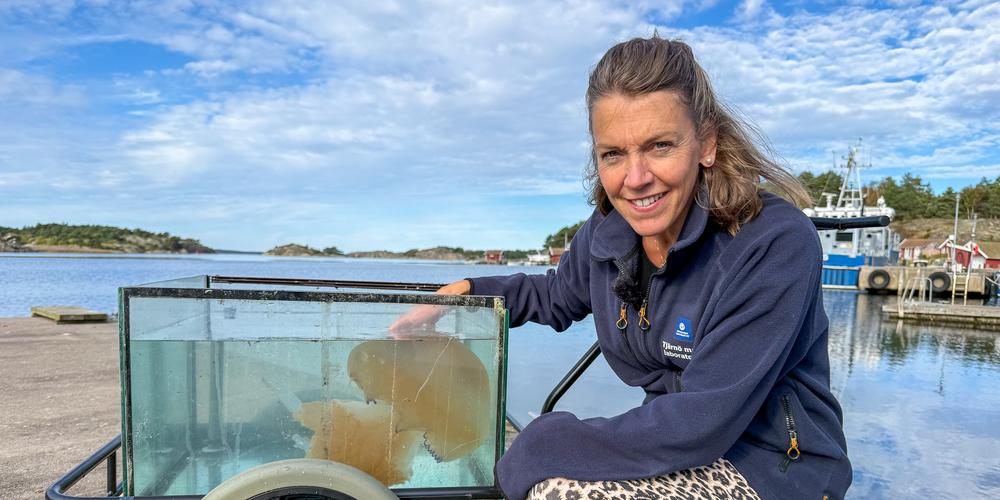
Over the autumn, several sightings of the unusual barrel jellyfish have been reported along the west coast in Sweden. In October, one specimen also appeared at Tjärnö Marine Laboratory.
”In Asia, they eat them dried. They don’t taste much, but they have a very interesting texture,” says jellyfish expert Christin Appelqvist at the Department of Marine Sciences.
How unusual is the barrel jellyfish in Sweden?
“It’s not all that common around here – not yet, at any rate – but I’m not surprised to see it. It’s a species native to the North-East Atlantic and the Mediterranean, and it sometimes reaches Swedish waters in late summer and autumn. It’s carried here by warm ocean currents.”
How do you recognise it?
“The upper part, known as the bell, is turquoise, blue, or milky white in colour. Unlike other Swedish jellyfish, the bell is very robust and that’s where the stinging cells are located, although they’re very mild. They have a beautiful purple rim around the edge and, underneath, a cluster of eight oral arms. In our waters, they often grow to about half a metre in length and half a metre in diameter across the bell. But they can grow up to one and a half metres in length.”
Are they dangerous?
“They belong to the cnidarian group, but they do not sting humans or even their own prey. Unlike our arctic red jellyfish, these have a closed mouth. Their arms lack stinging cells and instead have small pores through which they suck in zooplankton, which they then transport up to their digestive tract.”
But can they cause problems?
“When jellyfish bloom, or occur in large numbers, they can cause problems for human-made constructions, such as cooling water intakes at nuclear power stations or other facilities. This particular species is so compact that, if there are a lot of them, they can cause a real blockage and prevent water from circulating, even in a canal, for example.”
Have you ever tried eating them?
“Yes. They don’t have much flavour; it’s more about the interesting texture. You eat them dried, so they’re not like jelly at all; they’re more crunchy, like crisps. You can also soak them, in which case they become more like squid. When people eat jellyfish, it’s specifically those from the genus rhizostoma. It’s mainly in Asia that there’s active fishing for them and they’re consumed.”
What do you think about it turning up here on the West Coast?
“I love jellyfish, so I’m absolutely delighted. I enjoy watching it and seeing it swim. It’s a visitor here in the autumn, so I’m expecting it to show up,” says Christin Appelqvist.
Intervju: Mikael Andersson
