
The right seaweed in the right place matters for ecosystems
Having the right species in the right place can make a significant difference to how well an marine ecosystem functions. This is shown by research spanning from the rocky shores in Bohuslän on Sweden's west coast and to nearly 1,000 kilometres of British coastline.
The findings could have implications for future conservation efforts.
“An area can function perfectly well with just one dominant species. But when we look across larger areas, we see that different seaweed species dominate depending on where we are,” says marine biologist Ben Brunner, who has investigated how environmental conditions and the geographical distribution of seaweeds influence their growth in his doctoral thesis at the University of Gothenburg.

Brown seaweeds such as bladder wrack, toothed wrack and knotted wrack form dense seaweed canopies along the rocky shores of Bohuslän and similar coastlines across the North Atlantic. They provide food and shelter for many marine species and serve as important nursery grounds for fish.
“You can compare it to a forest on land. I'm basically studying the trees, but underwater,” says Brunner.
Trees and forests under water
Seaweeds also have economic value. In many countries, they are harvested to extract alginate, a substance used as a thickening and stabilising agent in a wide range of products.
Just like trees on land, different seaweed species thrive under different environmental conditions. Some can survive for several days out of the water when sea levels fall, while others grow further down the shore and need to remain submerged almost continuously.
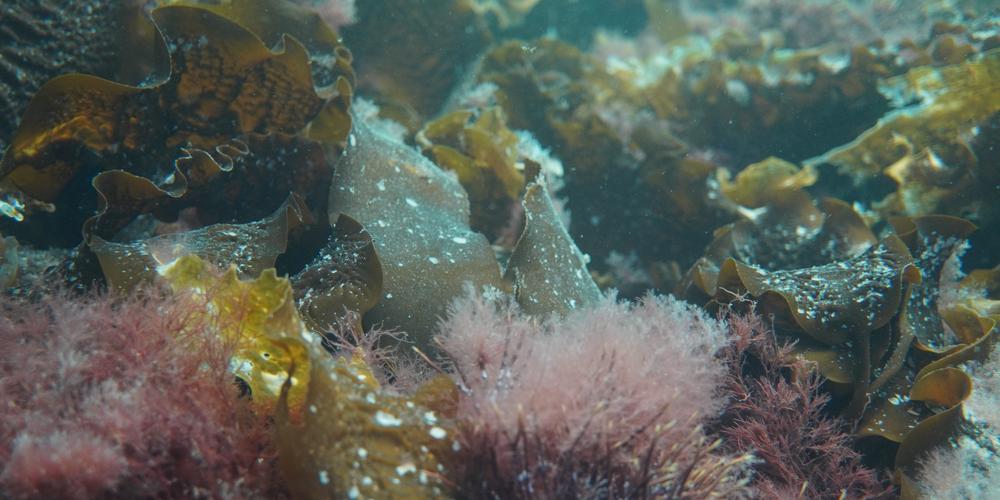
Brunner has conducted experiments with four seaweed species collected from five rocky shores around Tjärnö, investigating how well they perform when transplanted to parts of the shore where they do not normally grow. He has also broadened the scope of his research by analysing seaweed data from more than 1,600 sampling plots along nearly 1,000 kilometres of British coastline.
Using a computer model, he investigated what would happen if the dominant seaweed species were redistributed between different environments, regardless of where conditions suited them best. In this hypothetical scenario, the estimated seaweed biomass was just over 40 per cent lower.
Brunner stresses that this is a modelled comparison.
“This is not a forecast of future biomass loss. The calculation shows how much of the biomass can be attributed to species occurring in environments that suit them,” he explains.
Grows better in right environment
Nevertheless, the result highlights the potential importance of different seaweed species growing in suitable environments. A reduction in biomass could affect the functioning of seaweed habitats, as well as the species that depend on the habitats these seaweeds create.
The findings could have implications for how natural areas are protected and managed. Biodiversity is already a central consideration in conservation, where particularly species-rich areas are often highlighted as priorities for protection. According to Brunner, however, it is also important to consider the variation between different habitats.

His research shows that a single seaweed species can account for almost all the biomass in an area without necessarily indicating that the ecosystem functions less well. Across larger areas, however, different species may be needed to sustain ecosystem functioning.
“I think the main takeaway is that biodiversity doesn't only matter locally, but also across larger areas. We don't just need many species in one place, but the right species in the right places,” he says.
Ben Brunner´s thesis is found here: Biodiversity and Ecosystem Functioning Across Space and Environment in the Sea
Text: Mikael Andersson
Biodiversity
The variety of life in nature. It includes the diversity of species, genetic variation within species and the diversity of ecosystems. The distribution of different species across locations is also an important aspect of biodiversity.
Ecosystem
All the living organisms in an area, the physical environment they inhabit and the interactions between them. Examples include forests, lakes and seaweed habitats.
Ecosystem functioning
The natural processes that take place within an ecosystem, such as biomass production, decomposition of organic matter and nutrient cycling. The amount of biomass present can be used as an indicator of ecosystem functioning.
Ecosystem services
The benefits people obtain from ecosystems, including food, raw materials, water purification and habitats that support fish populations.
Brown seaweeds (brown algae)
A group of algae that includes bladder wrack, toothed wrack and knotted wrack. Large brown seaweeds form dense canopies that provide shelter, food and nursery habitats for many marine organisms.
Biomass
The total mass of living organisms in a given area. In Brunner's research, seaweed biomass is used as an indicator of ecosystem functioning. A lower biomass can mean fewer individuals, smaller individuals, or both.