Simple cleaning reduced bacteria on single-use medical devices
Three simple cleaning methods reduced bacterial levels on used single-use medical devices, according to a study from the University of Gothenburg. The findings could prove useful as a last-resort measure during severe shortages of medical supplies in a crisis or war.
Shortages of single-use medical devices can become a serious problem in a crisis or war. Similar concerns arose during the COVID-19 pandemic, but knowledge of simple cleaning methods suitable for field conditions remains limited.
The researchers tested ordinary dishwashing liquid, 70% alcohol, and peracetic acid on used single-use medical devices. All three methods substantially reduced bacterial levels, and the researchers detected no difference in effectiveness among them.
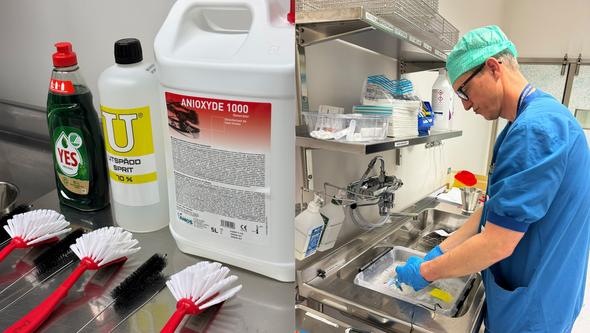
Simple methods put to the test
The study, published in the journal Prehospital and Disaster Medicine, included 90 used single-use medical devices of six different types from operating rooms. The devices were brushed, soaked, and air-dried under conditions designed to simulate healthcare in a resource-limited setting.
Respiratory infectious agents were detected on airway devices in 14 of 30 samples before cleaning. After cleaning, all samples tested negative. No visible effects on the function or structure of the devices were detected.
Karl Chevalley is a doctoral student at Sahlgrenska Academy at the University of Gothenburg and a senior consultant in Prehospital Intensive Care (PIV) at Sahlgrenska University Hospital:
“Simple cleaning methods can reduce the amount of microorganisms on used equipment. This does not replace sterile equipment, but the knowledge could prove useful in a disaster or wartime situation,” he says.
A last resort
The researchers found signs of possible cross-contamination when syringes and infusion equipment were cleaned together with other equipment. The problem was not observed when they were cleaned separately.
![[none]](/sites/default/files/styles/50_10_6_xmedium_1x/public/2026-09/Karl%20Chevalley%20och%20G%C3%B6ran%20Sandstr%C3%B6m%20DUO%2016x9.jpg?h=013facc1&itok=tbCU9t4g)
Göran Sandström is a researcher at Sahlgrenska Academy at the University of Gothenburg and the Swedish Defence University:
“Emergency stockpiles and functioning supply chains are the most important. But in war or a disaster, emergency and contingency methods are needed as a last resort,” he says.
The study was conducted in collaboration among the Centre for Disaster Medicine, Sahlgrenska Academy, Ryhov County Hospital, and the Swedish Defence University.
The study included a small number of devices and only one cleaning cycle. It does not show that the devices are safe to reuse on patients. The findings therefore need to be followed up in further studies.
Article: Contingency Methods for Cleaning Single-Use Medical Equipment in Crisis, Disaster, or War; https://doi.org/10.1017/S1049023X26109066
The study was conducted by researchers at Sahlgrenska Academy and the Centre for Disaster Medicine at the University of Gothenburg, Linköping University, Ryhov County Hospital, the Helicopter Emergency Medical Service in Region Västra Götaland, and the Swedish Defence University.
Staff working in anesthesiology, microbiology, and molecular biology at Ryhov County Hospital also contributed to the collection of study materials and the microbiological analyses.
The study was funded by Futurum – The Academy for Health and Welfare, Region Jönköping; the Centre for Disaster Medicine at the University of Gothenburg; and the Swedish Military Medical Association.
