Researchers and parliamentarians in dialogue on AI and democracy
Shallower understanding and a political culture in which reaction matters more than genuine attempts at mutual understanding. These are some of the risks that arise when AI systems begin selecting information on our behalf. In a recent talk at the Swedish Parliament, Jonas Ivarsson, Professor of Informatics, argued that democracy depends on our willingness to do the hard work of understanding.
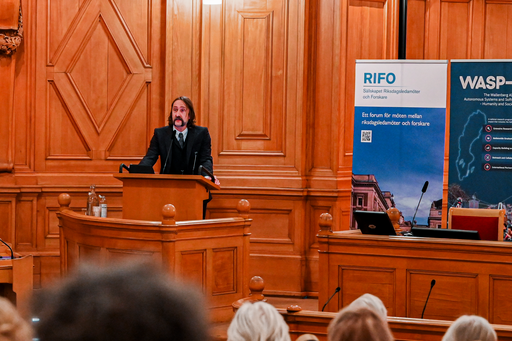
A small group of researchers presented their perspectives to members of the Swedish Parliament during the seminar Algorithms in Election Campaigns – Democracy Under New Conditions. The seminar explored how core democratic practices are being reshaped as artificial intelligence (AI) plays an increasingly influential role in both political processes and the ways people encounter and interpret information. One of the invited speakers was Jonas Ivarsson, Professor of Informatics at the University of Gothenburg.
“Democracy is not only a way of making decisions; it is also a way of knowing, a way of testing together what is actually the case,” Ivarsson told the members of parliament, who later took part in a panel discussion on the theme.
The deeper kind of knowledge that emerges when we actively seek out information, remain attentive to who produced it, and test it against other perspectives is increasingly being replaced by ready-made analyses in which we have played no part.
Ivarsson warns that there is a risk we will become users of intelligence rather than bearers of it. When apparently complete answers are available at once through artificial intelligence, we may gradually give up the responsibility to understand how things work. That shift may affect how political issues are understood and, ultimately, how decisions are made.
“Democracy rarely rests on speed,” he said. “It rests on the slower, often more demanding, willingness to understand. On the effort to see the same thing before moving on.”
Another consequence of AI’s growing presence is that political discussion, especially on social media, increasingly adjusts to the logic by which AI-driven algorithms select and amplify information. It is now widely recognized that content provoking strong and immediate reactions tends to gain the greatest visibility. More measured forms of discussion, where people share the aim of understanding one another and engaging seriously with differing views on complex issues, leave less of a trace. In this context, Ivarsson argues that elected representatives are responsible not only for advancing political ideas but also for modeling the tone and form of democratic conversation itself.
“The task is twofold. It is certainly about winning support and clarifying a position. But it is equally about showing how to listen, how to keep the world shared even when we disagree.”
Three further talks on AI and democracy were presented before members of parliament from the Liberals, the Green Party, the Social Democratic Party, and the Moderate Party joined a panel discussion, followed by questions and reflections from the audience.
The seminar was organized in collaboration between Rifo and the research programme Wallenberg AI, Autonomous Systems and Software Program – Humanity and Society (WASP-HS).
Talks
Algorithmic Opinion Formation and the New Conditions of Election Campaigns
Simon Lindgren, Professor of Sociology, Umeå University
AI Democracy?
Anne Kaun, Professor of Media and Communication Studies, Södertörn University
Can Our Democratic Institutions Be Preserved, or Does Current Development Require an Updated Version?
Malin Rönnblom, Professor of Political Science, Karlstad University
The Capacity to Understand Together – Democracy’s Quiet Precondition
Jonas Ivarsson, Professor of Informatics, University of Gothenburg
Participating members of the Swedish Parliament
Helena Gellerman (L)
Jan Riise (MP)
Jennie Nilsson (S)
Magnus Resare (M)