
Preschool children gain increased agency through the camera
All children have the right to learn to read, write, and count. But what happens when children also learn to understand and use a camera? A project in Gävle shows how visual literacy can become a key to both creativity and agency as early as in preschool.
In 2018, a project was launched in preschools in Gävle to explore how the camera can be used as a pedagogical tool. In total, 70 preschools and 5,400 children participated. The aim was to strengthen children’s agency, creativity, and media literacy, and in the long term to contribute to a more democratic societal development.
– We live in an image-saturated world. All children have the right to learn to read, write, and count, but it should be just as natural for them to learn how to decode and create images in a responsible way, says Linda Sternö, Senior Lecturer in Film at HDK-Valand, University of Gothenburg.
Giving space to children’s voices
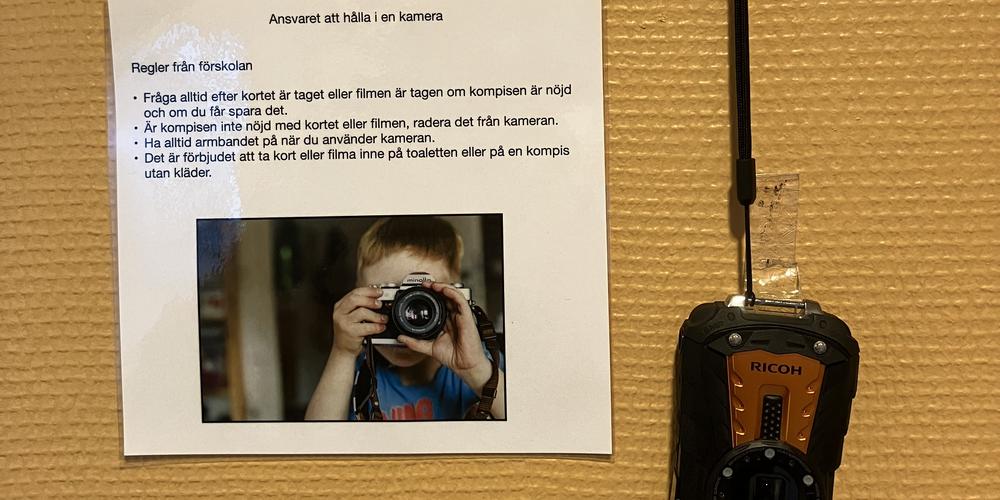
Linda Sternö was involved in developing the pedagogical material on which the project is based and was commissioned last year to conduct an evaluation. The evaluation shows that children’s agency in preschool has increased through working with the camera. When children are allowed to photograph their surroundings and are treated as experts on their own images, educators have the opportunity to listen to the child’s interpretation rather than steering the conversation.
– It has created new forms of dialogue. Children practice expressing themselves, asking each other questions, and listening to different perspectives. In this way, both communicative abilities and self-confidence are developed. They also become aware of consent and privacy and can themselves decide whether a picture may be taken or shown.
Through so-called “safety walks,” children have photographed places where they feel safe or unsafe, which has opened up conversations about the working environment and everyday life in preschool.
– The project has also helped increase media literacy among both children and educators. Children practice technical skills and image analysis, but also gain an early understanding of ethics and source criticism, for example, that images can be manipulated, says Linda Sternö.
Taking space in the public realm
As part of the project, children’s photographs have been exhibited in libraries and museums. In this way, they are given the opportunity to share their perspectives with the public and gain concrete experience of their voices being valued in society.
– When children show their images publicly, they become participants in a public conversation. This strengthens the sense that they can contribute and be taken seriously, says Linda Sternö.
To make it easier for more preschools to work with visual literacy, she has also compiled a teaching guide with 21 concrete “camera assignments.” The guide is aimed at preschool educators and brings together the experiences developed through the project.
– The hope is that more people will adopt this approach and that the discussion can also be expanded to new areas, such as how AI and generative images affect children’s visual worlds. I hope more people will see the possibilities, says Linda Sternö.