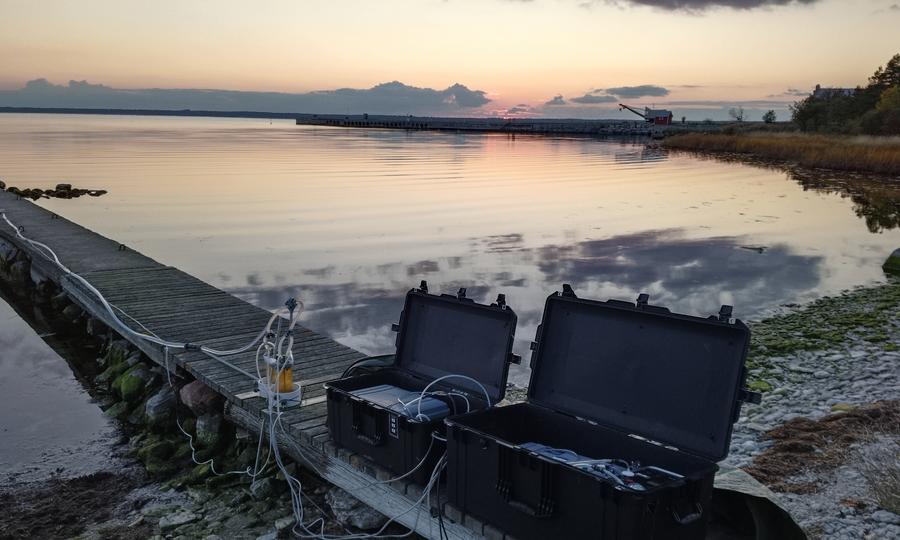
Not an average Master’s project: Gotland marine chemistry expedition
Cold waters and stormy waves did not stop the Master’s students in marine chemistry from taking samples off Gotland. The students spend a whole year working on their degree projects, with the aim to grow into independent researchers and experience the entire process from planning to scientific publication.
In October 2025, Master’s students Roberta Prado, Emma Ingoldsson and Aarathi Krishnan travelled for ten days around the island Gotland to collect samples to measure alkalinity, greenhouse gases, and submarine groundwater discharge into the Baltic Sea with their supervisors, Dr. Gloria Reithmaier and Prof. Isaac Santos.
The three students have chosen to do their degree projects in Marine Chemistry over the course of a full year – that is, 60 credits. The long time frame helps the students to dive deeper into their topics and develop their skills within both fieldwork, lab work, and data analysis with the aim to produce high-level research.
“We want students to get a real taste of what it’s like to be a researcher already at the master’s level. Students reach their full potential when they feel comfortable, safe, and are exposed to a large, diverse research community. We go to conferences as a team and grow together,” says Isaac Santos, Professor of Marine Chemistry at the Department of Marine Sciences and head of the Barefoot Biogeochemistry research group.
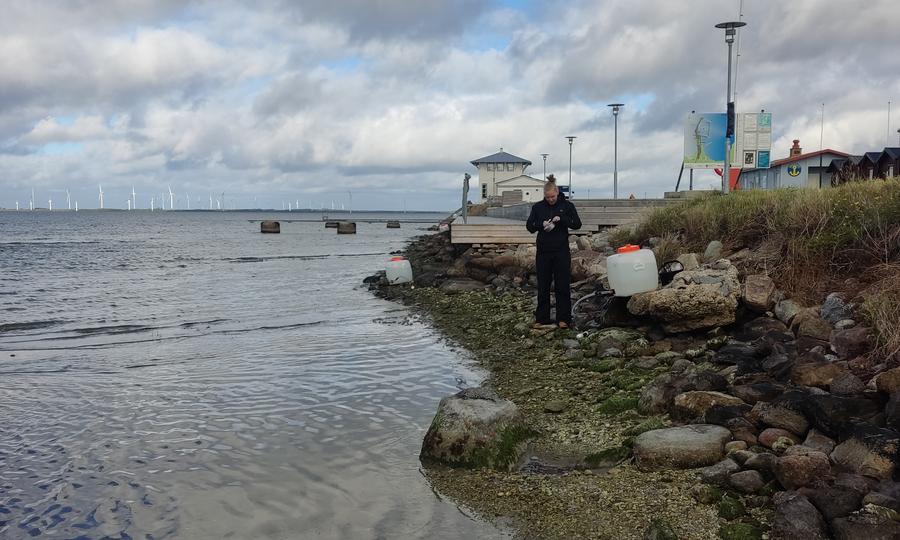
“The long time frame really helps me get an in-depth understanding of my topic, improve my critical thinking, and scientific writing skills, says Aarathi Krishnan, Master’s student in marine sciences, University of Gothenburg.
Adventurous field work
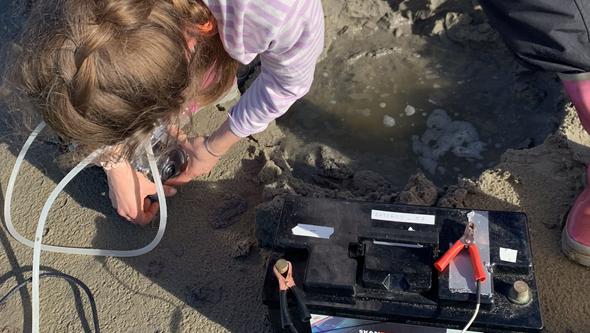
Fieldwork in marine chemistry is both adventurous and – physically demanding. Some of the sampling required the students to dig deep holes in the sand or paddle out to sea with heavy measuring equipment. At times it was very cold, with the water at ten degrees, stormy waves and jellyfish everywhere, but the demanding fieldwork also brought the group closer together.
“It was so much fun! I learned a lot, and got to try new things that I’d never done before. The scariest part was going out on a paddle board with all the equipment without falling in and losing things,” says Emma Ingoldsson.
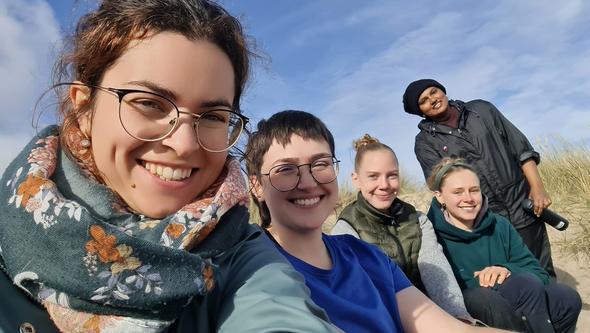
“I now feel more connected with the analysis. Taking the samples in the field makes it easier to work with them later in the lab”, says Roberta Prado.
“Gloria Reithmaier was a great mentor for me during the Gotland fieldwork. It was inspiring to see a young independent mother taking charge, sharing experiences and doing the practical work with us,” says Aarathi Krishnan.
Students become more employable
It is quite common for students to work alone in the lab when conducting their degree projects – but not in the Barefoot Biogeochemistry research group. Here, students become part of a large research group, and their degree projects are carried out through collaboration within the supportive group including many PhD students, researchers and senior professors.
“We want our MSc students to have access to the best technology, work on important research questions, and engage in both collaborative and independent work. We always aim for our students to produce high level research that can be published in scientific journals,” says Gloria Reithmaier, one of the supervisors and Researcher at the Department of Marine Sciences.
“Our MSc students publish high level scientific papers in collaboration with other students and academics. They start their own scientific legacy and become more employable by completing a project from start to finish”, says Prof. Isaac Santos.
“The Barefoot team helped me understand how research works. The ups, downs and the doubtful middle-ground – it was fun because of my mentors and the group. The support I got from them was unparalleled,” says Aarathi Krishnan.
Read more and apply
Read more and apply – Master in Marine Sciences
Writer:
Annika Wall
Communications coordinator
Contact: annika.wall@gu.se