
Newly arrived "bubble snail" discovered in experiment on eelgrass
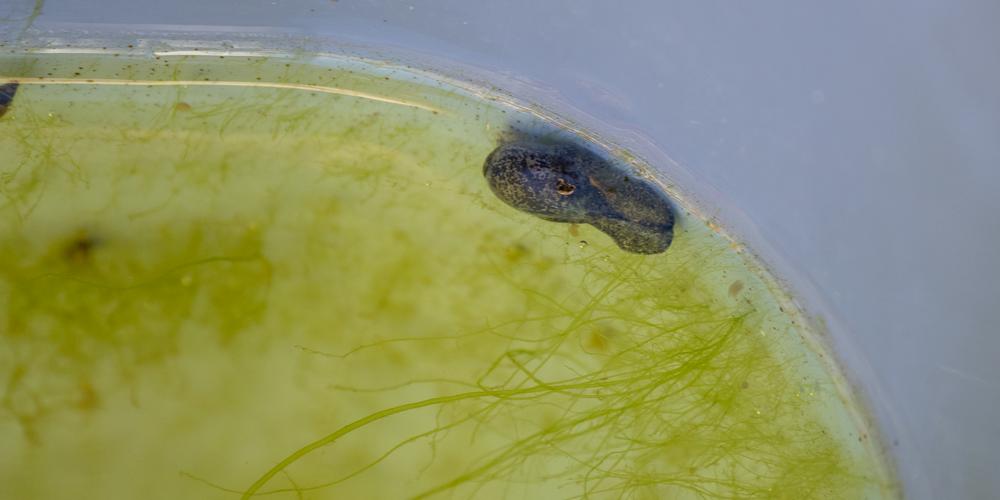
During an experiment with eelgrass, Master´s student Erica Wik discovered small snails she did not recognise. Detective work by the summer guides at Tjärnö Aquarium revealed that they are snails of the species Haminella solitaria, which is new to Sweden.
In her master's thesis, Erica Wik, a student at the Department of Marine Sciences, investigates whether stranded eelgrass can be used to restore eelgrass beds. During the summer, she planted eelgrass in large tanks at the Tjärnö Marine Laboratory, where she is doing her student work.
A few weeks into the experiment, she discovered some uninvited guests in her experiment.
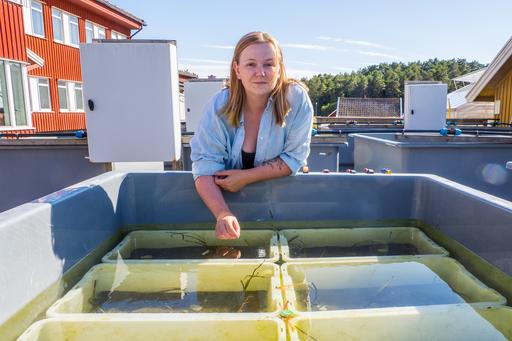
"They were snails that I didn't recognise, and I thought that the summer guides at the Tjärnö Aquarium could have them and show them to visitors under the microscope."
The guides turned to detectives
For Helena Samuelsson and Tilde Nyberg, summer guides at the Tjärnö Marine Laboratory, this marked the start of a few hours of detective work.
"We had to do some digging to try to find out what species it was. I didn't recognise it at all, and it wasn't mentioned in the The Encyclopedia of the Swedish Flora and Fauna," says Helena Samuelsson, who is an illustrator and used to work at the laboratory for many years.
"For a while, I thought I had found it, but the species I thought it was had eyes, and they weren't visible at all on these snails. Finally, I found it as a look-alike species that could be confused with another snail. It was described in a scientific article that I got from Christin Appelqvist, a marine biologist here at Tjärnö."
So it was you who finally identified the species?
"I would say it was a team effort, but I was the one who worked on it the most."
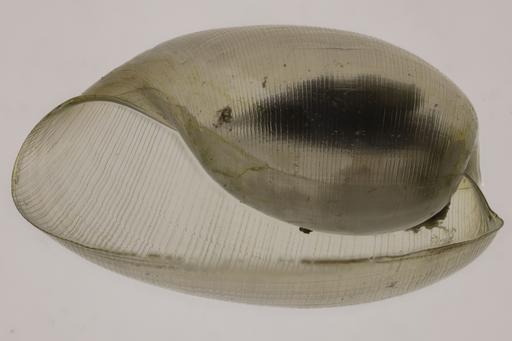
The species Haminella solitaria has no Swedish name and belongs to the family Haminoeidae, popularly known as "bubble snails" in English. It is common along the North American east coast, and some differences compared to native periwinkles are that the species has no head tentacles sticking out and that the shell is transparent and can be covered with tissue.
The snail has established itself in Denmark
"New species do appear here from time to time, and it's exciting and fun to be involved in discovering them," says Helena Samuelsson,
"But it's also a little worrying that new species spread so quickly, and we don't really know what that might mean for other species."
In Europe, the first reported sighting was on the German Baltic coast in 2016. Reports of the snail came from Denmark in 2020, and it has now established itself in Roskilde Fjord. One theory is that the snail came to Europe from North America as larvae in ballast water.
"This is a species that is spreading," says marine biologist Kennet Lundin, curator at the Gothenburg Museum of Natural History.
He verifies that it is the species Haminella solitaria when he sees pictures of the finds made on Tjärnö.
Kennet Lundin has not observed the snail himself, but he has received a report of a collection of eggs from the bubble snail on Koster. There is also a match on so-called e-DNA, i.e. DNA residues from the snail, which indicates that it is present in the area.
"It may well have arrived here on ocean currents from Denmark," says Kennet Lundin.
Is this a temporary visit, or is it here to stay?
"It's a little difficult to say before we get more observations, but it's probably only a matter of time before it establishes itself."
Lays eggs in bubbles
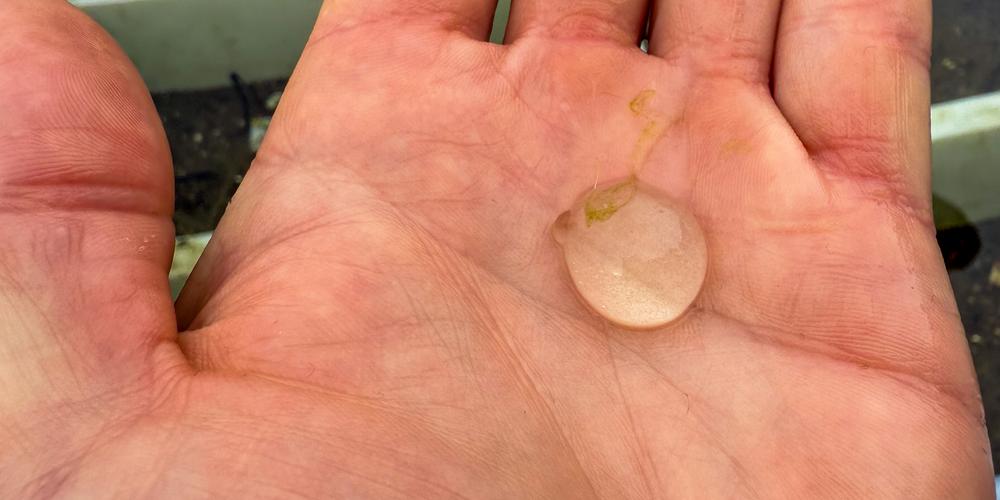
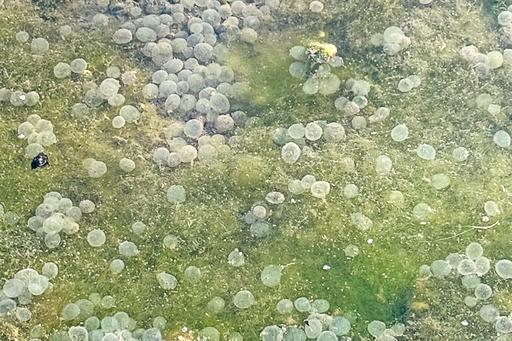
Neither Artportalen nor Inaturalist, where people can report species findings, have any reports of live snails from Sweden, except for the observation made on Tjärnö. However, questions and reports about Haminella solitaria have been sent directly to the laboratory during the summer. Both about live snails and about the clumps of eggs that the snails lay. They look like transparent bubbles, and Erica Wik has also noticed them in her eelgrass experiment.
"I have to clear away egg masses all the time. But it doesn't matter too much, the snails don't interfere with the experiment and they eat the filamentous algae, which is good for the eelgrass. Otherwise, the filamentous algae can settle on the grass and prevent sunlight from reaching it," she says.
Belongs to the Haminoeidae family, known as "bubble snails" in English.
Has a transparent shell that can be completely or partially covered by tissue; the shell resembles a bubble. The snail cannot hide completely in its shell.
The main tentacles are located at the back of the head. It has no protruding tentacles.
Lives in shallow water on sandy or muddy bottoms where it mainly eats algae.
Grows to about half a centimetre to just over a centimetre in length and is greyish in colour, often with small black dots and stripes.
Lays egg masses that look like bubbles and can be as large as or larger than the snail itself.
It has been confirmed and described in Denmark in a scientific article by marine biologist Kathe R Jensen (Jensen, K. (2022). The American snail Haminella solitaria (Say, 1822) has established itself in Roskilde Fjord. Flora og Fauna, 127, 1-4).