DEMSAM, the Centre for a Dementia-Friendly and Person-Centred Society at the University of Gothenburg, has now been inaugurated. By bringing together perspectives from across the entire care pathway and wider society, the centre aims to contribute to a society that better meets the needs of people living with dementia.
With music from strings, a ribbon-cutting ceremony, speeches and presentations, DEMSAM was formally inaugurated. The centre is funded by Forte with SEK 60 million and brings together research across healthcare, social care, municipalities, regional organisations, civil society and other societal actors in a long-term initiative.
Image
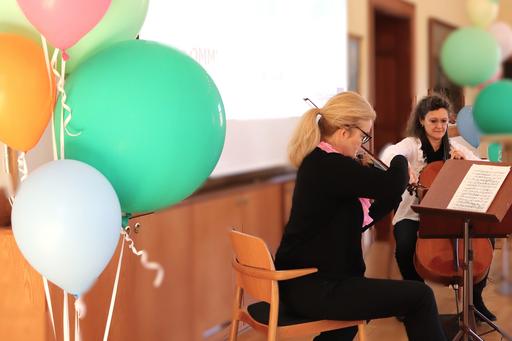
Culture and health are closely connected. Helena Kollback Heuman and Paula Gustafsson Apola from the Gothenburg Symphony Orchestra opened the event with music for violin and cello.
Photo: Lovisa Aijmer
If research is to make a difference, we need to be able to work all the way from identifying knowledge gaps and ideas through to implementation and evaluation
A broad collaboration is needed, as dementia affects large parts of everyday life. For people living with dementia and their families, daily life is shaped by everything from support at home and digital services to physical environments, interactions and access to appropriate care. DEMSAM is based on the premise that these elements need to be better connected, so that people living with dementia can remain involved, feel included and receive support that works in the lives they actually live.
Based on knowledge gaps and lived experience
Helle Wijk, Professor at the Institute of Health and Care Sciences and Director of DEMSAM, emphasised that the centre is grounded both in Sweden’s national dementia strategy and in the knowledge gaps that remain in the field.
“We know more and more about dementia diseases in terms of diagnosis, biomarkers and prevention, but we still know too little about how society needs to be organised so that people who are actually living with dementia can be involved, feel safe and receive coordinated support in everyday life,” says Helle Wijk.
Image
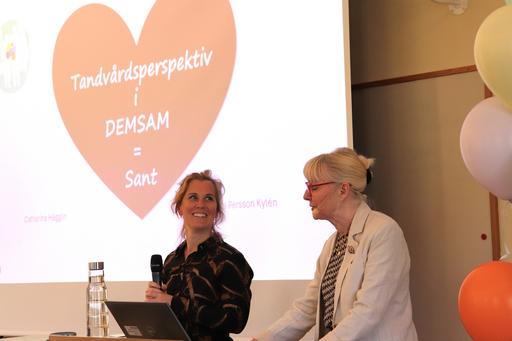
One area of research within DEMSAM is how to support oral health for people living with dementia. Jessica Persson Kylén and Catharina Hägglin are researchers in oral health sciences.
Photo: Lovisa Aijmer
A central idea in DEMSAM is that research should be carried out close to the people and organisations it concerns. This means co-creation with people living with dementia, families and carers, staff, decision-makers and other societal actors.
“We conduct research together with people affected by dementia, not about them. Lived experience is not an addition to DEMSAM, but a foundation for making the research relevant and useful,” says Hanna Falk Erhag, Associate Professor in Care sciences and Deputy Director.
Turning research into action
Long-term funding gives the centre the opportunity not only to develop new knowledge, but also to follow how approaches, methods and interventions work in practice.
“If research is to make a difference, we need to be able to work all the way from identifying knowledge gaps and developing ideas through to implementation and evaluation. Having funding for six years from the start, with the possibility of a four-year extension, is one of DEMSAM’s key strengths,” says Helle Wijk.
Karin Ahlberg, Head of the Institute of Health and Care Sciences, cut the ribbon and formally inaugurated the centre.
“What is so valuable here is that excellence and relevance go hand in hand. This is research that is truly used and makes a difference,” says Karin Ahlberg.
In her speech, Kerstin Uhlin, Deputy Head of Institute for Education at the Institute of Health and Care Sciences, highlighted the role of education in the work ahead.
“A dementia-friendly society can be a driver of change, where research, education and practice reinforce one another,” she says.
The strength lies in bringing together many perspectives
In Forte’s evaluation of DEMSAM, the centre’s strong focus on patient and family perspectives, lived experience and underrepresented groups was highlighted as a key strength. The reviewers also pointed to its potential to contribute to policy and service development in the field of dementia.
“I am very pleased that the inauguration captured the core of DEMSAM. It is about bringing together different professions, addressing all levels of care and including a wide range of perspectives. No single actor can create a dementia-friendly society on their own, but together we can build the structures that are needed,” says Helle Wijk.
Image
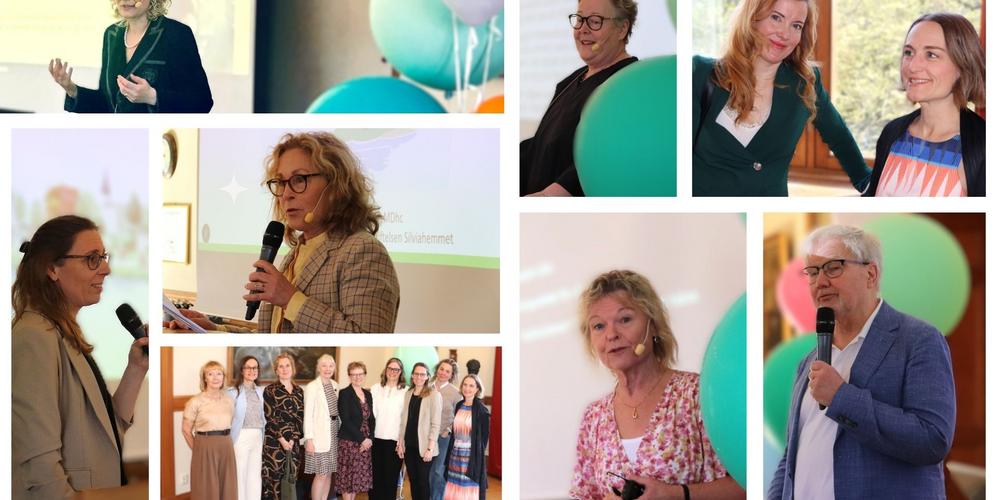
Photos from the inauguration: Silke Kern, Karin Ahlberg, Hanna Mac Innes, Qarin Lood, Madeleine Liljegren, Wilhelmina Hoffman, Kerstin Uhlin, Ingmar Skoog and the DEMSAM steering group
Photo: Lovisa Aijmer
More about DEMSAM
DEMSAM stands for the Centre for a Dementia-Friendly and Person-Centred Society. The centre is based at the University of Gothenburg and is run in collaboration with, among others, Chalmers University of Technology, the City of Gothenburg, Västra Götaland Region and the Gothenburg Region. It is funded by Forte with SEK 60 million.
The centre brings together research, healthcare, social care, municipalities, regional organisations, civil society, industry and interest organisations. Its work focuses on person-centred methods, dementia-friendly physical and social environments, collaboration between actors, as well as implementation, education and knowledge dissemination.
The aim is to contribute to a society in which people living with dementia can continue to be involved and live their lives on their own terms.
The inauguration took place in the University of Gothenburg’s main building and brought together around one hundred participants.
The centre is led by Helle Wijk, Director, and Hanna Falk Erhag, Deputy Director.