
Higher Education in Transition
How does AI affect our ability to read and write? How has the pandemic changed the role of the university teacher? And what is needed for research on higher education to grow? These were some of the questions discussed at the conference Research on Higher Education, held at the University of Gothenburg on 8–9 May 2025.

Professor Naomi S. Baron from American University in the USA spoke about what is at stake when AI is used to read and write academic texts.
“The greatest risk with AI’s impressive language abilities is that we are tempted to hand over these tasks to technology and thereby lose our own skills. We must make it clear—both to our students and ourselves—why it is so important that we continue to read and write ourselves,” says Naomi S. Baron.
Developing healthy scepticism
She also points to the risk that we stop genuinely seeking knowledge. After all, the word “research” means to search again. If we let AI do the work for us, we don’t even search once.

“The more we let AI write for us, the fewer opportunities we have to develop our own ability to express thoughts and ideas. At the same time, research shows that people still prefer texts written by humans, even when AI generates more grammatically correct language.”
To handle AI wisely, Naomi S. Baron believes that students must develop a healthy scepticism. This involves understanding how AI works and being able to evaluate the difference between human writing—based on experience and reflection—and a machine’s response to a prompt.
New demands on the teaching role in hybrid environments

Marie Leijon, Associate Professor at Malmö University, presented research from the project The University Teaching Profession in Post-Pandemic Hybrid Learning Environments. She demonstrated how the pandemic has changed the everyday life of university teachers.
“Many teachers have become skilled at teaching in different settings—on site, online or in hybrid forms—but this has often happened without sufficient support. It requires time, effort, and new competences,” says Marie Leijon.
She stresses that it no longer makes sense to separate physical and digital teaching environments—they are intertwined. And with this come new challenges.
“Teachers must not only handle the technology but also reflect on how different environments affect their teaching. In addition, more people are working from home, which brings new demands for flexibility and communication.”
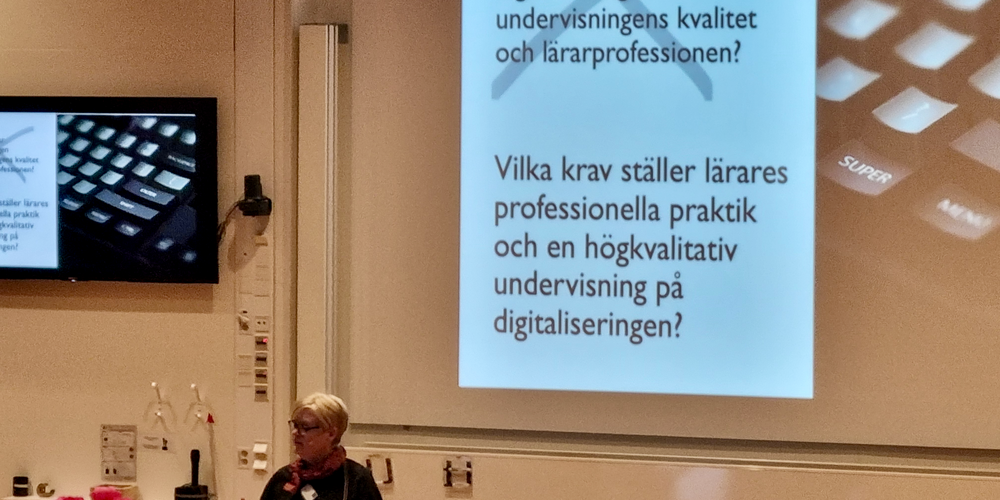
Marie Leijon believes that universities need to provide better conditions for teachers, by lowering technical thresholds and creating more space for pedagogical development.
“Teachers need time to reflect and develop their teaching based on research. It would be beneficial if this were clearly included as part of their duties.”
Research on higher education needs consolidation

Katarina Mårtensson and Torgny Roxå, researchers from Lund University, raised questions in their lecture about how research on higher education can be understood and organised.
“The field is broad and fragmented, which is both a strength and a challenge. It makes it difficult to mobilise resources, but there is a lot of positive development,” says Katarina Mårtensson, Professor of Education specialising in research on higher education.
She noted that the research field has been strengthened in recent years, partly through the journal Högre utbildning and through more universities creating academic posts where this type of research is included.
Torgny Roxå emphasises that the development of pedagogy and teaching must be based on scientific evidence. For the field to grow, more resources, national networks, doctoral schools and perhaps a dedicated research institute are needed.
“Academic development is an important part of research on higher education, but it is also an independent area with great relevance for the entire higher education sector,” says Torgny Roxå, Educational Developer and Professor at Genombrottet, the joint educational support and development unit at the Faculty of Engineering, Lund University.
An important meeting place for the future

Sylvi Vigmo, Deputy Head of the Department of Education, Communication and Learning at the University of Gothenburg, sees the conference as an important forum for raising issues concerning higher education from a broad perspective.
“This year, there were many presentations on AI, digitalisation, academic writing, and questions of inclusion and diversity. This shows how wide-ranging and at the same time pressing the field is,” says Sylvi Vigmo.
She hopes that participants return home with new insights, inspiration, and a strengthened commitment to continue developing higher education—both as a practice and as a research field.
“It is important that we meet across disciplines, share experiences and research results, and continue the conversation on the major and difficult questions affecting the future of higher education,” says Sylvi Vigmo.
The Research on Higher Education conference was held for the fourth time on 8–9 May 2025. It was organised by the Department of Education, Communication and Learning (IPKL) in collaboration with the Unit for Pedagogical Development and Interactive Learning (PIL) and the Academic Language Unit (ASK) at the University of Gothenburg, in cooperation with the journal Högre utbildning.