
Gyde launches Iceland’s first blue community garden
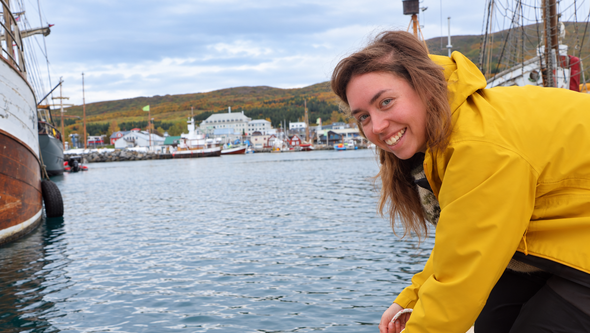
Gyde Rudolph has found her place in the world: the small village of Húsavík in Iceland. Thanks to the Sea and Society Master’s programme, she is now launching Iceland’s first blue community garden – where residents can come together to grow seaweed and mussels.
What do you work with?
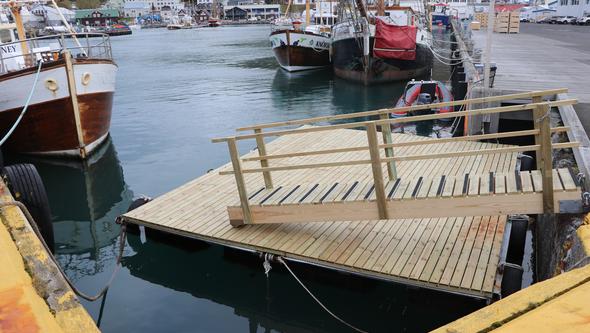
“I’m developing a blue community garden in Húsavík in northern Iceland. It’s the first of its kind in the country. We have just deployed the platform in the sea, and the idea is to create a space where people can learn more about the sea and get involved in cultivating seaweed and mussels.”
“The project is very much about bringing people together. I want the site to be used not only for cultivation, but also for education, research, and activities involving the local community.”
How did you come up with the idea?
“When I was studying for my Master’s degree in Sea and Society in Gothenburg, we went on a study visit to Flytevi, the blue community garden in Frihamnen. I was really inspired and told one of the managers at the innovation centre here in Húsavík about it. She gave me the task of creating something similar – and now here it is!”
“During the programme, we learnt how many different interests have to coexist in the sea and how complicated it can be, for example, to plan activities in a harbour. Now I get to put my knowledge into practice.”
What do you do at work?
“It varies! I write grant applications, collaborate with researchers, students and architects, and liaise with local businesses.”
“At the moment, we’re working on developing a student and volunteer programme and partnerships with schools, amongst other things. When we were building the platform itself, I was also involved in the practical construction work. The next step is to start farming, for example seaweed or mussels.”
What’s the best thing about your job?
“The freedom to develop the project in different directions. I enjoy that the work is so interdisciplinary and that I can combine my many different interests in culture and sustainable development.”
“Recently, for example, I’ve been working more with art and culture linked to the project, but in the future, we could also work on monitoring pollution in the harbour.”
But how did you end up in Iceland?
“Through an internship. I’m very interested in Iceland’s, and other island nations’, relationship between society, nature and the sea, and as part of my Master’s programme, we had the opportunity to do an internship. I found two internships in Iceland – first in Reykjavík and then in Húsavík. After that, I simply stayed.”
“My first internship in Húsavík was at a research centre affiliated with the University of Iceland, which specialises in whale research. In collaboration with whale-watching boats, we collected data on whale behaviour, amongst other things. I then wrote my Master’s thesis on whale-watching and also worked part-time at the Icelandic Centre for Tourism Research on a project concerning citizen science and whale-watching tourism."
Why did you choose to study Sea and Society?
“I grew up near the sea in northern Germany and was really fascinated by dolphins when I was little. Like many other children, I dreamt of becoming a marine biologist, but later I chose a different path and completed a bachelor’s degree in subjects including English, linguistics, literature and sustainable development.”
“When I discovered Sea and Society, I realised the programme accepted students from a variety of academic backgrounds. For me, it was an opportunity to return to my childhood interest in the sea without already having a degree in marine biology.”
“Today, I can combine my various interests in my work with the blue community garden. In many ways, it feels as though everything has fallen into place.”
What aspects of the programme have been most useful in your work?
“Sea and Society is a broad programme, and I can now see how many of the courses are somehow linked to my project. For example, we studied humanity’s historical relationship with the sea, and marine spatial planning.”
“The things we learned about the blue economy are also extremely useful. Whale watching is a very important industry in Húsavík, but at the same time it’s important for a small community to be able to diversify its economy.”
Do you have any tips for new students?
“Approach the programme with an open mind and be prepared to go in different directions. You can’t predict everything with 100 per cent certainty when you’re studying – or working with – nature; I’ve learnt that not least from the weather here in Iceland. You have to be flexible and adapt when conditions change.”
“Here in Iceland, there’s an expression, ‘þetta reddast’, which I really like. It’s an optimistic outlook on life, where you trust that things will somehow work out in the end. And that’s how it’s been for me.”
Interview: Karl-Johan Nylén


