
Expedition to the Baltic Sea to investigate how low oxygen areas affect the climate
Using a specially built autonomous underwater laboratory, researchers from the University of Gothenburg are travelling all over the world to study how microorganisms in ocean areas with extremely low oxygen levels affect the climate. Now, they are headed to the Baltic Sea.
“The Baltic Sea is severely affected by eutrophication, which has increased the extent of oxygen-depleted areas. That is why the Baltic Sea is ideal for our research,” says Laura Bristow, Senior Lecturer at the Department of Marine Sciences.
On Monday 29 June, Laura Bristow and her fellow researchers will set sail for the Gotland Deep in the Baltic Sea aboard the University of Gothenburg’s research vessel, the R/V Skagerak. This expedition is part of the larger RECLESS research project, which aims to create the first comprehensive global model of microbial ecosystems in oxygen-depleted marine environments.
Nitrogen is central to the research.

This is because the marine nitrogen cycle changes in oxygen-depleted marine areas, which in turn affects two greenhouse gases: carbon dioxide and nitrous oxide.
And the key question for researchers is simply: to what extent does this affect the climate?
Increase in oxygen-depleted areas – a growing global problem
“We still have major gaps in our knowledge regarding how oxygen depletion in the ocean affects the nitrogen cycle. This means we cannot make reliable climate forecasts. To understand the future, we need to understand how the system works right now,” says Laura Bristow, a researcher at the Department of Marine Sciences, University of Gothenburg, and an expert on microbial nitrogen transformations in oxygen minimum zones.
Oxygen-depleted areas in the ocean are expected to expand globally, both in numbers and size. It is therefore important to investigate whether the processes differ between different areas of the ocean. Last year, the researchers were in the Bay of Bengal off the coast of India, which is a large, open ocean basin with deep waters. This time, the research team will be investigating the opposite: a shallow coastal system in the Baltic Sea.
“We are conducting the same experiments, using the same methods and techniques, to see if there are any differences or similarities. Our aim is to develop a comprehensive modelling system that captures processes in many different environments,” says Laura Bristow.
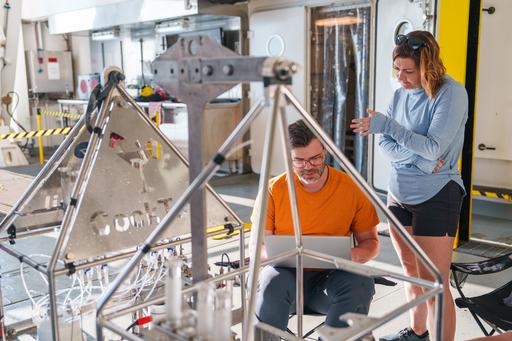
Scouting for answers with a Game-Changing Underwater Laboratory
The expedition will travel to the Gotland Deep and remain there for two weeks. To understand how oxygen dynamics look on site, the team will deploy autonomous underwater gliders to determine how much oxygen is present in the area, but also use a brand-new, custom-made underwater laboratory called CockTail.
CockTail is a revolutionary measuring instrument custom-built for this research endeavour. The instrument can both collect and analyse samples in-situ, deep in the ocean, where the microbes live and thrive. In this way, the researchers will obtain significantly more reliable results than if they were to collect the water samples for analysis on board the vessel.
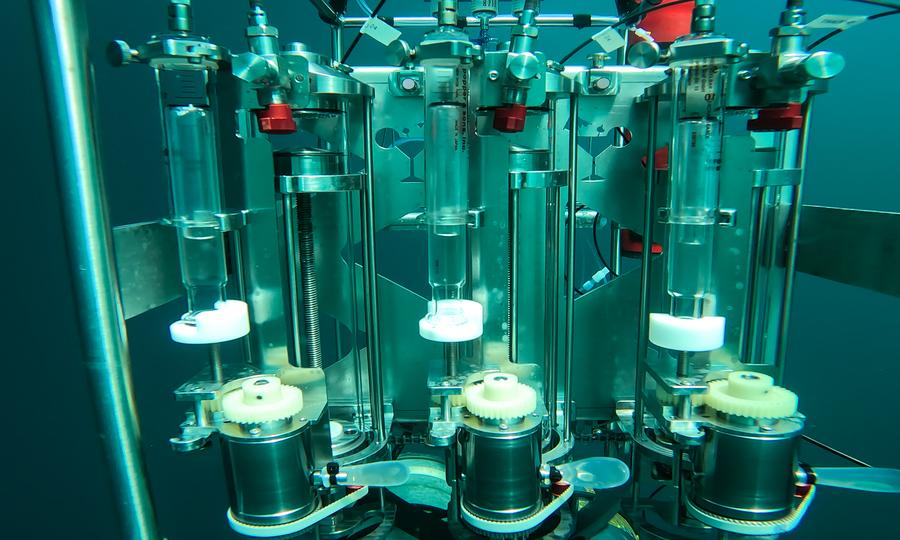
At each site, CockTail will be deployed to measure microbial activity across the oxygen gradient of the water column for around 30 hours, all the while linked to a long cable.
This is a major round-the-clock undertaking for the researchers, which will generate vast amounts of measurement data to be analysed.
Can’t use any bad weather on the cruise
But it is also a battle against the elements.
“We can’t use any bad weather on the cruise. It’s difficult to lower a long cable and get good results in a raging sea. But so far, weather forecasts are looking good!” says Laura Bristow.
Writer: Annika Wall
Contact
Laura Bristow
Department of Marine Sciences, University of Gothenburg
Email: laura.bristow@gu.se
Tel: +46 766-18 61 96
Join the R/V Skagerak
Follow the expedition and the R/V Skagerak’s position on Marine Traffic.
Read more about Recless Baltic 2026.
What: The Recless: Baltic 2026 expedition will investigate microbial nitrogen cycling in the low-oxygen waters of the Baltic Sea
When: 29 June to 20 July 2026
Where: The University of Gothenburg’s research vessel, R/V Skagerak, will travel from Oskarshamn on 28 June, continue via Visby to the Gotland Deep, and conclude the expedition at Nya Varvet in Gothenburg.
About the project: RECLESS employs a new interdisciplinary approach that combines oceanographic, biogeochemical, and microbiological methods to investigate everything from individual cells to ecosystem models. The aim is to create the first comprehensive global model of microbial ecosystems in oxygen-depleted marine environments, known as Oxygen Minimum Zones.
Funding and Collaboration: The project is funded by a prestigious ERC Synergy Grant and is a collaboration between four principal investigators: Laura Bristow (University of Gothenburg, Sweden), Bo Thamdrup (University of Southern Denmark), Katharina Kitzinger (University of Vienna, Austria), and Emily Zakem (Carnegie Science, US). For the Baltic cruise, they team up with collaborators from Voice of the Ocean, the Woods Hole Oceanographic Institution and University of Vienna.


