
Dag Hanstorp awarded the Faculty of Science and Technology Pedagogical Award 2025
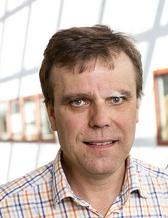
From children discovering physics for the first time to preschool teachers and international research colleagues – Dag Hanstorp, professor in physics, has the ability to spark curiosity for his subject. Now he is awarded the Faculty of Science and Technology Pedagogical Award 2025.
Congratulations! How does it feel?
“It feels great to be recognised for teaching! I see education as the most important mission of a university, which makes this award particularly meaningful.”
You don’t just teach university students, but also children and schoolteachers. How do you adapt your teaching to such different groups?
"It is always about being able to see things from the student’s perspective and building on what the student already knows. For me, the face-to-face meeting is crucial. You quickly see what the student understands, and they can give immediate feedback on your teaching."
What is the best part of your job?
“Being able to see young people develop. I particularly value supervising students over a longer period, where I can follow their growth in knowledge and understanding.”
“My international engagement also means a lot. I was for example recently made an honorary doctor at Latin America’s largest university, UNAM in Mexico City, where we are currently finalising an agreement for a double degree at both the master’s and doctoral levels. It is rewarding to create opportunities for students to study in different countries and to strengthen collaboration across borders.”
The award highlights your commitment to developing the physics courses at the university. What is the biggest challenge in this work?
“In physics, balancing theory and experiment is important, but teaching often leans too much towards theory because it is easier to assess. Experimental skills are just as important for understanding the subject, and I believe we need much more practical work in undergraduate education.”
Why is physics the best subject in the world?
“Because we try to understand and explain how the universe works, from the smallest to the largest scales. Physics reduces a complex world to simple principles. Seeing parallels and being able to use the same model to explain different phenomena – that is what I find beautiful about physics.”
Award motivation:
Dag Hanstorp has, over many years, initiated and developed a wide range of courses at all levels within the department’s undergraduate education. With a degree in teaching as his foundation, he combines his own curiosity for research and new teaching methods with the need for further education for teachers in Swedish schools, the development of physics courses at the University of Gothenburg, and educational collaborations with international universities across several continents. Examples include professional development for preschool teachers, fostering elementary pupils’ curiosity for science and technology, advanced physics courses for upper secondary students, study visits to CERN for undergraduate students, and teacher exchanges with universities in both Mexico and India. Dag is highly appreciated as a lecturer and consistently receives excellent evaluations from his students. He is an exemplary colleague, and his extensive network and numerous trusted positions testify to his outstanding professional ability. With contagious enthusiasm, he sparks curiosity in everyone he meets—whether it is children, preschool staff, or professors.
The Pedagogical Award recognises excellence in teaching. It can be awarded to one person or be shared among multiple recipients. The award ceremony will take place on 5 November.
