CERGU Welcomes Natalia Volvach
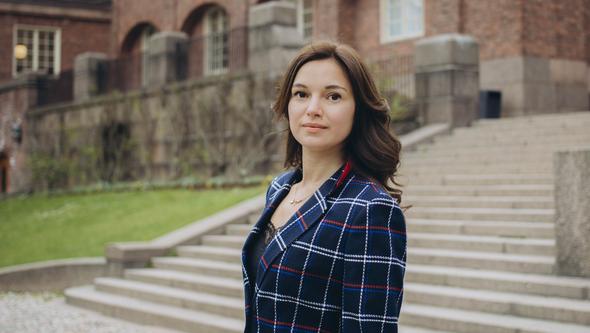
Meet the third new CERGU postdoc, Natalia Volvach!
In 2025, CERGU announced a call for new postdoctoral researchers in European Studies. The response was remarkable: more than 140 applicants from around the world applied for the opportunity to work at the Centre for European Research at the University of Gothenburg (CERGU).
In the previous interviews, we met Tobias Wuttke, employed at the Department of Business Administration within the School of Business, Economics, and Law and Ben Rosher who is employed by the School of Global Studies, at the Faculty of Social Sciences. Today, we introduce our third and final new postdoc, Natalia Volvach. Natalia's employment is placed at the Gender and Cultural Studies Unit, Department of Cultural Sciences, Faculty of the Humanities. CERGU's research administrator Angie Sohlberg interviewed Natalia about her interest in CERGU and her current postdoc project. Welcome to CERGU, Natalia, Tobias, and Ben!
Angie Sohlberg: Welcome to CERGU and congratulations! As you know by now, the competition was tough. How did you hear about CERGU and what made you apply?
Natalia Volvach: Thank you, Angie. I am very glad to be here and to
have the opportunity to work on my research over the next two years. I heard about CERGU through my academic network and was excited to see the call for applications. What motivated me to apply was its openness, both in terms of topics and approaches. This openness resonated strongly with my own interdisciplinary work, which is grounded in sociolinguistics but draws from anthropology, human geography, and memory studies. CERGU offers an ideal environment, where I can pursue my research interests related to Europe from multiple perspectives and in conversation with different scholars.
AS: Prior to joining us at CERGU, what were you doing and where were you living?
NV: Before joining the University of Gothenburg, I worked at Stockholm University, where I earned my Ph.D. in 2023 at the Centre for Research on Bilingualism and completed a postdoctoral project funded by the Anna Ahlström and Ellen Terserus Foundation. Prior to that I was a Junior Research Fellow in the Ukraine in European Dialogue programme at the Institute for Human Sciences (IWM) in Vienna. I also hold a Master’s degree in German Linguistics and Eastern European Studies from the University of Bern. I am originally from Kherson in southern Ukraine, where I grew up and where my family lived until recently. My research has a combined interest in multilingualism, violence, and migration. In recent years, I have primarily worked on the project Ukrainian Voices in Sweden, which explores the lived experiences of language among Ukrainians who fled the war and settled in Sweden following Russia’s full-scale invasion in 2022. In parallel, I continued working with material from my Ph.D. research on the semiotic landscapes of Russian-occupied Crimea, collected in 2017 and 2019. This work resulted in a book, Absencing and Haunting in Semiotic Landscapes: Words, Voids and Ghosts in Qırım–Crimea, which will be published in May this year and will be launched in fall 2026 at the University of Gothenburg.
AS: Congratulations on your upcoming book! That sounds exciting. Our network is very international and multidisciplinary. What do you hope to contribute to and gain from being a part of a centre with a large, international group of researchers from lots of different disciplines?
NV: I hope to build a lasting connection with CERGU and the Department of Cultural Sciences that extends beyond my postdoctoral period. I see my contribution in fostering interdisciplinary exchange, for instance by inviting international scholars, organizing symposia and publishing joint collections. Next year, I’d like to organize a symposium and an exhibition on language, trauma, and vulnerability in times of war that would bring together researchers, educators, artists, and other societal actors. I believe that CERGU’s international and multidisciplinary environment would be an ideal place for these events.
AS: Now I'd like to ask you about your postdoc project. Tell us briefly what your plan is for your two years as a CERGU postdoc.
NV: During my time as a CERGU postdoc, I will continue writing and editing earlier work while developing a new project entitled Dreams of Violence. This project will explore how the Russian war against Ukraine is lived and processed through dreams, approaching them as intimate and affective experiences of war. By using arts-based methodologies, I will examine how violence is internalized, embodied, and imaginatively reworked. By situating dreams within the affective geopolitics of war, the project will contribute to theoretical and methodological debates on violence, trauma, and vulnerability, while conceptualizing war in Europe as something that moves across human bodies, spaces, and borders. As such, the project aligns with CERGU’s research theme European Mobilities and Borders. It will also be developed in conversation with MAGnituDe, a major research project at CERGU.
AS: It sounds like you have a plan that will keep you very busy over these next two years, Natalia. Finally, when you're not researching and writing, what do you like to do in your free time?
NV: In my free time, I enjoy being outdoors, walking, running, and cross-country skiing, when possible. I am still learning how to separate ‘work’ from my free time, though. Since my research is closely connected to where I come from and to my sense of self, I am continually rethinking what it means to write and do research in ways that allow me to find meaning, grounding, and care in unstable times.